
SettingsSettings for this calculationUS
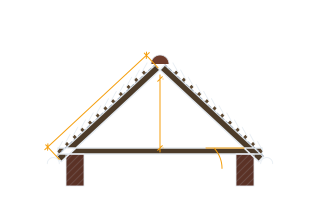
The length of the continuous standing seam panel run.
Measure the full length of the metal panel run, eave to ridge or between fixed points, since thermal movement scales with the panel's total length.
The metal's coefficient of linear thermal expansion, per °C.
Aluminum expands roughly twice as much as steel for the same temperature change — use approximately 23×10⁻⁶ per °C for aluminum panels and 12×10⁻⁶ per °C for steel panels. This field wants the PER °C figure even when the swing above is showing Fahrenheit. A US data sheet quotes the coefficient per °F, which is 5/9 of the per-°C number: aluminum is about 12.8 per °F and steel about 6.7. Typing 12.8 here would be read as a steel panel and would under-report the movement by 44%, and 6.7 is below this field's minimum and would be pulled up to 10. Multiply a per-°F figure by 1.8 before entering it.
The expected difference between the panel's hottest and coldest surface temperatures.
Metal roof surface temperatures swing far more than ambient air temperature due to solar gain — use the panel's expected in-service temperature range, not just the local air temperature range.
Expected thermal movement
0.3229 in
The arithmetic is exact — this is the standard linear expansion relation with nothing estimated. The accuracy is entirely in the two figures you enter, and the coefficient is per °C even when the swing above is reading Fahrenheit: multiply a per-°F data-sheet figure by 1.8 first.
They open the calculator with your figures already in it
Standing Seam Roof Thermal Movement Calculator: 0.3229 in — shown in imperial, US market. The link sets both, so the result they see is the one on your screen.
Show calculation logicHide calculation logic
How this was calculated
Formula source(s)
- Linear thermal expansion: ΔL = L × α × ΔT, where α is the metal's coefficient of thermal expansion (commonly ~23×10⁻⁶ per °C for aluminum, ~12×10⁻⁶ per °C for steel) and ΔT is the panel's expected temperature swing
Inputs used
- Panel Run Length
- 19.5 ft
- Coefficient of Thermal Expansion (×10⁻⁶ per °C — 23 aluminum, 12 steel)
- 23
- Expected Temperature Swing
- 108 °F
Confidence note: The arithmetic is exact — this is the standard linear expansion relation with nothing estimated. The accuracy is entirely in the two figures you enter, and the coefficient is per °C even when the swing above is reading Fahrenheit: multiply a per-°F data-sheet figure by 1.8 first.
What this calculation does not cover
- This is free, unrestrained movement of the panel over the swing you enter. It is the total travel the assembly has to allow, not the movement that actually occurs — a panel held at both ends does not expand, it loads its fixings instead.
- Nothing here checks the clip. Whether a sliding clip has that much slot, whether the fixed point is where you think it is, and how much travel a seam or end lap can take are all product figures from the manufacturer, and a movement figure larger than the slot is the failure this calculation is meant to prevent rather than describe.
- The coefficient is treated as a single constant over the whole swing. Published values are means over a stated band, and coated, laminated or composite panels do not necessarily move as the bare metal does.
- Surface temperature, not air temperature, drives this, and the swing is yours to supply. A dark panel in sun runs far above ambient and radiates below it at night, so a swing taken from a weather record will understate the real range.
- Only length along the run is calculated. Movement across the panel width, movement of the structure the panel is fixed to, and any permanent set from repeated cycling are outside this figure.
Add the equipment this sizes
This result is a specification — 0.3229 in — not a quantity. Put the thing it sizes into your project: how many, what you call it, and your supplier’s price.
Part of a bigger job
This trade is one line of a job takeoff. Run the whole job and every other trade comes back with it, off the same measurements.
Computed in your browser — nothing you enter is uploaded. Presented in US customary units and US trade terminology. Where a formula follows a published standard, that standard and its edition are cited beside it on this page; where none governs, the page says so. Local amendments override model codes — verify against the code in force where you build.
Sources checked 2026-09-03 · in the site-wide review of 2026-09-06 · v1.1.1
Regulatory standards & verification citations1
- Linear thermal expansion: ΔL = L × α × ΔT, where α is the metal's coefficient of thermal expansion (commonly ~23×10⁻⁶ per °C for aluminum, ~12×10⁻⁶ per °C for steel) and ΔT is the panel's expected temperature swing
Cite this page
Your workspace
Most jobs need more than one number. Add the calculators you need next and they open right here, underneath this one — your figures stay on screen and nothing is lost to a page change.