
SettingsSettings for this calculationUS
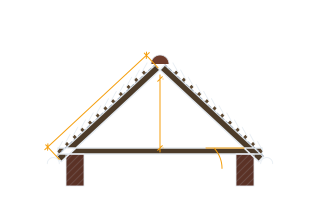
The length of a single roof panel, measured along the roof slope.
Along the slope, and this is the figure that decides how the roof handles MOVEMENT. A long panel expands and contracts more, which is what determines whether sliding clips are needed, how much travel they need, and where the fixed point is set — usually the ridge or the eave, but never both. Long panels reduce end laps and buy a harder detailing problem in exchange.
The on-center spacing between clips along the panel, per the manufacturer's installation instructions.
Clip spacing is often tightened near eaves and in high-wind zones — check the panel manufacturer's wind-load-specific spacing table.
The total number of panels across the roof width.
Across the width, so with the panel length above it gives the number of seams — and clips live in seams. Panels narrower than the system's maximum therefore cost twice: more seams to form and more clips to fix, both of which are labour rather than material. Where a roof width does not divide neatly, it is usually cheaper to lose the remainder in one narrower panel at a verge than to reduce every panel.
Total clips needed
110 clips
- Clips per panel
- 11
- Whole clip bays up a panel
- 9
- Short bay at the top of the panel
- 1.5 ft
They open the calculator with your figures already in it
Standing Seam Metal Roof Clip Count Calculator: 110 clips — shown in imperial, US market. The link sets both, so the result they see is the one on your screen.
Show calculation logicHide calculation logic
How this was calculated
Formula source(s)
- Clips per panel = ceil(panel length ÷ clip spacing) + 1, the standard layout method for standing seam panel clip fastening; total clips = clips per panel × number of panels
Inputs used
- Panel Length (Along Slope)
- 19.5 ft
- Clip Spacing
- 2 ft
- Number of Panels
- 10
Intermediate steps
- Clips per panel
- 11
- Whole clip bays up a panel
- 9
- Short bay at the top of the panel
- 1.5 ft
What this calculation does not cover
- Counts clips, but the roof is held down by whatever the clips are screwed into. Uplift capacity is a fastener pull-out figure — two screws into 22-gauge deck hold a fraction of the same clip landed on a purlin or into structural plywood — so an identical clip count passes on one substrate and fails on another. Without the deck gauge or purlin spacing, this is a quantity, not an uplift design.
- Says nothing about how far a sliding clip can actually slide. Steel moves roughly 0.012 mm per metre per degree C, so a 12 m panel swinging 70 C between a winter night and a black roof in July travels about 10 mm along its length. If the clip's travel is shorter than that, or the panel was set at one end of its range on a cold morning, the clip bottoms out and the panel oil-cans or tears at the fixed point.
- Clip height is a selection, not a count. The clip has to reach from the substrate up to the seam through everything in between — rigid insulation, a thermal spacer block, a recover board — and a clip sized for a bare deck will not engage the seam over 50 mm (2 in) of insulation. Settle the height against the actual roof build-up before ordering this quantity of them.
Estimated cost — your price
This site holds no price list for this material — local prices vary too much to publish honestly. Enter your supplier's price and the result is costed with it.
Part of a bigger job
This trade is one line of a job takeoff. Run the whole job and every other trade comes back with it, off the same measurements.
Computed in your browser — nothing you enter is uploaded. Presented in US customary units and US trade terminology. Where a formula follows a published standard, that standard and its edition are cited beside it on this page; where none governs, the page says so. Local amendments override model codes — verify against the code in force where you build.
Sources checked 2026-09-06 · in the site-wide review of 2026-09-06 · v1.0.1
Regulatory standards & verification citations1
- Clips per panel = ceil(panel length ÷ clip spacing) + 1, the standard layout method for standing seam panel clip fastening; total clips = clips per panel × number of panels
Cite this page
Your workspace
Most jobs need more than one number. Add the calculators you need next and they open right here, underneath this one — your figures stay on screen and nothing is lost to a page change.
Tools and safety for this job
To fix roof sheeting and soffit panels. Generic types, no brands, no prices.
Protection this work requires
- Most fatal falls on small jobs are from under three metres: use a tower or a ladder tied at the top, and never work off the top two rungs.
- Knives cause more site injuries than any power tool: cut away from your body, change blades often, and wear cut-resistant gloves to EN 388 level C for repeated cutting.
Fix roof sheeting and soffit panels: Roof work is the commonest cause of serious fall injury on domestic sites, and profiled sheeting adds a danger of its own: older fibre-cement and plastic sheets, and the rooflights set among them, can give way under a person's weight without warning. Edge protection or a properly erected tower is the equipment that matters most here, and a roof that is fragile, steep, high or wet is a job for a roofer with the right access and staging, not a longer ladder.
Show the 6 tools this job needsHide tools
Essential
Chalk line
Extension ladder
Impact driver
Metal snips
Tape measure
Tower scaffold or trestles
Also needed as materials: chalk refill, impact driver bits.
what each roofing tool is for, and the spec that decides which to buy where one does.