
SettingsSettings for this calculationUS
The total roof area to be shingled.
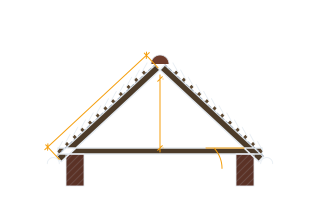
Measured on the SLOPE rather than on plan. A triple-lap roof puts three thicknesses of shingle over every point, so the timber bought is roughly three times this area — which is exactly why the bundle coverage below is quoted against a reference exposure instead of as a plain area. Hips and valleys add more again, because both sides are cut to a line and the offcuts are not reusable.
The actual weather exposure you plan to lay the shingles at.
Wood shingles are laid in a triple-lap pattern, so the exposure sets how much of each shingle is left visible between courses.
The coverage a single bundle provides at the reference exposure, from the shingle bundle's label.
Take it from the label WITH the exposure it is quoted at, because the two numbers only mean anything together. A coverage separated from its exposure is the commonest way this goes wrong: the same bundle covers less when laid at a shorter exposure and more at a longer one, and the figure on the wrapper assumes one specific setting-out that may not be yours.
The exposure the bundle's coverage rating is based on — commonly 5 in (127 mm) for 16 in (406 mm) shingles.
The exposure the RATING assumes, not the one you intend to lay at — the difference between the two is what this calculation converts. Your own exposure is not free to choose either: it is capped by the shingle length, since three thicknesses must still cover every joint, and it is reduced further on a shallow pitch where water travels further sideways before it drains.
Shingle bundles needed
44 bundles
Bundle coverage ratings vary by manufacturer, shingle length, and grade — verify the standard coverage and reference exposure against your specific product's bundle label before ordering.
- Scaled coverage per bundle
- 25 sq ft
They open the calculator with your figures already in it
Wood Shingle Triple-Lap Exposure Calculator: 44 bundles — shown in imperial, US market. The link sets both, so the result they see is the one on your screen.
Show calculation logicHide calculation logic
How this was calculated
Formula source(s)
- Wood shingles are laid in a triple-lap pattern; bundle coverage is rated at a standard exposure (commonly 5 in (127 mm) for 16 in (406 mm) shingles) and scales linearly with actual exposure ÷ standard exposure
Inputs used
- Roof Area
- 1080 sq ft
- Shingle Exposure
- 5 in
- Standard bundle coverage at reference exposure
- 25 sq ft
- Reference Exposure for That Coverage Rating
- 5 in
Intermediate steps
- Scaled coverage per bundle
- 25 sq ft
Confidence note: Bundle coverage ratings vary by manufacturer, shingle length, and grade — verify the standard coverage and reference exposure against your specific product's bundle label before ordering.
What this calculation does not cover
- The exposure entered has a ceiling this page does not enforce — the shingle's own length sets it. Triple lap exists only while the exposure is roughly a third of the shingle length, so a 16 in shingle at 5 in exposure is covered three deep and the same shingle at 6 in is covered twice. Bundle coverage here is scaled for any exposure typed in, including ones that quietly convert a triple-lap roof into a double-lap one.
- Roof pitch pulls the maximum exposure back further still. On slopes shallower than about 4:12 the standard maximum exposure is reduced, because water runs off more slowly and wind drives it further up under each course — laying the full-pitch exposure on a shallow roof buys fewer bundles and a roof that leaks in driving rain. Settle the exposure against the pitch before it goes into the field above.
- Bundles and site time move together as the exposure tightens, and the site time moves harder. Dropping from a 5 in (127 mm) exposure to 4 in (102 mm) adds a quarter more bundles, but it also adds a quarter more courses, a quarter more nails and a quarter more time on the roof — so an exposure change costed off the bundle count alone understates what it does to the job.
Estimated cost — your price
This site holds no price list for this material — local prices vary too much to publish honestly. Enter your supplier's price and the result is costed with it.
Part of a bigger job
Or plan the space itself: measure it once, doors and windows included, and this figure comes back worked out on that space, with what goes with it.
Computed in your browser — nothing you enter is uploaded. Presented in US customary units and US trade terminology. Where a formula follows a published standard, that standard and its edition are cited beside it on this page; where none governs, the page says so. Local amendments override model codes — verify against the code in force where you build.
Sources checked 2026-09-06 · in the site-wide review of 2026-09-06 · v1.0.1
Regulatory standards & verification citations1
- Wood shingles are laid in a triple-lap pattern; bundle coverage is rated at a standard exposure (commonly 5 in (127 mm) for 16 in (406 mm) shingles) and scales linearly with actual exposure ÷ standard exposure
Cite this page
Your workspace
Most jobs need more than one number. Add the calculators you need next and they open right here, underneath this one — your figures stay on screen and nothing is lost to a page change.
Tools and safety for this job
To lay shingles. Generic types, no brands, no prices.
Protection this work requires
- Most fatal falls on small jobs are from under three metres: use a tower or a ladder tied at the top, and never work off the top two rungs.
- Knives cause more site injuries than any power tool: cut away from your body, change blades often, and wear cut-resistant gloves to EN 388 level C for repeated cutting.
Lay shingles: Roof work is the commonest cause of serious fall injury on domestic sites. Edge protection or a properly erected tower is the equipment that matters most here, and a roof that is steep, high, brittle or wet is a job for a roofer with the right access, not a longer ladder.
Show the 6 tools this job needsHide tools
Essential
Chalk line
Claw hammer
Extension ladder
Tape measure
Tower scaffold or trestles
Utility knife
Also needed as materials: chalk refill, replacement blades.
what each roofing tool is for, and the spec that decides which to buy where one does.