
SettingsSettings for this calculationUS
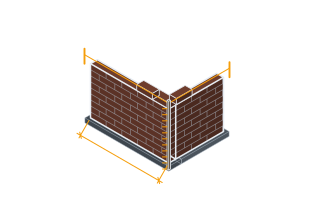
The total AAC wall face area.
Face area of the wall, openings deducted — on a wall that is mostly window the deduction is most of the order. AAC is the case where the quantity is small and the tolerance is not: a thin-bed joint is a few millimetres deep, so coverage depends on how flat the blocks are laid and how well the first course was levelled, not on the wall's size alone. A wall laid out of level eats mortar making up the difference.
The thin-bed mortar joint thickness.
AAC block uses very thin joints, typically 1-3mm (about 1/32 to 1/8 in), applied with a notched trowel — much thinner than conventional masonry mortar joints.
The specific thin-bed mortar product's consumption rate.
1.3 kg/m²/mm is a commonly cited rate — always check your specific product's technical data sheet. THIS FIELD IGNORES THE UNIT TOGGLE. Wall Area and Joint Thickness above follow it; this one stays exactly as typed, so it always means kilograms per square metre of wall per millimetre of joint, even while those two are showing imperial. The imperial form of the same rate is pounds per square-foot of wall per in of joint, and the factor is NOT the 10.7639 of the area alone — the pound and the in convert too, and together they net 5.2023. So 1.3 kg/m²/mm = 6.76 in pound-and-in units, the same quantity as a mortar density of 1,300 kg/m³ or 81.2 pcf; divide a pound-and-in figure by 5.2023 before entering it. Typing it raw is not quietly accepted, but it is not caught either: 0.8-2 here is only 4.16-10.40 in those units, so any real product's imperial figure sits above the maximum and is rewritten to 2 — the box does say it substituted a number, but it names only the value, so it reads as a cap on a legitimate rate rather than a wrong unit. At the 50 m² wall and 2 mm joint this page opens with, that turns 130 kg of mortar into 200 kg: 54% over, about 441 lb shown instead of about 287 lb, or eight 25 kg bags instead of six.
Thin-bed mortar needed
288 lb
Coverage rate varies by specific product formulation and trowel notch size — confirm against your chosen thin-bed mortar's technical data sheet.
- Wall area
- 540 sq ft
They open the calculator with your figures already in it
AAC Block Thin-Bed Mortar Calculator: 288 lb — shown in imperial, US market. The link sets both, so the result they see is the one on your screen.
Show calculation logicHide calculation logic
How this was calculated
Formula source(s)
- AAC thin-bed mortar consumption = wall area x joint thickness (mm) x the specific product's coverage rate (kg per m² per mm of joint thickness), per manufacturer technical data sheets. Thin-bed mortar is stocked in 25 kg bags in the metric markets where AAC is a mainstream system; no comparably standard North American bag size is established here, so the imperial result is reported as a mortar quantity rather than a bag count
Inputs used
- Wall Area
- 540 sq ft
- Joint Thickness
- 0.08 in
- Coverage Rate (kg/m²/mm)
- 1.3
Intermediate steps
- Wall area
- 540 sq ft
Confidence note: Coverage rate varies by specific product formulation and trowel notch size — confirm against your chosen thin-bed mortar's technical data sheet.
What this calculation does not cover
- No waste allowance is applied. The figure is the calculated mortar only — nothing is added for material left in the bucket, mortar dropped off the trowel, the extra worked in at cut blocks and around openings, or a bag opened at the end of the job. The metric result rounds up to whole 25 kg (55 lb) bags, which is packaging arithmetic, not a wastage factor.
- Wall area is taken as a plain gross face area: openings are not deducted, and the calculation has no idea of your block height or wall thickness — the two things that actually set how much bed-joint surface exists per square metre of wall. Before trusting the number, check whether your product's published rate is quoted per square metre of wall face or per square metre of bedded surface, because this model treats them as the same thing.
- The coverage rate is whatever you type and nothing checks it. Trowel notch size, block face texture and absorbency, how heavily the applicator loads the sledge, and temperature all move real consumption away from a technical data sheet figure, and none of them are inputs here.
- In imperial the answer is a quantity of mortar, not a count of packages — no North American bag size is assumed, so you have to divide by whatever your supplier actually stocks. In metric it is rounded up to 25 kg (55 lb) bags specifically; a different sack size changes the count.
- This is a quantity take-off, not a specification. It does not cover the levelling bed of conventional mortar the first course is normally laid on, says nothing about reinforcement, adhesion, fire rating or structural performance, and does not decide whether thin-bed adhesive is the right product for your block system — that comes from the block manufacturer's installation instructions.
Estimated cost — your price
This site holds no price list for this material — local prices vary too much to publish honestly. Enter your supplier's price and the result is costed with it.
Computed in your browser — nothing you enter is uploaded. Presented in US customary units and US trade terminology. Where a formula follows a published standard, that standard and its edition are cited beside it on this page; where none governs, the page says so. Local amendments override model codes — verify against the code in force where you build.
Sources checked 2026-09-05 · in the site-wide review of 2026-09-06 · v1.0.1
Regulatory standards & verification citations1
- AAC thin-bed mortar consumption = wall area x joint thickness (mm) x the specific product's coverage rate (kg per m² per mm of joint thickness), per manufacturer technical data sheets. Thin-bed mortar is stocked in 25 kg bags in the metric markets where AAC is a mainstream system; no comparably standard North American bag size is established here, so the imperial result is reported as a mortar quantity rather than a bag count
Cite this page
Your workspace
Most jobs need more than one number. Add the calculators you need next and they open right here, underneath this one — your figures stay on screen and nothing is lost to a page change.
Tools and safety for this job
To mix adhesive or mortar and mix mortar. Generic types, no brands, no prices.
Protection this work requires
- Cutting or grinding concrete, masonry, screed, tile or fibre-cement board releases respirable silica: cut wet or extract at the tool, and wear a P2/N95 respirator at minimum — a nuisance dust mask does not filter it.
- Wet cement and lime burn skin and eyes painlessly until the damage is done: waterproof gloves to EN 374, safety glasses whenever the mix can splash, and never kneel in wet mix in permeable trousers.
Show the 5 tools this job needsHide tools
Essential
Mixing bucket or tub
Paddle mixer
Shovel and spade
Wheelbarrow
Recommended
Cement mixer
what each tiling tool is for and what each masonry tool is for, and the spec that decides which to buy where one does.