
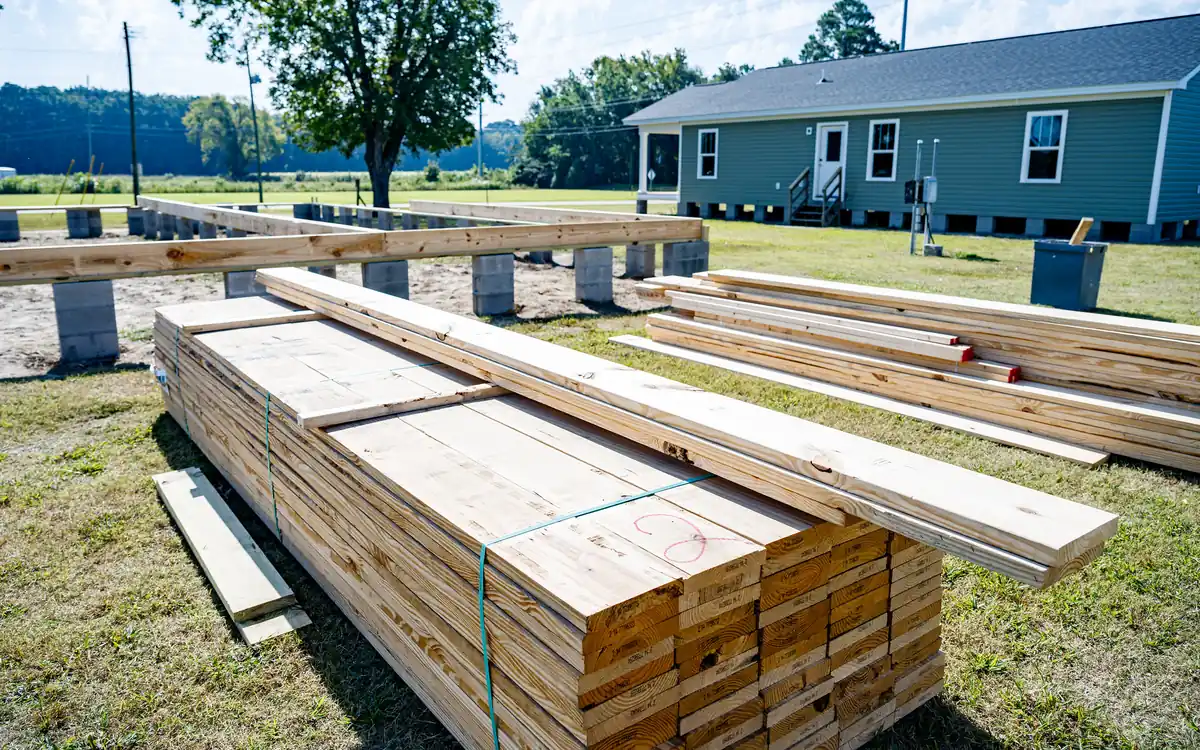
How the two differ in kind
These are not two versions of the same product, and almost every practical difference comes from that. An asphalt shingle is a manufactured unit with the decisions already inside it: the product's own geometry sets the exposure — the cutout on a three-tab, the lamination line on an architectural shingle — the printed nail line tells the crew where to fix it, and a heat-activated sealing strip bonds each course down onto the one below so the finished roof behaves like a near-continuous mat. There is nothing for the installer to work out about how much of it shows. A cedar roof is the opposite — solid wood pieces lapped so that a shingle roof carries three thicknesses over every point on it, or a shake roof two thicknesses with a felt interlayment woven between the courses. It has no seal and no membrane. It is designed to get wet, shed most of it and dry out before the next time, and the exposure that governs the whole assembly is a number somebody has to choose correctly on the day.
That is why the upkeep question has a different answer than most people expect. A cedar roof's regime is not a coat of something on a cycle — it is a condition you maintain: valleys and keyways clear of needles and leaf litter, moss and lichen not left sitting there holding damp against the wood, branches cut back off the plane, gutters actually flowing. All of it exists to protect the same mechanism, which is drying. And the uncomfortable part is that your site has a bigger vote than your diligence. A roof plane with sun on it and air moving over and under it forgives years of neglect; a shaded, north-facing plane under a tree canopy stays wet no matter how conscientious you are, and it will take the roof apart from beneath while the top looks fine. Asphalt has no equivalent regime at all, because nothing you do to it changes its clock: it is aged by heat cycling and ultraviolet, and it loses granules from the day it is laid whether or not anyone climbs up there.
Which sets up the inversion worth understanding before you choose. The damp, shaded, tree-covered roof that kills cedar is the roof an asphalt covering lasts longest on, and the hot, open, well-exposed plane that suits cedar is the one that ages asphalt fastest. Beyond that sit three gates that can end the conversation before taste is consulted: fire, where whole jurisdictions in wildfire country prohibit wood roofs and insurers who permit them may load or decline the policy; slope, where the code's wood provisions begin above where asphalt's do; and the substrate you already own, because cedar needs a surface that lets its underside dry and asphalt needs a continuous deck, and those are not the same roof. One last thing belongs in the decision because it is what this choice is usually made for: cedar leaves the yard warm brown and does not stay that way. It weathers to silver-grey, faster on the sunny elevations and darker and greener on the shaded ones, so a hip roof ages at four different rates. If the picture in your head is the colour it arrives in, that picture has a life of a year or two.
The factors that actually differ
| Cedar shakes / shingles | Asphalt shingles | |
|---|---|---|
| How the water is actually held out | Redundancy in solid wood. Three thicknesses over every point on a shingle roof — two plus an interlayment felt on a shake roof — so a split piece, a cupped butt or a lifted tail is usually still a watertight roof, with two more layers underneath it. | A bonded mat. Self-sealing strips melt the courses together into something close to a membrane, which is what makes it hard for wind to get under. The redundancy is thinner though: a puncture is much closer to a hole in the roof. |
| What has to be underneath | A substrate that breathes — spaced sheathing, or battens over a deck — because the underside has to dry as well as the face. It is the single detail that most often separates a cedar roof that lasts from one that rots quietly from below. | A continuous solid deck, without gaps or soft spots. Its ventilation requirement is the space below rather than the covering: intake at the eave, exhaust at the ridge, and no interest at all in what the underside of a shingle is doing. |
| Exposure: a decision or a given | A number you have to get right. Triple lap forces the exposure under a third of the shingle's length, the Cedar Shake and Shingle Bureau's tables tighten it further as the slope drops, and bundle coverage scales linearly with whatever you settle on — so the exposure sets the order quantity. | Manufactured in. The product's own geometry — cutout or lamination line, printed nail line, seal strip — fixes what shows, and the bundle label fixes the coverage: three bundles to the roofing square for the ordinary three-tab and architectural products, more only for the heavyweight designer ranges. No site decision moves either. Estimating reduces to true sloped area plus a waste allowance. |
| Minimum slope | Higher, and shakes higher than shingles — the wood provisions start above where asphalt's do. On a shallow roof the response is a tighter exposure and more material, not merely another layer of underlayment. | Lower. Adopted codes commonly permit it down to a shallow pitch with doubled underlayment, which is why it turns up on porch roofs, dormer tops and low additions where a wood covering is simply not allowed. |
| Fire class and permission | Combustible unless it is pressure-impregnated fire-retardant-treated cedar inside a tested assembly. In wildfire-exposed regions this is a gate, not a preference: some jurisdictions prohibit wood roofs outright and some insurers load or refuse the policy. | Class A as an assembly almost everywhere, which is exactly why it is the default covering in the places wood is banned. No treatment specification, no conversation with the underwriter. |
| What ends its life | Water that does not leave. Shade, an overhanging canopy, litter packed into the keyways, moss holding damp against the wood — the same product on a sunny open plane and on a shaded one gives two entirely different lifespans. | Heat and ultraviolet. Thermal cycling and cumulative granule loss run on their own schedule regardless of attention, which is why a cool shaded north slope is where an asphalt roof lasts longest — the very roof that would destroy cedar. |
| The upkeep it asks for | Real, ongoing and mostly janitorial: keep it clear, keep it dry, keep the trees off it. Skippable for a while and then abruptly not, because the damage happens under the surface before it shows on it. | Effectively none until something is wrong. There is no regime that buys extra years, which is a genuine advantage for a house that will change hands or be let, and no advantage whatsoever to anyone who enjoys maintaining things. |
| Damage and repair | Piece by piece, indefinitely: the nails are cut out with a ripper and a replacement is slid up into the course. It is a skill rather than an afternoon, but it keeps the roof going for as long as somebody will do it — and new wood among weathered wood stands out only until it silvers in. | Warm-weather work. The sealed tabs above have to be broken free without tearing them, which they do when cold, then the piece replaced and the bond re-established. Matching a decade-old colour is the visible half; the mat also gets more brittle with every year you wait. |
| How it looks in five years | A moving target. Warm brown on delivery, silver-grey in service, and unevenly so — the sun elevations go first while shaded planes stay darker and can green up. The colour that sold you the roof is the first season or two of it. | Roughly what you picked, slowly dulling. Colour is a manufactured decision that stays a recognisable version of itself until granule loss flattens it, and it ages at much the same rate on every elevation. |
Which one, and when
Choose cedar shakes / shingles when…
- The wood is the point, and the roof you actually want is the weathered silver-grey one rather than the honey-brown one that arrives on the pallet.
- The planes get sun and air: a decent pitch, no canopy sitting over them, nothing that keeps a course damp into the afternoon.
- The substrate can breathe — spaced sheathing already up there on an older house, or a new build where battens over the deck are still a free decision rather than a retrofit.
- You want a covering that stays repairable piece by piece for as long as someone is willing to do the work, instead of one that ages and is replaced as a single mat.
- The building's context asks for it: a conservation area, a covenant, or a vernacular the roof is supposed to belong to.
Choose asphalt shingles when…
- Any fire gate fails — a jurisdiction that prohibits wood roofs, a wildfire exposure zone, an insurer that loads or declines. Establish this first, because it can settle the question before anything else is discussed.
- The roof is shaded, overhung by trees, or shallow. Those are the conditions that turn a cedar roof into a moss bed, and they are the conditions asphalt handles best.
- Nobody is realistically going to keep the roof clear — not you in fifteen years, not a tenant, not the next owner. Cedar bought without that commitment is a maintenance debt with a nice photograph.
- The deck is solid and staying solid, and adding a ventilated substrate layer is not in the scope or the budget of this job.
- Cut-up geometry or a short ownership horizon: hips, valleys and rakes are exactly where cedar's labour and waste concentrate, and where asphalt's solved details cost the least.
Now run your own numbers
This page holds no prices on purpose — a national average is wrong for almost every real project. Quantify both options with your dimensions and your local quotes.
Frequently asked questions
- Shakes or shingles — which am I actually choosing between?
- They are different products and their arithmetic does not transfer. A shingle is sawn on both faces, thin, and laid three thicknesses deep. A shake is split rather than sawn, thicker, more textured from the ground, and laid at a larger exposure with only two thicknesses over a given point — which is why a felt interlayment is woven between the courses as part of the tested assembly rather than as an extra. They weigh differently, they are graded differently, and their exposure tables are not interchangeable. The triple-lap calculator here is the shingle arithmetic; a shake takeoff worked from a triple-lap assumption comes out wrong in the direction that costs you material.
- Can cedar go over my existing asphalt roof?
- No, in the way that matters. Cedar survives by drying from both faces, and laying it on top of an old asphalt mat gives it precisely the opposite — a sealed, impermeable surface pressed against its underside. A cedar reroof means a tear-off plus a substrate that breathes, and that is scope rather than preference. Asphalt is the format that tolerates a layover where the deck is sound, the existing layer count permits it and the code in force allows it. The reverse direction has its own catch: putting asphalt on a house that currently has cedar on spaced sheathing means laying a continuous deck over the spacing first, so that is a tear-off with a full-area material added on top of it.
- Will my insurer accept a cedar roof?
- Ask before you design, and ask in writing. In wildfire-exposed regions the answers range from a straightforward yes, through a premium loading or a requirement that the product be treated, to a flat refusal — and in some jurisdictions the code removes the choice before the insurer is consulted. Fire-retardant-treated cedar exists and reaches a higher class as part of a tested assembly, but understand what it is: a pressure impregnation with a specified retention, ordered as such, not something brushed on afterwards, and the rating belongs to the assembly rather than to the shingle on its own. With asphalt this conversation does not happen, which is worth naming as one of its real advantages.
- Do I have to oil or treat it every few years?
- This is where expectation and mechanism diverge. What decides a cedar roof's life is whether the wood dries after it gets wet, and that is set by the assembly and the site — substrate ventilation, the exposure it was laid at, pitch, aspect, tree cover and how clear the roof is kept. Coatings are contested territory: some hold pigment or slow moss growth, none convert a permanently damp shaded plane into a dry one, and any product going onto a roof has to be one that will not trap moisture inside the wood. Zinc or copper strips near the ridge are a common moss measure and work by washing metal salts down the slope with every rain. Budget the clearing, not the coating.
- What actually kills a cedar roof early?
- Rarely the wood itself — usually the details around it. A substrate that will not let the underside dry. An exposure laid more generous than the slope and the length permit, which quietly removes the lap the assembly depends on. Fasteners that were not stainless or properly hot-dip galvanised, because cedar's own extractives corrode plain steel and stain the roof on the way to losing the fixing. And debris left to hold water in the keyways and valleys. Grade belongs on the same list: the Cedar Shake and Shingle Bureau's labels are distinct products with different permitted exposures and intended uses, and a roof specified in one and delivered in another is not the roof that was priced.
- Which costs more, and where does the money go?
- Cedar, on essentially every line — and the useful part is knowing which lines and how each one scales, since this site publishes no figures. Asphalt is a commodity whose coverage is fixed by the product and laid quickly by a trade you can get several genuinely comparable bids from, so its cost tracks area and very little else. Cedar's material quantity is not fixed at all: bundle coverage scales with the exposure you lay at, so a tighter exposure forced by a shallower pitch means more bundles on the same roof. Around that sit stainless fasteners, a ventilated substrate asphalt does not need, an interlayment if you are laying shakes, and a scarcer trade whose quote spread is wide. Its labour and waste then concentrate on the linear features rather than the field — hips, valleys, ridges and rakes, where the joint-offset rule consumes pieces — so a cut-up roof penalises cedar far more than it penalises asphalt. Finally, price the exit: changing your mind later is a tear-off in both directions, plus a full-area deck if you are going from spaced sheathing to asphalt. Run both calculators, watching that they ask for different things: the shingle one takes the plan-view footprint and applies the slope multiplier itself, while the wood one takes the true sloped area you have already worked out — hand the same figure to both and one of them is wrong by the pitch. Then put those quantities in front of your own quotes.