
How the two differ in kind
The R-value on the bag is not the fight. Installed the way each product actually installs, the same nominal R performs differently — and the difference is gaps. An attic floor is a minefield of joists, wiring, pipes, junction boxes and odd bays. Batts are rectangles; attics are not. Every place a rectangle meets a non-rectangle either gets hand-cut precisely or becomes a void, and voids are disproportionate: a few percent of missed area costs far more than a few percent of performance, because heat takes the bypass.
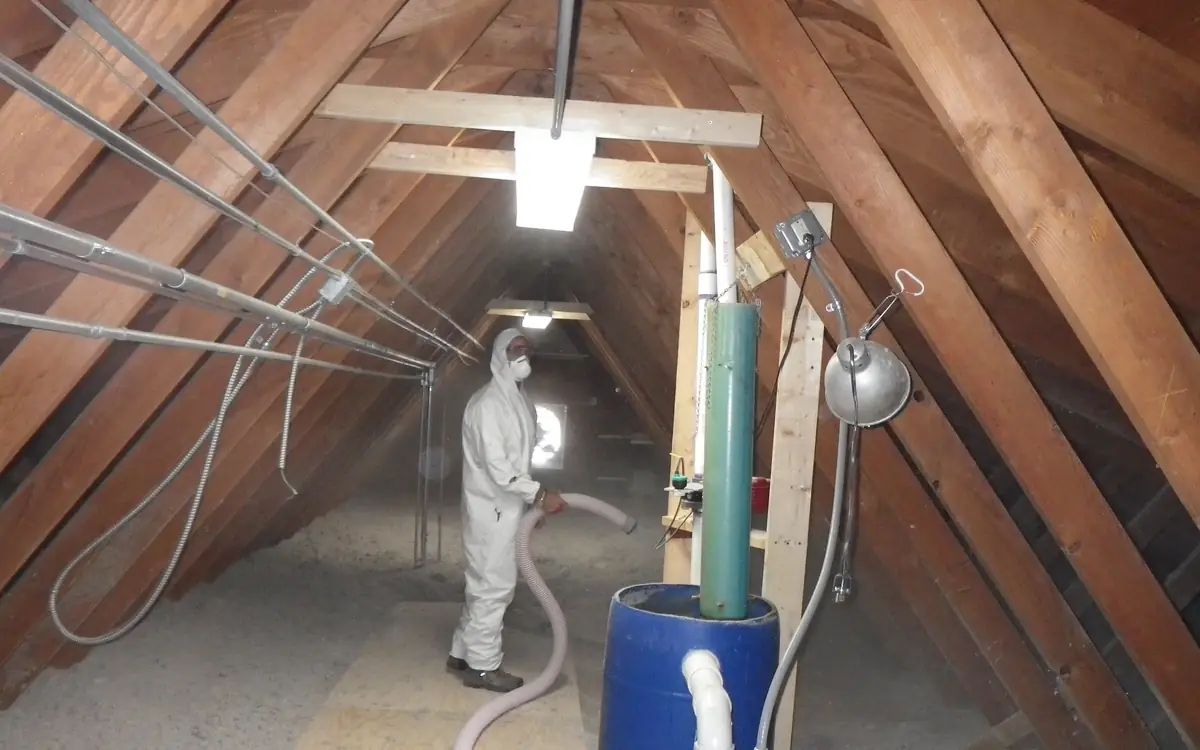
Loose fill is the opposite trade. Blown as a fluffy monolith, it flows around every obstruction and fills every bay to one continuous depth — coverage is its superpower. Its weaknesses are mechanical: it settles over the years (the bag's stated settled thickness is the honest number, not the fresh-blown fluff), it cannot hold itself in a vertical open wall, and once it is down, working in that attic means swimming in it.
The machine is the practical pivot. Blowing needs a hopper and a hose — rentable, loud, a two-person job for an afternoon. Batts need a knife and patience. For one small area, batts win on logistics alone; for a whole open attic, the machine pays for itself in coverage quality.
The factors that actually differ
| Batts (rolls) | Blown-in (loose fill) | |
|---|---|---|
| Gap performance | Only as good as the cutting; every service penetration is a hand-fitted joint. | Flows around obstructions; continuous coverage is the default, not the achievement. |
| Where it can go | Anywhere it can be held: walls, sloped ceilings, floors, between exposed studs. | Horizontal or contained cavities only; an open vertical wall will not hold it. |
| Settling | Holds its loft if not compressed at install. | Settles by design — depth must be blown to the chart's initial thickness to end at the rated settled R. |
| Future access | Lift a batt, do the wiring, lay it back. | Every later job in the attic disturbs the blanket and needs raking back level. |
| Tools | Knife, straightedge, PPE. | Blowing machine (usually free-with-purchase or rented) plus a feeder at the hopper. |
| Top-ups | Awkward over existing irregular fill. | The natural top-up: blow more over whatever is there. |
| Fitting around obstructions | Cut to fit, and the cutting is where performance is won or lost. A batt compressed to fit, or left with a gap at a wire or a pipe, loses far more than the area of the gap. | Flows around everything. Wires, pipes, awkward junctions and irregular joist spacing are filled without a cut, which is the single biggest practical advantage. |
| Convection within the layer | Gaps at the edges of a batt allow air to loop around it, carrying heat past the insulation rather than through it. Neat fitting is not tidiness, it is performance. | Dense-packed material resists air movement within itself, which is why it performs closer to its nominal value in a real assembly. |
| Settling over time | Does not settle. What is installed stays where it is. | Loose-fill can settle over years and leave the top of the layer thinner than installed — which is why installed depth is recorded and why depth markers exist. |
| Inspection afterwards | Visible. You can see whether it was fitted well, which is why a poorly fitted batt installation is at least diagnosable. | Invisible once installed. Coverage is verified by bag count against area and by depth markers, not by looking — and a thin spot is undetectable from above. |
Which one, and when
Choose batts (rolls) when…
- Open stud walls or rafter slopes — loose fill simply cannot serve them.
- You will need to get back into this attic and want the insulation liftable.
- The area is small enough that machine logistics outweigh coverage gains.
Choose blown-in (loose fill) when…
- A big open attic floor with the usual obstruction chaos.
- Topping up old, uneven existing insulation.
- Coverage quality matters more than future serviceability.
Now run your own numbers
This page holds no prices on purpose — a national average is wrong for almost every real project. Quantify both options with your dimensions and your local quotes.
Frequently asked questions
- Is the R-value per inch different?
- Modestly, and it varies more by product than by format. What differs decisively is INSTALLED performance: field studies consistently show gap-related losses dominating product differences. A perfectly cut batt job matches the chart; an ordinary one does not, and loose fill's ordinary job is much closer to its chart.
- Can I blow over old batts?
- Yes — it is the standard top-up and one of blown fill's best uses. The loose fill fills the gaps between and above the old batts. Do not do it the other way round: batts laid over loose fill compress it unevenly and bridge on the high spots.
- What about vents and downlights?
- The same rules for both: baffles keep the eave ventilation path open before any insulation goes near it, and non-rated downlights need clearance or covers. Loose fill makes these details MORE important, because it will happily flow into places batts would never reach — including over the vents.
- Does it matter if a batt is slightly compressed?
- Yes, and in a way that is easy to underestimate. Insulation works by trapping still air, and compressing it reduces the thickness without proportionally increasing the material's resistance per unit thickness — so a batt squeezed into a space thinner than its nominal depth delivers close to the resistance of that smaller thickness. Stuffing a thicker batt into a thinner cavity therefore buys almost nothing over the correct batt. The other direction is worse: a batt that does not fill the width leaves a gap at the edge, and air can loop around it from the warm side to the cold side and back, carrying heat past the insulation entirely. That convection loop can cost far more than the fraction of area the gap represents.
- Will blown insulation settle and leave a thin spot?
- Loose-fill can, which is why installed depth and settled depth are quoted separately and why the coverage chart on the bag is the governing document. The installer's obligation is to place a stated number of bags over a stated area to achieve a stated settled thickness, and the verification is bag count against area rather than an impression from the hatch. Depth markers fixed to the joists before the material goes in make the result checkable afterwards by anyone. Dense-packed installations in closed cavities behave differently: packed to the correct density they do not settle, and the density is what the installer is contracting to deliver rather than a depth.
- Can I put batts over existing blown insulation, or the reverse?
- Both, and the rule is the same as for any insulation upgrade: nothing may be compressed and no vapour barrier may end up in the middle. Laying unfaced batts across existing loose-fill at right angles to the joists is a standard and effective upgrade, because the new layer covers the joists that were previously bridging the old one. What must not happen is laying FACED batts on top, because the facing becomes a vapour retarder part-way up the assembly where moisture can condense against it. Blowing over existing batts is equally fine provided the batts are not disturbed into gaps in the process.
- What actually decides the performance of either in a real attic?
- Air sealing, done before either goes in — and it is consistently worth more than the insulation choice. Warm moist air leaking up through the ceiling plane at top plates, recessed lights, service penetrations and the loft hatch carries heat past any insulation and deposits moisture in the roof, and the insulation is then blamed for both. The order of work is seal the ceiling plane, ensure the eaves ventilation path is open and baffled, and then insulate — and a modest depth over a sealed ceiling outperforms a generous depth over a leaky one. This is also why the two products converge in practice: fitted well over a sealed plane, either works; fitted badly, both disappoint.