
SettingsSettings for this calculationUS
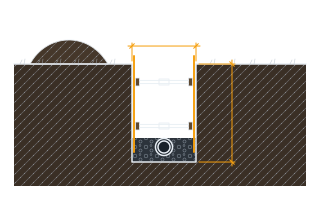
The total volume of soil to be treated with lime.
Measure the volume of the subgrade or embankment layer that will actually be mixed with lime, not the full project footprint if only part of it is stabilized.
The dry density of the soil being stabilized.
Use the in-place or maximum dry density of the specific soil from your geotechnical report — this value scales the mass of soil per unit volume, and directly scales the lime mass required.
The target lime dosage as a percentage of the soil's dry weight.
This percentage should come from a geotechnical lab mix-design study for your specific soil, not an assumed value.
Lime needed
14,100 lb
The correct lime percentage for your soil must be determined by a geotechnical lab mix-design study (e.g. per ASTM D6276) — this calculator only converts a known target percentage into a material quantity, it does not determine the required percentage itself.
They open the calculator with your figures already in it
Soil Stabilization Lime Content Calculator: 14,105 lb — shown in imperial, US market. The link sets both, so the result they see is the one on your screen.
Show calculation logicHide calculation logic
How this was calculated
Formula source(s)
- Lime mass = soil volume × soil dry density × target lime content percentage (by dry weight), the standard method for proportioning lime in lime-soil stabilization
Inputs used
- Soil Volume to Stabilize
- 130.75 yd³
- Soil Dry Density
- 99.88 pcf
- Target Lime Content (% by Dry Weight)
- 4
Confidence note: The correct lime percentage for your soil must be determined by a geotechnical lab mix-design study (e.g. per ASTM D6276) — this calculator only converts a known target percentage into a material quantity, it does not determine the required percentage itself.
What this calculation does not cover
- The dosage percentage belongs to a specific product, and the two products are not interchangeable by mass. Quicklime is roughly a third more effective per unit weight than hydrated lime — about 0.76 kg (1.7 lb) of quicklime does the work of 1 kg (2.2 lb) of hydrate — so a mix design written for one and ordered as the other lands about 25% out in one direction or the other. Quicklime also needs its own water added on site and burns skin and eyes wherever it meets sweat.
- Delivered lime is not pure lime. Commercial product is sold on an available-lime content in the low-to-mid nineties, and anything that has sat open in a stockpile or an unsealed silo has carbonated back toward limestone, which does nothing at all for the soil. The mix design is written on active lime, so ordering the nominal mass under-doses the job by exactly the shortfall.
- Says nothing about whether this soil should be limed in the first place. Soils carrying soluble sulfate react with lime and water to grow ettringite, which swells and heaves a finished pavement months after handover, and the screen for it is a separate soluble-sulfate determination run on the same samples as the mix design. A dosage figure is a quantity, not a clearance to proceed.
Estimated cost — your price
This site holds no price list for this material — local prices vary too much to publish honestly. Enter your supplier's price and the result is costed with it.
Computed in your browser — nothing you enter is uploaded. Presented in US customary units and US trade terminology. Where a formula follows a published standard, that standard and its edition are cited beside it on this page; where none governs, the page says so. Local amendments override model codes — verify against the code in force where you build.
Sources checked 2026-09-06 · in the site-wide review of 2026-09-06 · v1.1.1
Regulatory standards & verification citations1
- Lime mass = soil volume × soil dry density × target lime content percentage (by dry weight), the standard method for proportioning lime in lime-soil stabilization
Cite this page
Your workspace
Most jobs need more than one number. Add the calculators you need next and they open right here, underneath this one — your figures stay on screen and nothing is lost to a page change.