
SettingsSettings for this calculationUS
Total area of the beds to mulch.
Measure the planted area, not the whole garden. For a border, length times average depth of the bed is close enough — beds are rarely rectangular and the error is small at this depth.
How deep the mulch layer goes.
75-100 mm suppresses weeds and holds moisture. Thinner than 50 mm and weeds come through; thicker than 100 mm and you risk starving roots of oxygen, particularly on a heavy soil.
The bag your supplier sells.
Check the bag rather than assuming a standard, because bag volumes differ between suppliers by enough to change the count noticeably over a large bed. It is also worth running the job both ways: above a fairly modest quantity, bulk delivery costs less than the same volume in bags, and the crossover point is lower than most people expect — often a single large border rather than a whole garden.
Mulch required
28 bags
Bag counts round up — you cannot buy part of a bag, and the last bag is usually the one that finishes the edges.
- Volume
- 2.04 yd³
- Cubic yards
- 2.04 yd³
- Litres
- 1,557.43 L
- Approximate weight
- 1,373.42 lb
They open the calculator with your figures already in it
Mulch Calculator: 28 bags — shown in imperial, US market. The link sets both, so the result they see is the one on your screen.
Show calculation logicHide calculation logic
How this was calculated
Formula source(s)
- 75-100 mm (3-4 in) mulch depth for weed suppression and moisture retention — university extension horticulture guidance
- Bagged mulch is commonly sold in 2 ft³ (56.6 L) bags in North America and 50-70 L bags elsewhere
Inputs used
- Bed area
- 220 sq ft
- Mulch depth
- 3 in
- Bag size
- 2 ft³ bag (56.6 L) — US/CA
Intermediate steps
- Volume
- 2.04 yd³
- Cubic yards
- 2.04 yd³
- Litres
- 1,557.43 L
- Approximate weight
- 1,373.42 lb
Confidence note: Bag counts round up — you cannot buy part of a bag, and the last bag is usually the one that finishes the edges.
What this calculation does not cover
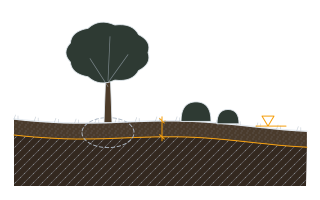
- Nothing is deducted for what already stands in the bed — area times depth covers the whole figure you enter, including the ground taken by established plants, the standoff you should be leaving around every trunk and stem, and any stepping stones, edging or path inside the measurement.
- The depth is read as new material going onto bare soil, so where you are topping up an existing layer you should enter the shortfall you are making up rather than the finished depth you want; the residue already in place is subtracted nowhere in the arithmetic.
- No settlement or decomposition allowance is applied to the volume. What comes back is the layer as it is spread, and organic mulch consolidates under rain and treading and then loses depth as it rots down, so a bed that measures right on the day it is laid will read shallower by the end of a season.
- The bag list is three fixed capacities divided into the total as an exact volume, and the labelled capacity is taken at face value. Mulch sold in any other sack size, or sold by weight rather than by volume, will not divide out to the count shown here.
- The approximate weight row multiplies the volume by a single constant density regardless of what you are actually spreading. Bark, wood chip, straw and composted fines do not weigh the same, and none of them weigh the same wet as dry, so treat that row as a rough sense of the load rather than a figure to check a barrow, a car boot or a trailer rating against.
- Choosing bulk delivery hands back the bare volume the bed holds, with none of the rounding a supplier's scoop imposes: loose material is sold in whole scoops, in half-scoop steps and in minimum loads, so the docket will read higher than this number.
Estimated cost — your price
This site holds no price list for this material — local prices vary too much to publish honestly. Enter your supplier's price and the result is costed with it.
Part of a bigger job
This trade is one line of a job takeoff. Run the whole job and every other trade comes back with it, off the same measurements.
also measuresTopsoilLandscape FabricLawn Edging
Computed in your browser — nothing you enter is uploaded. Presented in US customary units and US trade terminology. Where a formula follows a published standard, that standard and its edition are cited beside it on this page; where none governs, the page says so. Local amendments override model codes — verify against the code in force where you build.
Sources checked 2026-09-05 · in the site-wide review of 2026-09-06 · v1.0.1
Regulatory standards & verification citations2
- 75-100 mm (3-4 in) mulch depth for weed suppression and moisture retention — university extension horticulture guidance
- Bagged mulch is commonly sold in 2 ft³ (56.6 L) bags in North America and 50-70 L bags elsewhere
Cite this page
Your workspace
Most jobs need more than one number. Add the calculators you need next and they open right here, underneath this one — your figures stay on screen and nothing is lost to a page change.