
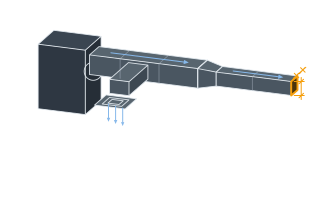
SettingsSettings for this calculationUS
The standard allowance most suppliers and estimating guides assume for ordinary work.
The combined length of all duct joints and seams to seal.
Add up the length of every duct joint, elbow connection, and register boot seam in the accessible ductwork you're sealing.
Mastic left in the tub, on the brush and on the glove.
A thick sealant loads a brush heavily, and the last of a tub is hard to use cleanly. Overhead seams in a tight crawlspace or attic drip and waste more than seams at bench height, so raise the figure where most of the work is above your head.
Duct mastic needed
2 quarts
Coverage varies with how thickly the mastic is applied and how wide the seams are — check your specific product's coverage rating.
- Seam length (with waste)
- 53.9 linear ft
They open the calculator with your figures already in it
Duct Sealing Mastic Calculator: 2 quarts — shown in imperial, US market. The link sets both, so the result they see is the one on your screen.
Show calculation logicHide calculation logic
How this was calculated
Formula source(s)
- Coverage derived from the applied geometry rather than quoted: a US quart is 57.75 in³, and a 2 in wide band at the ~1/16 in wet thickness duct mastic is brushed at gives about 38 linear ft per quart. A 3 in band at the same thickness gives about 26 ft
- The widely published '100 linear ft' coverage figure for duct mastic is per GALLON, not per quart — four quarts — which is about 26 ft per quart and consistent with a 3 in band
Inputs used
- Total Seam Length
- 49 ft
- Brushing Waste (%)
- 10
Intermediate steps
- Seam length (with waste)
- 53.9 linear ft
Confidence note: Coverage varies with how thickly the mastic is applied and how wide the seams are — check your specific product's coverage rating.
What this calculation does not cover
- The whole answer rests on one coverage rate, worked from a 2 in band at about 1/16 in wet — roughly 38 linear ft per quart. There is no input for band width or thickness, and those two change the material per linear foot several times over: a 3 in band at the same thickness is about 26 ft per quart, and a heavy 1/8 in coat halves it again. Check the coverage printed on the tub you are buying and scale the result.
- Published coverage figures for duct mastic are usually quoted per GALLON, and this result is in QUARTS — four to a gallon. A '100 linear ft' figure read off a datasheet and applied to a quart tub over-states the coverage fourfold, which is the error this calculator itself shipped with until 2026-09-02.
- Only the seam length you type in is quantified — nothing here identifies which seams to measure. Register boots, plenum takeoff collars, the air-handler cabinet joints, flex-to-collar connections and the entire return side each leak, and any duct buried in a wall, floor cavity or sealed chase cannot be reached at all. Ductwork you cannot get to is not in the number and is not in the seal.
- Nothing but the mastic itself is counted. Reinforcing mesh or fabric tape for gaps too wide for mastic alone, brushes, disposable gloves, and the time and material to clean dust and oil off galvanised flange before anything sticks are all separate. The result is also given in US quarts, which does not map onto the litre tubs sold outside North America.
- A material quantity is not a leakage measurement. This does not tell you how leaky the system is now, how much it will improve, or what a duct leakage test will read. Where the adopted code requires a duct leakage test, the pass is decided by the measured result on the finished system, not by how much sealant was bought or applied.
- Scope is HVAC supply and return air distribution. Duct mastic of this kind is not a sealant for flue pipe, vent connectors or anything else carrying combustion gases, and it is not what a grease-laden kitchen exhaust duct requires — that work needs continuous liquid-tight seams, not a brushed sealant. Do not use this quantity to plan sealing on either.
Estimated cost — your price
This site holds no price list for this material — local prices vary too much to publish honestly. Enter your supplier's price and the result is costed with it.
Part of bigger jobs
This trade is one line of several job takeoffs. Run the whole job and every other trade comes back with it, off the same measurements.
Computed in your browser — nothing you enter is uploaded. Presented in US customary units and US trade terminology. Where a formula follows a published standard, that standard and its edition are cited beside it on this page; where none governs, the page says so. Local amendments override model codes — verify against the code in force where you build.
Sources checked 2026-09-17 · v1.1.0
Regulatory standards & verification citations2
- Coverage derived from the applied geometry rather than quoted: a US quart is 57.75 in³, and a 2 in wide band at the ~1/16 in wet thickness duct mastic is brushed at gives about 38 linear ft per quart. A 3 in band at the same thickness gives about 26 ft
- The widely published '100 linear ft' coverage figure for duct mastic is per GALLON, not per quart — four quarts — which is about 26 ft per quart and consistent with a 3 in band
Cite this page
Your workspace
Most jobs need more than one number. Add the calculators you need next and they open right here, underneath this one — your figures stay on screen and nothing is lost to a page change.
Tools and safety for this job
To run the ductwork and its fittings. Generic types, no brands, no prices.
Protection this work requires
- Mineral and glass wool irritate skin, eyes and airways: cover your arms, wear a P2/N95 respirator while cutting, and rinse in cold water — hot water drives fibres in.
- Boards, blocks and bagged material cause most lasting back injuries on small sites: two people or a lifter for full sheets, and never a bag on one shoulder up a ladder.
- Most fatal falls on small jobs are from under three metres: use a tower or a ladder tied at the top, and never work off the top two rungs.
- Knives cause more site injuries than any power tool: cut away from your body, change blades often, and wear cut-resistant gloves to EN 388 level C for repeated cutting.
Run the ductwork and its fittings: Running, supporting and sealing duct is within reach of a competent installer. The duct sizes, routes and fittings come from the ventilation or air-handling design, and this site never sizes a duct; where a duct passes through a fire-separating wall or floor, the damper or fire-stopping it needs is set by the fire strategy and is the fire-stopping row's, not this one's. The hanger, mastic and wrap pages measure the run they are given.
Show the 7 tools this job needsHide tools
Essential
Cordless drill/driver
Tape measure
Utility knife
Recommended
Brushes
Crawl boards
Metal snips
Step ladder
Also needed as materials: drill and driver bits, replacement blades.
what each hvac tool is for, and the spec that decides which to buy where one does.