
SettingsSettings for this calculationUS
The wet room's own floor, not the landing outside it.
A bathroom is ventilated as its own volume because the door is shut when it matters. Where a WC is a separate compartment it is a separate calculation, and a room with a permanently open arch to a bedroom is neither — it is one larger volume and a harder problem than this page solves.
Floor to ceiling, for the volume.
Take the real height rather than a nominal one — a room with a dropped ceiling over the shower has less volume than its walls suggest, and a room in a loft with a sloping ceiling has less again. Volume is directly proportional to the answer, so an error here passes straight through.
How many times the room's whole volume is replaced each hour.
Domestic guidance for a bathroom commonly lands between 8 and 15 air changes an hour, and the higher end applies where there is a shower rather than only a bath. Some codes set a flat volume-per-second figure instead of a rate — where yours does, that number governs and this page is a cross-check on it rather than a substitute.
Measured along the duct, not across the room.
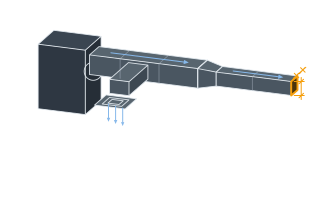
Follow the route the duct actually takes, including the rise into a ceiling void and the drop to the terminal. A run that looks like two metres on a plan is regularly four once it has gone up, across and out, and every one of those metres is resistance the fan's box never accounted for.
Every change of direction, including the one at the terminal.
Count the turn out of the fan spigot and the turn into the wall or roof terminal — both are bends and both are usually forgotten. A sagging loop of flexible duct lying in a ceiling void is several bends that nobody counted and nobody can see.
Corrugated flexible costs far more per bend than rigid.
Flexible duct is quicker to fit and the reason a great many extractors underperform: its corrugated wall is rougher than smooth bore along every straight metre, and its bends compress on the inside where rigid bends do not. Where a run is long or has several turns, rigid is the difference between a fan that clears the mirror and one that hums.
Extract rate required
69.3 CFM
62% of the run's resistance is the bends rather than the straight duct. Read the required flow against the fan's curve at that equivalent length, not against the figure on the box.
- Room volume
- 520 cu ft
- Equivalent duct length
- 26.4 ft
- Each bend is worth
- 8.2 ft of duct
They open the calculator with your figures already in it
Bathroom Extract Fan Rate and Duct Resistance Calculator: 69.33 CFM — shown in imperial, US market. The link sets both, so the result they see is the one on your screen.
Show calculation logicHide calculation logic
How this was calculated
Formula source(s)
- Required extract flow is the room volume multiplied by the target air changes per hour, divided by 3.6 to convert cubic metres per hour into litres per second
- A fan's quoted flow is measured at zero static pressure — free air, with no duct attached — so it is an upper bound rather than a delivered rate, and the difference on a real run is substantial
- Duct fittings are costed as an equivalent length of the same straight duct; a bend in corrugated flexible duct is worth considerably more than the same bend in rigid, because the inner wall compresses as it turns
Inputs used
- Room floor area
- 65 sq ft
- Ceiling height
- 8 ft
- Air changes per hour
- 8
- Straight duct run
- 10 ft
- Bends in the run
- 2
- Duct type
- Flexible (corrugated)
Intermediate steps
- Room volume
- 520 cu ft
- Equivalent duct length
- 26.4 ft
- Each bend is worth
- 8.2 ft of duct
Confidence note: 62% of the run's resistance is the bends rather than the straight duct. Read the required flow against the fan's curve at that equivalent length, not against the figure on the box.
What this calculation does not cover
- THIS IS THE REQUIREMENT, NOT WHAT YOUR FAN WILL DELIVER. A fan's quoted flow is measured in free air with no duct attached. What it moves through the run described here depends on that fan's own pressure curve, which is a property of the fan and cannot be derived from anything on this page — so the page gives you the two numbers to read against the curve and deliberately invents no third one.
- The equivalent length prices the fittings, not the terminal. A louvred grille, an insect mesh or a backdraught shutter each add resistance of their own, and a mesh that has been in a coastal wall for five years adds a great deal more than a new one.
- Air has to get IN. An extract rate is only achievable if the same volume can enter — under the door, through a trickle vent, from the landing. A fan cannot move what cannot be replaced, so a well-sealed room with a tight door is one where the fan works against itself, and no duct calculation sees that.
- Nothing here covers the fan's noise, its run-on timer, humidity sensing, or whether the terminal position satisfies the separation distances a code asks for. A duct discharging under a soffit vent is putting the moisture back into the roof.
- An air change rate and a flat volume-per-second figure are different specifications, and codes use both. Where yours sets a flat figure, that figure governs; this page then tells you what air change rate it amounts to in your room.
Add the equipment this sizes
This result is a specification — 69.3 CFM — not a quantity. Put the thing it sizes into your project: how many, what you call it, and your supplier’s price.
Part of bigger jobs
This trade is one line of several job takeoffs. Run the whole job and every other trade comes back with it, off the same measurements.
Computed in your browser — nothing you enter is uploaded. Presented in US customary units and US trade terminology. Where a formula follows a published standard, that standard and its edition are cited beside it on this page; where none governs, the page says so. Local amendments override model codes — verify against the code in force where you build.
Sources checked 2026-09-24 · v1.0.0
Regulatory standards & verification citations3
- Required extract flow is the room volume multiplied by the target air changes per hour, divided by 3.6 to convert cubic metres per hour into litres per second
- A fan's quoted flow is measured at zero static pressure — free air, with no duct attached — so it is an upper bound rather than a delivered rate, and the difference on a real run is substantial
- Duct fittings are costed as an equivalent length of the same straight duct; a bend in corrugated flexible duct is worth considerably more than the same bend in rigid, because the inner wall compresses as it turns
Cite this page
Your workspace
Most jobs need more than one number. Add the calculators you need next and they open right here, underneath this one — your figures stay on screen and nothing is lost to a page change.
Tools and safety for this job
To commission mechanical ventilation. Generic types, no brands, no prices.
Protection this work requires
- Most fatal falls on small jobs are from under three metres: use a tower or a ladder tied at the top, and never work off the top two rungs.
- Assume every cable is live until proved dead at the point you will touch, with a two-pole tester you have just proved on a known source.
Commission mechanical ventilation: Measuring a fan's airflow with a meter is within reach of a careful DIYer, and it says whether the fan moves the air it was sized for. Wiring the fan is electrical work, and where a market requires the measured rates to be recorded for a building authority, the record comes from the installer or a competent tester, not from this site.
Show the 2 tools this job needsHide tools
Essential
Airflow meter
Recommended
Step ladder
what each hvac tool is for, and the spec that decides which to buy where one does.