
Monday is booked and the only record is a thumbs-up
The quotation arrived as an attachment on the Thursday. You read it twice, replied that it looked good and could he still make the second week of the month, and he replied that he could, that it would be two weeks on site, that the old units would come out whole rather than be broken up, that the skip would stand on the drive and not the road, and that he would need the side gate left open. Somewhere inside those three messages a contract came into existence. Neither of you could now write down what is in it in the same words, and neither of you will read the thread again until something has gone wrong.
Being clear about that changes what the exercise is for. In England and Wales a contract to build is valid without any writing at all, so the question is not whether you have one but whether either of you could prove a particular term — and the party who cannot prove a term is the party it was there to protect. Section 50 of the Consumer Rights Act 2015 reaches further than most people realise: information the trader gives you about the service, which you take into account in deciding to go ahead, is already a term. The promise about the two weeks and the units lifted out rather than smashed is binding today. It is simply undated, unwitnessed and held in one person's memory.
Some jurisdictions refuse to leave this to the parties. California's home improvement provisions in the Business and Professions Code, at section 7159, require the contract to be in writing and signed, a copy given to the owner before work begins, and prescribe its contents — the contracting entity and its licence number, a description of the project, the price, approximate start and completion dates, the payment schedule and a set of notices. New South Wales does something comparable under the Home Building Act 1989 above a contract value threshold. England and Wales impose no equivalent on a general builder, which is why what follows is a list of decisions rather than a form.
It is a pack, not a page
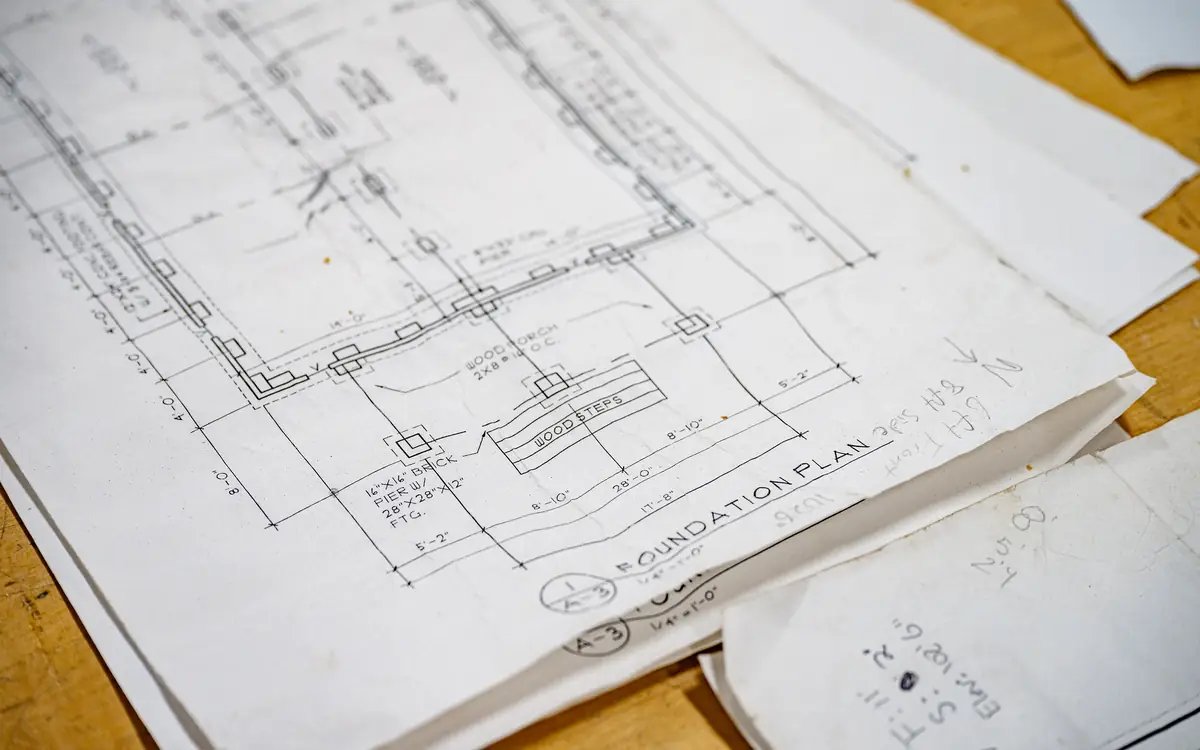
Almost nobody signs a contract for domestic building work. What they sign is one document out of six that all form part of it, which is why the argument in month three is so often about which of the six was right. The pack is the agreement — a standard form or a covering page you have written; the accepted quotation with its assumptions and exclusions; the drawings, by sheet number and revision letter; any specification or scope schedule; the payment schedule; and a list of what you are supplying or doing yourself. Naming those six on the front page takes ten minutes and is most of the work.
The list needs an order, because two of those documents will eventually disagree. Standard forms carry a precedence clause and a home-made agreement has to borrow the idea: the agreement governs the quotation, the quotation governs the drawings, and the drawings govern anything said in an email. Which order you choose matters far less than choosing one. Two conventions come with it whatever you decide — figured dimensions beat scaled ones, so nobody builds to what a ruler said off a printed sheet, and every drawing enters the pack with its revision letter, because Rev C and Rev E of one sheet are two different buildings and both will be on site by June.
That is also where the promises made in your kitchen become ordinary written terms. The two weeks, the units lifted out whole, the skip on the drive rather than the road, the make and model of boiler rather than or similar: one line each on the scope schedule. Identity belongs on the same page, because a sole trader, a limited company and a trading name are three different things to sue; the disclosure duties that put the right one on a builder's paperwork are covered from his side on the quotation page. Your own check takes a minute — the entity on the front of the pack must be the entity on the invoices and on the insurance certificate.
- Number the documents on the front page, one line each, with the date or revision letter identifying the version you mean.
- Print or file that exact set. A drawing living only in a folder somebody else can update is not a contract document.
- Write the order of precedence in one sentence, and say that figured dimensions govern over scaled ones.
- Turn every spoken promise you are relying on into a line of the scope schedule, in the words you want read back to you.
- List what you are supplying or doing yourself, with the date each has to be available to the builder.
- Both parties initial every drawing, then each keep a complete copy — not a copy each of different halves.
What the sum is a sum of
The figure in the box stops being an estimate the moment it is signed and becomes an obligation, which behaves differently under pressure. Know what is inside it first, because everything the contract does afterwards attaches to the composition rather than to the total: a sum built mostly of materials moves with the merchant's price list, a sum built mostly of labour moves with the programme, and a sum that quietly includes fees somebody else will invoice you for separately is a sum you will pay twice.
Four categories sit in the gap between what the builder priced and what the project costs you, and each wants a sentence saying which side of the line it is on. Statutory charges — the building control application or permit, the inspection visits, a water authority's build-over agreement — are usually the owner's and outside the sum. So are professional fees for the engineer's calculations, an architect, a party wall surveyor or an asbestos survey. Utility connection and diversion charges are quoted by the utility to you, not to the builder. And anything you are buying yourself needs a date attached, because a builder waiting on your tiles has a legitimate claim for the week he lost.
Tax has to be legible on the face of the total rather than assumed. Whether the figure is inclusive or exclusive of VAT is a term, not a formatting choice, and a builder below the registration threshold is quoting a different kind of price. Which rate applies to your job — a new dwelling, a conversion, a house empty long enough to qualify, or ordinary repair — is set out in HMRC VAT Notice 708. The domestic reverse charge in Notice 735 causes confusion and does not apply to you: it operates between VAT-registered businesses inside the Construction Industry Scheme, and a private householder is an end user outside it.
Then decide how long the number is fixed for, because a fixed price is only fixed until somebody writes down what happens if it is not. The standard forms treat this as a choice: JCT's fluctuations provisions are where a firm price and a price that moves with cost are selected between, and NEC4 does the same through its secondary option for price adjustment for inflation. With no form behind it, silence means the builder carries it — which is fine, is priced into the number in front of you, and is one honest reason a longer job costs more per week than a short one.
Assemble the number yourself from materials, labour and the statutory charges before you agree to anybody else's version of it. What you are looking for is not the total — it is which of those three lines you are actually transferring to the builder and which of them stay in your name and arrive as separate invoices. The contingency field belongs to you rather than to the contract sum, for the reason the next section gives.
Total cost of all materials for the project.
Total cost of hired labor, if any.
Building permits, inspection fees, and similar required costs.
Extra buffer for unexpected costs — nearly every renovation finds at least one surprise.
Total project budget
$10,695
- Materials
- $5,000
- Labor
- $4,000
- Permits & fees
- $300
- Subtotal
- $9,300
- Contingency buffer
- $1,395
They open the calculator with your figures already in it
Renovation Budget Calculator: 10,695 USD — shown in imperial, US market. The link sets both, so the result they see is the one on your screen.
What this calculation does not cover
- Sales tax, delivery charges, tool and equipment rental, dumpster and disposal fees, and temporary storage or lodging have no field of their own — the subtotal is exactly materials plus labor plus permits, so anything else reaches the total only if you fold it into one of those three figures yourself.
- The buffer multiplies the combined subtotal, so a fixed-price cabinet order, an open-ended demolition line and a published permit fee are all padded at the same percentage; there is no way to carry a heavier margin on just the part of the job that holds the unknowns.
- If the labor figure is your own hours-times-rate estimate rather than a contractor's quote, a general contractor's overhead and profit on materials and subcontracted trades appears nowhere in the sum, which adds only the three amounts entered.
- Every set of entries returns the same high confidence, including a 0% buffer at the bottom of the allowed range or the 50% at the top, because nothing in the arithmetic examines whether the percentage chosen suits the work being priced.
- Each amount is treated as a price known today: no duration, phasing or draw schedule enters the calculation, so a project whose material prices move between quote and purchase, or whose costs straddle two budget years, is totalled as though it all happened at once.
The money that must not be written into it
There is a second number in this project and it belongs nowhere in the contract. Your reserve is the money held against what nobody can see yet; the contract sum is what you have promised to pay a specific person for a specific list of work. Add the two together on the signature page and the private cushion has become an obligation, gone the moment the ink dries. It also has to stay out of the conversation, which is harder. A builder told the total you have available has been given the answer to a question he has not asked, and the effect is rarely dishonesty — it is that every later judgement call, on the specification, the making good, the tiling nobody measured, drifts toward the number he knows exists. He does the same to you: the quotation guide describes the contingency an estimator carries and is not allowed to show. Two people each holding an undisclosed margin is not a failure of trust. It is how a fixed price stays fixed.
What the reserve covers is broader than most people allow for, and almost none of it is the builder's fault. There is the work behind the plaster nobody could have priced, which becomes a variation the day it is found. There are the costs the project imposes on you rather than on the site: storage, a fortnight somewhere else, eating out, temporary heating, the second skip. And there is the reason it exists — a discovery you have no money for stops the job, and a stopped job costs more per week than a running one, because the crew you sent away has been booked by somebody else. How the reserve is drawn down, and the rule separating a discovery from a change of mind, are covered on the variation and budget pages.
Size the reserve against the specific things this building might be hiding rather than against a habit, and then write the result on a sheet that never goes in the pack. The number is a decision about your own exposure, not a term you are offering anybody.
Your planned budget before adding a buffer for the unexpected.
The extra buffer to add for unexpected issues.
Total budget with contingency
$23,000
Contingency is a planning buffer, not a guarantee — projects that uncover major surprises (structural damage, code-required upgrades) can still exceed even a generous contingency.
- Contingency amount
- $3,000
They open the calculator with your figures already in it
Project Contingency Calculator: 23,000 $ (total recommended budget) — shown in imperial, US market. The link sets both, so the result they see is the one on your screen.
What this calculation does not cover
- The percentage is applied to the base budget as one flat multiplier, so every dollar of the job is treated as carrying identical risk. A $20,000 kitchen made up of $14,000 of fixed-price cabinetry already on order and $6,000 of demolition into an unknown wall gets the same $3,000 buffer at 15% as one that is speculative end to end. Where the risk sits in a single part of the scope, size a buffer against that part and add it to the rest rather than smearing one rate across the total.
- Nothing in the arithmetic is a fixed amount: the buffer is purely proportional, so it shrinks with the budget while many of the surprises it is meant to absorb do not. A failed inspection, half a day of extra excavation or an emergency call-out costs roughly the same on a $3,000 job as on a $300,000 one, yet 15% sets aside $450 on the first and $45,000 on the second. Small jobs are the ones a percentage rule quietly under-buffers.
- Whatever is missing from the base figure stays missing from the answer. The base budget is read as a single opaque number, so if permits, disposal, delivery charges or temporary accommodation were never counted in it, a 15% buffer on that total does not fund them — it scales an incomplete estimate rather than completing it.
- The output is a lump sum with no timing in it. No term asks when the money is drawn or how long ago the base was priced, so a buffer taken on a year-old estimate is a percentage of a stale number. Re-running the figure part-way through a job would need the remaining scope and the buffer already consumed, and neither is tracked here.
- The percent field accepts whole numbers from 5 to 50 and the base accepts $100 to $2,000,000; those are input bounds, not guidance about where your job belongs. The commonly cited 10-20% range is a general renovation figure, and nothing in the calculation weighs building age, how much structural work is involved, or how firm your quotes are to place you within it.
Which basis you are contracting on, and where that points the incentive
Three arrangements are in ordinary domestic use and they allocate one risk very differently: the risk that the work costs more than anybody thought. Under a lump sum the builder carries it and has priced for carrying it. Under cost of the work plus a fee, you carry it, and the fee buys management rather than certainty. Under a remeasured arrangement the rates are fixed and the quantities are not. Identifying which of these a quotation is has been dealt with on the quote-comparison page; what matters here is the drafting, because two of the three need terms a lump sum does not.
If you are signing anything that pays a fee on top of cost, the phrase cost of the work is the most important term in the document and is almost never defined in a domestic one. It has to say whether labour is charged at the rate paid or at a stated hourly rate, whether the builder's own time on site is a cost or covered by the fee, whether small tools and consumables are cost or overhead, what happens to plant he already owns, whether subcontract invoices pass through at face value, and whether trade discounts are yours or his. Every one is a real argument on real jobs, and each is one line written when neither of you has money at stake.
Then look at where the arrangement points. A percentage fee on cost rewards cost, which is not an accusation of bad faith but is a structure nobody should sign without noticing. The three standard answers are a fixed fee in pounds rather than a percentage, so the fee stops moving when the cost does; a guaranteed maximum above which the overrun is the builder's; and a shared-savings term, so that coming in under the maximum is worth something to the person who can make it happen. NEC4 makes the fee percentage an explicit entry in the Contract Data precisely so it is negotiated rather than assumed. Whatever figure you land on, write what it applies to and whether it applies again to anything a subcontractor has already marked up — and read the markup-against-margin arithmetic on the quote-comparison page before you negotiate it.
Take a plausible cost for this job and run the fee percentage across it, then run it again with the cost fifteen per cent higher. On a lump sum that second number is somebody else's problem; on cost plus a fee it is yours twice over, and seeing the two totals side by side is usually what settles which basis you want to be on.
Your direct cost for materials on this job.
Your direct labor cost for this job (wages, not billed rate).
The percentage added on top of costs to cover overhead and profit.
Total price to charge
$9,600
- Cost subtotal
- $8,000
- Markup amount
- $1,600
- Gross margin on the price
- 16.67 %
They open the calculator with your figures already in it
Contractor Markup Calculator: 9,600 $ (total price to charge) — shown in imperial, US market. The link sets both, so the result they see is the one on your screen.
What this calculation does not cover
- Only two cost lines feed the subtotal — materials and labor. Permits, equipment and tool rental, dumpster and disposal fees, subcontractor invoices, insurance, fuel and supervision are not inputs, so anything you have not already buried inside those two figures is neither marked up nor billed.
- Materials and labor are marked up at one identical rate, because the percentage is applied once to their combined subtotal. If you price material at one percentage and labor at another — a common split — price the two separately and add the results, since a single blended figure here will not reproduce that.
- The markup amount in the breakdown is gross, not profit: it is the one figure that has to carry overhead and profit together, and there is no overhead input to separate them. Office costs, vehicles, estimating time and idle days come out of that same amount before anything is left over.
- The gross margin row is the same money expressed against the price instead of against the cost, and it is always the smaller percentage of the two — a 20 per cent markup is a 16.7 per cent margin. It is shown because the two are routinely used interchangeably and are not equal; it is still gross, so overhead has not been taken out of it, and it is not a net profit figure.
- Nothing is added after the markup — the total is exactly the subtotal multiplied by one plus your percentage. Sales tax, VAT or GST, permit fees passed through to the client, and card or financing charges all sit outside it, so the number is a price to quote rather than a finished invoice.
- The costs you enter are treated as final and already known. There is no waste allowance and no contingency term, so if supplier prices move between quote and purchase or the hours run long, the overrun comes out of the markup instead of being added to the price.
- Each cost line accepts up to 500,000 and the markup up to 200 per cent, which caps how large a single job this will price without splitting it. The currency is a label only: the answer comes back in whatever currency you typed the costs in, with no conversion and no rounding to a tidy quotable figure.
Dates that can actually be breached
A start date and a completion date are not the same kind of promise, and a domestic contract often contains neither in a form that means anything. Starting on or around is not a date. Completion in about eight weeks is not a date. What you want is a stated day for possession of the site and a stated day for completion — and the first of those is your obligation, because you have to give him the house, or the part of it he needs, on the day you said. A client who is not ready is in breach as surely as a builder who is late, and it is the commonest first breach on domestic jobs.
The hours the work may happen in belong in the same clause, because they are the term most likely to be tested by a neighbour rather than by you. Local authorities in England and Wales control construction noise under sections 60 and 61 of the Control of Pollution Act 1974, by a notice imposing hours and methods or by a prior consent the contractor applies for, so the hours you write need to sit inside what the authority would impose. Access, parking, use of the lavatory, where the skip stands and who holds keys are cheap to write and expensive to discover.
The clause nobody drafts is the one that does the real work: what happens when the completion date is missed. First, a route for extending time, listing the events that entitle the builder to more of it — and the honest list includes things you cause, because where a contract has no extension mechanism and the employer then delays the work, English law has for half a century treated the completion date as falling away, leaving only an obligation to finish within a reasonable time. That is the doctrine argued in Peak Construction (Liverpool) Ltd v McKinney Foundations Ltd, so a contract too harsh to accommodate your own delays ends up with no date in it. Second, what a missed date costs. A fixed weekly sum is enforceable in the United Kingdom only if it protects a legitimate interest and is not out of all proportion to it — the test set in Cavendish Square Holding BV v Talal El Makdessi and ParkingEye Ltd v Beavis — and the domestic forms mostly omit one, leaving you to prove actual loss. Where nothing is written, section 52 of the Consumer Rights Act 2015 supplies a reasonable time and nothing more.
| What causes the delay | Whose risk it should be | What the clause has to say |
|---|---|---|
| You change your mind, or decide late between two tiles | Yours — the builder cannot buy what has not been chosen | A date by which each decision is due, and an entitlement to time if it is missed |
| Something is found behind the plaster that nobody priced | Yours, as the owner of the building it was found in | That a discovery entitles him to time as well as money, and that both are answered together |
| A material you are supplying arrives late or short | Yours, on everything you took out of his scope | The date each client-supplied item must be on site, and what happens to the programme if it is not |
| His subcontractor takes another job, or his labour does not turn up | His, entirely | That the contractor's own supply chain is never a ground for extending time |
| Exceptionally adverse weather, as against ordinary winter | Shared, and only if the contract defines which is which | Either name a measurable definition or leave it out; adverse weather undefined is an argument, not a term |
| A statutory undertaker or an inspection nobody could schedule | Neither party's, so it has to be allocated deliberately | That time is extended but no money follows, unless you have agreed otherwise |
The right to change your mind is a term you have to buy
Here is the part that surprises people who have never signed a building contract. Without a clause saying otherwise, a builder is entitled to do exactly the work described and nothing else, and he is under no obligation whatsoever to do anything you think of later. He may agree to. He may also decline, or name a price, and you are in the weakest negotiating position available to a human being: a monopoly supplier is standing in your house, the alternative is a different firm who would have to start by inspecting his work, and you want a socket moved four hundred millimetres.
The variation clause buys you out of that position, and it is worth reading as a purchase rather than as boilerplate. You are buying three things: that you may instruct changes within the general scope, that he must carry them out, and that the price comes from a method written down in advance rather than from negotiation with a trench open. In exchange you accept limits, and the sensible ones belong in the clause — that a change may entitle him to time as well as money, that he may object where an instruction would make the work unsafe or unbuildable, and that a change so large it is really a different project sits outside it. Say expressly whether work you remove may be given to somebody else; that sentence prevents the most bad-tempered argument in the category. None of the machinery for running the clause belongs on this page — how an instruction is issued and by whom, the valuation bases, what an omission is worth as a credit and the register that keeps it straight are covered on the variation guide. The only question before signing is whether the clause produces numbers you can live with.
Price one realistic extra under the clause exactly as it is written — the work itself, plus whatever percentage the clause allows, plus any handling charge it permits per change. If the mechanism turns a modest bit of work into a number that makes you wince, that is the clause telling you something now rather than in week six.
Your direct material + labor cost for the added scope.
Markup applied to the additional work, same as your normal project markup.
A flat fee covering paperwork, re-scheduling, and coordination overhead.
Total change order cost
$2,400
- Markup amount
- $300
They open the calculator with your figures already in it
Change Order Cost Calculator: 2,400 $ (total change order cost) — shown in imperial, US market. The link sets both, so the result they see is the one on your screen.
What this calculation does not cover
- Markup lands on the added work cost alone — the administrative fee is added after it and is never marked up, so a contract that allows markup on the processing charge will settle slightly above this figure.
- One percentage covers the whole variation, with no split between overhead and profit and no separate rate for subcontracted work; where a sub's price already carries its own uplift, no second tier is stacked on top of it here.
- Time is absent from the arithmetic. Nothing is priced for extra days on site, extended preliminaries, or the disruption to work already sequenced around the original scope, which on a mid-project change is often the larger number.
- The flat fee is counted once per run. Several small variations that each trigger their own charge, or one order bundling unrelated items, have to be worked through individually rather than as a single lump.
- Deductive changes have no route in: the added work cost cannot be taken below zero, so a credit for scope removed has to be handled as its own line away from this page.
- The added work cost is entered as one figure, so nothing distinguishes short-notice material pricing, restocking on cancelled orders, or remedial work to undo what was already built — those belong inside the number you type, or they are missing from the total.
Nothing starts until these are on the table
Every piece of leverage you will ever have exists in the days before the first van arrives. After that the house is a building site, the alternative firms are unavailable, and a request that would have taken a phone call in March becomes a confrontation in May. So the last drafting move is to make the start date conditional: the works commence on the later of the stated date and the day the following documents have been provided, and here is the list.
Insurance is two certificates and a phone call: public liability in the exact name of the contracting entity, in date, with a limit you have read; an employers' liability certificate where anybody is employed; and your own household insurer told in writing that structural work is about to begin, because most buildings policies restrict cover during alteration. What the cover has to be, who insures the works and how a joint names policy behaves are covered on the insurance page. Registration is the other half — notifiable electrical work under Part P of the Building Regulations is self-certified through a competent person scheme or notified to building control, gas work is restricted by the Gas Safety (Installation and Use) Regulations 1998 to an approved class of persons, and replacement glazing runs through its own schemes. Ask which route the firm intends before Monday, because that answer decides whose fee it is.
The rest is consents and calculations, every item of which is somebody else's signature rather than the builder's. The building control application or the approved inspector's initial notice, with the plans-approval or building-notice route chosen deliberately. Planning permission, or written confirmation that the work is permitted development. The engineer's calculations for any opening, and who pays for the padstone schedule. Party wall notices served and any award in place — a separate exercise with its own timetable, covered on the party wall page, and the one item here that cannot be compressed. And where more than one contractor will be on site, the appointments described next, in writing.
| Document | Who issues it | What the agreement should state |
|---|---|---|
| Public and employers' liability certificates | The contractor's insurer or broker | The exact contracting entity, the limit, and an obligation to maintain the cover for the whole of the works |
| Competent person scheme registration, or a notification | The scheme operator, or building control | Which route will be used for each notifiable element, and whose price the fee sits in |
| Building control application or initial notice | The local authority or the approved inspector | Who submits it, who pays it, and that inspections are attended rather than merely booked |
| Planning consent, or confirmation of permitted development | The local planning authority | That the works as drawn are the works consented, and who reapplies if they are not |
| Structural calculations and any padstone schedule | The structural engineer you appointed | That the drawings in the pack are the calculated ones, and who instructs a revision |
| Party wall notices, and any award | You, or the surveyors appointed under the award | That work to the shared structure does not begin before the award, whatever the programme says |
Duties that do not stay with the builder because he is the builder
There is a comfortable belief that health and safety on a domestic job is entirely the builder's department. It is mostly true, and true because of a provision rather than because of common sense. Regulation 7 of the Construction (Design and Management) Regulations 2015 passes a domestic client's duties to the contractor where there is one, and to the principal contractor where there is more than one; they may pass to the principal designer instead, but only under a written agreement. Regulation 5 requires both appointments to be in writing when more than one contractor is engaged. England has since acquired a parallel regime through Part 2A of the Building Regulations 2010, inserted by the Building Regulations etc. (Amendment) (England) Regulations 2023.
The reason this belongs in a contract rather than a leaflet is the case the belief does not cover. Engage one builder and the duties land on him with nobody writing anything. Engage a plasterer, an electrician, a plumber and a joiner yourself, sequence them from your own kitchen and decide whose week is whose, and you are a client with more than one contractor and no principal contractor appointed. Regulation 7 then settles it without asking you: the contractor in control of the construction phase becomes the principal contractor by default, and the designer in control of the earlier phase becomes the principal designer. The duties do not land on you — but they land on whoever happens to be in control rather than on whoever you would have chosen, and they land on a firm that does not know it is carrying them. The fix is one line in each agreement naming who holds the role.
Choosing the argument you would rather have
The last clause to write is the one both parties expect never to use, and the only one drafted while you still like each other; its worth is that a disagreement arriving in month three has somewhere to go other than two people getting entrenched in a half-finished room. Adjudication, the fast route the commercial world takes for granted, is not automatically available on a contract with a residential occupier — the reason is set out on the stage-payments page — and you get it only by agreeing to it. If you want it, name the body that will appoint the adjudicator, because a right to adjudicate with nobody nominated is a right to argue about who nominates. The Royal Institution of Chartered Surveyors runs an appointment service for adjudicators, mediators and arbitrators, and the Chartered Institute of Arbitrators does the same. Mediation costs less and settles more domestic disputes than any other step.
Two things sit outside your contract and are worth knowing before you need them. Under the Alternative Dispute Resolution for Consumer Disputes (Competent Authorities and Information) Regulations 2015, a trader who exhausts an internal complaints procedure without resolving a complaint must tell the consumer of a certified ADR body and whether it intends to use it; many builders belong to a scheme through a trade body or the government-endorsed TrustMark framework, worth asking about before appointment rather than during a dispute. If it reaches court in England and Wales, the Practice Direction on Pre-Action Conduct and Protocols and, for larger matters, the Pre-Action Protocol for Construction and Engineering Disputes set out what has to happen first, and the small claims track under Part 26 of the Civil Procedure Rules normally takes claims up to ten thousand pounds without a solicitor. American contracts import the ladder wholesale: the AIA general conditions run claims through an initial decision maker and then mediation before binding resolution, with arbitration under the American Arbitration Association's construction industry rules as the alternative to court.
- Name one person on each side entitled to raise and to settle a complaint, and require it in writing.
- Give a response period in days, and say what happens when it passes without an answer.
- Name mediation as the next step, and the body supplying the mediator if you cannot agree on one.
- Say whether adjudication is agreed, and if so name the nominating body — a right with no nominator is not a route.
- State the governing law and the courts, which matters the moment the builder is registered across a border.
- Agree that work continues while a dispute runs, unless the dispute is about whether that work is safe.
Two signatures, one pack, one start date
The finishing act is smaller than the preparation. Both parties sign the agreement page, both date it, both initial every drawing in the numbered list, and each takes away a complete copy of the same pack. Where a jurisdiction requires the owner to be given a copy before work begins, that hand-over is when it happens rather than something posted later. If the builder is a company, whoever signs should be entitled to bind it, with the name printed under the signature so it is still legible in two years.
None of this makes a poor builder into a good one, and the document is no substitute for choosing well. What it does is make disagreement survivable, and it does most of that work for the builder rather than against him: a firm that knows what it has to build, by when, with which decisions arriving on which dates, and what happens the day something is found behind the plaster, can plan a job instead of guessing at one. The pack is mostly a record of what you both already believe. Its value is that in September, when your two memories of February have quietly drifted apart, there is a third account that has not moved.
What has to exist on paper before the gate is unlocked
Six decisions that are cheap to make while the job is still a proposal and effectively impossible to make once a crew is on site, each of which ends as a line in the pack.
- The numbered document list, with an order of precedence — Agreement, quotation, drawings by revision letter, specification, payment schedule, client-supplied items — named on the front page, with one sentence saying which governs when two of them disagree.
- What the contract sum does not include — Statutory charges, professional fees, utility connections and anything you are buying yourself, each stated as out of the sum with a date attached to the items the builder is waiting on.
- The tax position and the length of the fixed price — Inclusive or exclusive on the face of the total, the applicable rate checked against HMRC VAT Notice 708, and a deliberate choice about whether the price moves with cost or does not.
- Possession, completion, hours and the route for extending time — A day you hand over the site, a day the work ends, hours that sit inside what the local authority would impose, and an extension mechanism that covers delays you cause as well as ones he does.
- A variation clause you have priced a real change through — The right to instruct changes, his obligation to carry them out, the method the price is arrived at, and whether removed work may be given to another trade — tested on an extra you can already see coming.
- The conditions the start date is contingent on — Insurance certificates in the contracting entity's name, scheme registrations for notifiable work, the building control submission, consents, calculations and any party wall award — all before Monday, not after it.
Opens the calculators above on one screen with the dimensions from this article already filled in. Quantities only — this site publishes no price list, because local prices vary too much to publish honestly.