
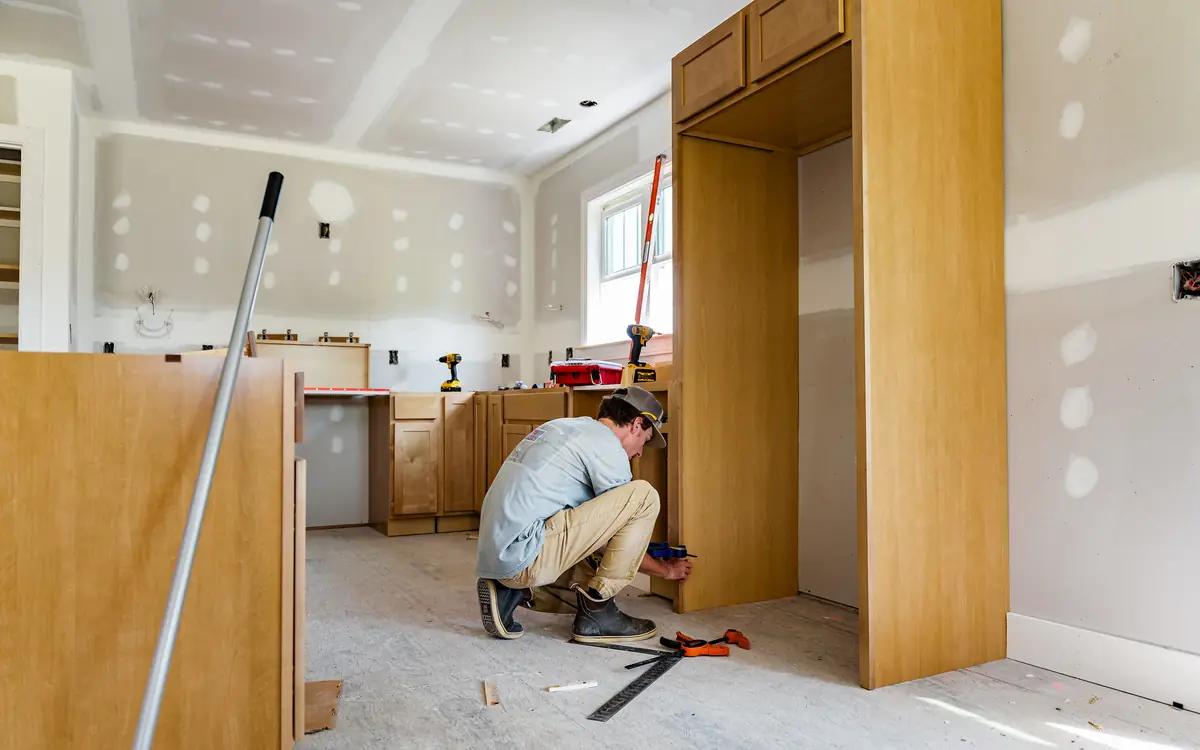
The job
Modelled, not recorded. Every figure here is the answer the Deck Board Calculator gives for these inputs, written down in both unit systems and re-run whenever the site is built. No job was carried out, so there is no measured overrun on this page.
The deck is attached to the back of the house: 16 ft (4.88 m) along the wall and 12 ft (3.66 m) out into the yard, room for a table and chairs with space to walk round them. The joists run out from the house, so the boards run the other way, parallel to the wall, and each row of boards runs the full 16 ft length of the deck.
The boards are bought at 16 ft, the stock length that matches the deck's length exactly, so every row is one board with no butt joint in it. That is the choice the calculator is most sensitive to, and the section on changing the job shows what happens when the stock length is shorter than the deck.
The boards are the common five-quarter decking the calculator's source describes, with an actual face width a little under the nominal one and a gap between boards for drainage and seasonal movement. The calculator uses that face width and gap to count the rows; a wider or narrower board, or a hidden-fastener system with its own gap, would change the rows.
The inputs, exactly as entered
| Input | Value | Why |
|---|---|---|
| Deck Length | 16 ft (4.88 m) | Along the house wall, the direction the boards run, from one end of the rim joist to the other. |
| Deck Width | 12 ft (3.66 m) | Out from the house, across the joists, which sets how many rows of board the deck takes. |
| Board Length | 16 ft (4.8 m (~16 ft)) | Chosen to match the deck's length, so each row is one board. |
The working, step by step
1. Deck area
192 sq ft (17.84 m²)
Length times width gives 192 sq ft. The area is shown for reference, because it is how decks are usually described, but the boards are not counted from it: a deck board is a row, not a share of an area.
2. Rows of boards (across width)
26 rows
The width divided by one board's face plus its gap, rounded up, gives 26 rows. The last row is often ripped narrower to finish flush at the outer rim, and it still takes a full board, which the round-up allows for.
3. Boards per row (along length)
1 board
The deck's length divided by the stock length, rounded up, gives 1 board for each row. With a board exactly as long as the deck, the ends are trimmed square after fastening and nothing is joined, which is the neatest and strongest way to board a deck.
Estimated deck board needed
26 boards
The order is 26 boards at 16 ft. The calculator has no waste input, because it counts whole boards row by row, so add a few for culls: boards that are split, badly bowed or marked are set aside at the yard or on site, and composite boards that must match in colour should all come from one run. Fasteners, joist tape and the fascia that covers the rim are separate purchases with calculators of their own.
What to buy
| Quantity | Figure | What it is for |
|---|---|---|
| Estimated deck board needed | 26 boards | Deck boards at the stock length entered, one per row; add a few spares for culls. |
The allowance, and what it does here
There is no percentage on this calculator: the count is rows times boards per row, and the round-ups in both are the allowance. On this deck the only offcut is the square trim at the board ends and the strip ripped off the last row. A deck whose length does not match a stock length is where waste really appears, as the shorter-board variant below shows, and a deck on a diagonal or with a picture-frame border wastes far more and needs counting by hand.
The common mistake
Buying the cheapest board length without checking the deck
Shorter boards are easier to carry and often cheaper by the piece, so it is tempting to buy them by default. The count is not an area divided by a board: each row needs enough boards to reach the full length, and a board that falls short by a few feet means a second board in every row, most of it cut off. On this deck the shorter stock length doubles the number of boards. Match the stock length to the deck's length, or to a fraction of it that lands on joists, before choosing on price.
Change the job, and see what moves
The same deck, in shorter boards
Board Length: 12 ft (3.6 m (~12 ft)) → 52 boards
Buy the boards at 12 ft instead and each row needs 2 boards, so the order doubles to 52 boards. The second board in each row covers only the last few feet; the rest is offcut, and every row also gains a butt joint that has to land on a joist.
A deck that projects further from the house
Deck Width: 14 ft (4.27 m) → 30 boards
Build the deck 14 ft out from the house and it takes 30 boards: the rows rise to 30 rows while each row is still one board. Depth adds boards in proportion; length, as long as it stays within one stock length, adds nothing to the count but the board's length.
What to run next
- Deck Screws Calculator
Every board is fastened at every joist, and the screws or clips are counted from the boards and the joist spacing.
- Deck Joist Span and Size Calculator
The joists the boards sit on are sized and spaced for their span, which sets where the board ends can land.
- Deck Footing Calculator
The posts and footings that carry the beam are counted and sized from the same deck's plan.
Sources
The method and every constant behind these figures belong to the Deck Board Calculator, version 1.0.1, last verified 2026-09-05. It rests on:
- A standard 5/4x6 deck board has an actual width of about 5.5 in; a 1/8-1/4 in gap between boards is standard for drainage and seasonal expansion
Frequently asked questions
- How many deck boards for a 16 by 12 ft deck?
- With 16 ft boards running the length, 26 boards: 26 rows across the width, one board each. Add a few for culls.
- Should deck boards be the same length as the deck?
- Where a stock length matches, yes: each row is one board with no joint. On this deck, boards one stock size shorter double the order to 52 boards.
- How is the number of rows worked out?
- From the deck's width, the board's actual face width and the drainage gap between boards, rounded up: 26 rows for this deck.