
SettingsSettings for this calculationUS
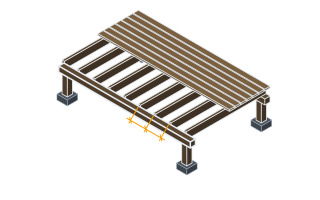
The length of the deck in the direction the boards run.
Measure along the direction your deck boards will be laid.
Tools needed: Tape measure
The width of the deck, perpendicular to the board direction.
Measure perpendicular to the length.
Tools needed: Tape measure
The length of deck board stock you plan to buy.
Longer boards mean fewer seams but cost more per board and are harder to handle.
Estimated deck board needed
56 boards
- Deck area
- 253.5 sq ft
- Rows of boards (across width)
- 28 rows
- Boards per row (along length)
- 2 boards
They open the calculator with your figures already in it
Deck Board Calculator: 56 boards — shown in imperial, US market. The link sets both, so the result they see is the one on your screen.
Show calculation logicHide calculation logic
How this was calculated
Formula source(s)
- A standard 5/4x6 deck board has an actual width of about 5.5 in; a 1/8-1/4 in gap between boards is standard for drainage and seasonal expansion
Inputs used
- Deck Length
- 19.5 ft
- Deck Width
- 13 ft
- Board Length
- 12 ft
Intermediate steps
- Deck area
- 253.5 sq ft
- Rows of boards (across width)
- 28 rows
- Boards per row (along length)
- 2 boards
What this calculation does not cover
- Board width and the gap between boards are fixed together as a single 5.625 in pitch — a 5.5 in board plus a 1/8 in drainage gap — and neither is offered as an input, so the row count only describes nominal 5/4x6 stock. Narrower composite or hardwood boards change it quickly: at 5.25 in wide the same deck needs about 5 per cent more rows, and the wider gap that grooved hidden-fastener clips set gives you fewer.
- Boards per row is worked out once and then multiplied by the number of rows, so an offcut is never carried across to start the next row. On the default 6 m deck that is two full 12 ft boards bought for every one of the 28 rows and a 4.3 ft tail discarded 28 times, when in practice many of those tails would be reused — whether they can be depends on the seams landing on a joist and on how you stagger them, and neither is modelled here.
- No waste, breakage or cutting allowance is added anywhere in the figure. Boards culled at the yard for crown, cup or splits, the ripping the outermost row usually needs to bring the deck to its finished width, and cuts around posts, notches and openings all come out of the same count, so ordering exactly this number leaves nothing to reject.
- The footprint is treated as one plain rectangle with every board running the same way: area is length times width, and rows come straight off the width figure. An L-shaped or wrapped deck has to be entered as separate rectangles and the counts added, and any surface where the boards turn to run the other way has to be worked out on its own, because the width input is what defines the direction rows are counted in.
- The board-length choices are held in feet and the metric labels are rounded: choosing 2.4 m (~8 ft) still puts a full 8 ft into the arithmetic, which is 2.4384 m and about 1.6 per cent longer than the board you would actually be handed. On a deck length that only just divides into the nominal figure, that difference is enough to leave each row one board short.
- The square-foot figure in the breakdown is the gross rectangle, not the timber it takes to cover it — roughly one part in 45 of that surface is drainage gap once the boards are down. Pricing decking from the area and pricing it from the board count will not agree, and the board count is the one to order from.
Estimated cost — your price
This site holds no price list for this material — local prices vary too much to publish honestly. Enter your supplier's price and the result is costed with it.
Part of bigger jobs
This trade is one line of a job takeoff. Run the whole job and every other trade comes back with it, off the same measurements.
Or plan the space itself: measure it once, doors and windows included, and this figure comes back worked out on that space, with what goes with it.
also measuresDeck FootingDeck ScrewsDeck Stain
Computed in your browser — nothing you enter is uploaded. Presented in US customary units and US trade terminology. Where a formula follows a published standard, that standard and its edition are cited beside it on this page; where none governs, the page says so. Local amendments override model codes — verify against the code in force where you build.
Sources checked 2026-09-05 · in the site-wide review of 2026-09-06 · v1.0.1
Regulatory standards & verification citations1
- A standard 5/4x6 deck board has an actual width of about 5.5 in; a 1/8-1/4 in gap between boards is standard for drainage and seasonal expansion
Cite this page
Your workspace
Most jobs need more than one number. Add the calculators you need next and they open right here, underneath this one — your figures stay on screen and nothing is lost to a page change.
Tools and safety for this job
To cut framing lumber and frame joists and a deck. Generic types, no brands, no prices.
Protection this work requires
- Hardwood dust is a recognised carcinogen: extract at the tool and wear a P2/N95 respirator when cutting or sanding indoors.
- Saws, grinders and breakers run above 85 dB, where hearing damage accumulates and does not recover: defenders or plugs for every cut, not just the long ones.
- Boards, blocks and bagged material cause most lasting back injuries on small sites: two people or a lifter for full sheets, and never a bag on one shoulder up a ladder.
- Most fatal falls on small jobs are from under three metres: use a tower or a ladder tied at the top, and never work off the top two rungs.
Show the 10 tools this job needsHide tools
Essential
Circular saw
Claw hammer
Combination or framing square
Cordless drill/driver
Spirit level
Tape measure
Recommended
Impact driver
Mitre saw
String line and pins
Optional
Hand saw
Also needed as materials: circular saw blades, drill and driver bits, impact driver bits, mitre saw blades.
what each carpentry tool is for, and the spec that decides which to buy where one does.