
SettingsSettings for this calculationUS
The outline of the water surface seen from above.
Pick the outline that matches the water from above. An oval comes two ways: a true ellipse curves all the way round, while most above-ground ovals and plenty of in-ground ones have two straight sides with a half-circle at each end, and that one holds more water for the same length and width. A shape not listed, such as an L or a freeform, can be split into pieces this page does take, worked one at a time and added together.
The length of the pool.
Measure the water surface length, inside the walls rather than over the coping.
The width of the pool.
Measure perpendicular to the length.
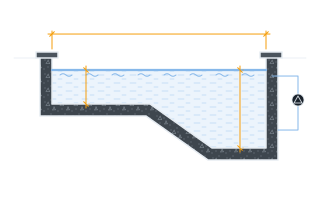
Work the volume at one depth, or at the average of a shallow end and a deep end.
Most above-ground pools and many plunge and lap pools are one depth throughout. A pool that runs down from a shallow end to a deep end is worked the way the Pool & Hot Tub Alliance's operator handbook works it: at the average of the two end depths.
The water depth, or the average depth if you already know it.
Measure from the water line, which usually sits a little below the coping or the top of the wall, down to the floor. For a pool with a consistent depth (like most above-ground pools), use that single depth; for one with a shallow end and a deep end, choose the sloping floor instead and enter both.
Estimated pool volume
20,370 gallons
A rectangle's water surface is its length times its width. The depth entered is applied across the whole of that area. The volume is that area times the depth.
- Volume in cubic feet
- 2,722.5 ft³
- Water surface area
- 544.5 sq ft
- Depth the volume is worked at
- 5 ft
They open the calculator with your figures already in it
Pool Volume Calculator (Rectangular, Round, Oval or Kidney): 20,366 gallons — shown in imperial, US market. The link sets both, so the result they see is the one on your screen.
Show calculation logicHide calculation logic
How this was calculated
Formula source(s)
- Pool volume (gallons) = length x width x average depth (all in ft) x 7.4805 US gallons per cubic ft, the exact 1,728 ÷ 231 (a US gallon is 231 cubic inches)
- Pool & Hot Tub Alliance (PHTA), Pool & Spa Operator Handbook (© 2021), Appendix B-4, Conversion & Calculation Guide: Average Depth = (Shallow Depth + Deep Depth) ÷ 2; Volume Circle (gallons) = 3.14 × radius × radius × Avg. Depth × 7.5; Volume Oval (gallons) = Short Radius × Long Radius × 3.14 × Avg. Depth × 7.5; Volume Kidney (gallons) = (Width A + Width B) × Length × 0.45 × Avg. Depth × 7.5, dimensions in feet, with a reference to the handbook's Figure 3-3 for the kidney (not reproduced here). This page uses π for 3.14 and the exact 7.4805 US gallons per cubic foot for 7.5
- Hayward, Chemistry Quick Start Guide (092510 Rev A), Step 1, Calculate Pool Volume: rectangular L × W × average depth × 7.5 (gallons, feet) or × 1000 (litres, metres); round D × D × average depth × 5.9 or × 785; oval L × W × average depth × 6.7 or × 893
- Plane geometry of an oval with straight sides: two half-circles of diameter W joined by a W × (L − W) rectangle cover W(L − W) + πW²/4, which at L = 2W is (1 + π/4)/2 = 0.893 of L × W; 0.893 × 7.5 = 6.70, which matches, to the figures printed, the 6.7 Hayward's guide gives an oval (Hayward does not say which oval it means)
Inputs used
- Pool Shape
- Rectangle
- Pool Length
- 33 ft
- Pool Width
- 16.5 ft
- Pool Diameter
- 18 ft
- Oval Length, End to End
- 30 ft
- Oval Width, Side to Side
- 15 ft
- Overall Length, Including Both Rounded Ends
- 30 ft
- Width Between the Straight Sides
- 15 ft
- Kidney Length, End to End
- 30 ft
- Width Across the Larger Lobe (A)
- 15 ft
- Width Across the Smaller Lobe (B)
- 11.5 ft
- Floor
- One depth: a flat floor, or an average depth you already know
- Average Depth
- 5 ft
- Shallow-End Water Depth
- 3.5 ft
- Deep-End Water Depth
- 6.5 ft
Intermediate steps
- Volume in cubic feet
- 2,722.5 ft³
- Water surface area
- 544.5 sq ft
- Depth the volume is worked at
- 5 ft
Confidence note: A rectangle's water surface is its length times its width. The depth entered is applied across the whole of that area. The volume is that area times the depth.
What this calculation does not cover
- One depth is applied across the whole plan, whether it is typed in or worked from the two ends. Averaging the shallow-end and deep-end figures is exact only where the floor falls at one steady rate from end wall to end wall, or where the shallow and deep sections cover equal plan area. On the usual arrangement - a large flat shallow section, a slope, then a smaller deep end - the plain average overstates the volume, and everything built on that figure inherits the overstatement in the same direction.
- Nothing inside the outline is deducted. Steps, benches, tanning ledges, swim-outs, beach entries and coved or radiused corners all occupy space this calculation fills with water. A plan that is none of the five shapes here - an L, a lazy L, a Roman or Grecian end, a true freeform - is outside the model; split it into pieces the page does take, work each at its own depth and add them.
- Only the water standing in the pool basin is counted. Pipework, skimmers, the filter, the heater and any attached spa, balance tank or vanishing-edge catch basin hold further water that circulates through the system and has to be dosed with it, and none of that appears in this figure.
- This is a capacity estimate, not a dosing instruction. How much of any product to add depends on its active strength, your current test readings and your target concentration, and an overstated volume overdoses every time it is used. Dose once, circulate a full turnover, then test before dosing again - never dose twice off the same volume figure.
- The fill itself is not covered: no source flow rate, no fill time, no metered water cost, and no account of the hardness, alkalinity or metal content of the incoming water, which is what sets the pool's starting chemistry and how much correction it needs on day one.
Estimated cost — your price
This site holds no price list for this material — local prices vary too much to publish honestly. Enter your supplier's price and the result is costed with it.
Part of a bigger job
This trade is one line of a job takeoff. Run the whole job and every other trade comes back with it, off the same measurements.
also measuresPool Cover & Liner AreaPaverPaver Edging
Computed in your browser — nothing you enter is uploaded. Presented in US customary units and US trade terminology. Where a formula follows a published standard, that standard and its edition are cited beside it on this page; where none governs, the page says so. Local amendments override model codes — verify against the code in force where you build.
Sources checked 2026-10-05 · v1.1.0
Regulatory standards & verification citations4
- Pool volume (gallons) = length x width x average depth (all in ft) x 7.4805 US gallons per cubic ft, the exact 1,728 ÷ 231 (a US gallon is 231 cubic inches)
- Pool & Hot Tub Alliance (PHTA), Pool & Spa Operator Handbook (© 2021), Appendix B-4, Conversion & Calculation Guide: Average Depth = (Shallow Depth + Deep Depth) ÷ 2; Volume Circle (gallons) = 3.14 × radius × radius × Avg. Depth × 7.5; Volume Oval (gallons) = Short Radius × Long Radius × 3.14 × Avg. Depth × 7.5; Volume Kidney (gallons) = (Width A + Width B) × Length × 0.45 × Avg. Depth × 7.5, dimensions in feet, with a reference to the handbook's Figure 3-3 for the kidney (not reproduced here). This page uses π for 3.14 and the exact 7.4805 US gallons per cubic foot for 7.5
- Hayward, Chemistry Quick Start Guide (092510 Rev A), Step 1, Calculate Pool Volume: rectangular L × W × average depth × 7.5 (gallons, feet) or × 1000 (litres, metres); round D × D × average depth × 5.9 or × 785; oval L × W × average depth × 6.7 or × 893
- Plane geometry of an oval with straight sides: two half-circles of diameter W joined by a W × (L − W) rectangle cover W(L − W) + πW²/4, which at L = 2W is (1 + π/4)/2 = 0.893 of L × W; 0.893 × 7.5 = 6.70, which matches, to the figures printed, the 6.7 Hayward's guide gives an oval (Hayward does not say which oval it means)
Cite this page
Your workspace
Most jobs need more than one number. Add the calculators you need next and they open right here, underneath this one — your figures stay on screen and nothing is lost to a page change.