
SettingsSettings for this calculationUS
Which figure leads the answer. Both are worked out every time and shown below it.
The water is what the pump's turnover, any treatment and fish stocking are worked from. The liner is what you buy before any of that, and it is a sheet much larger than the pond's surface, because it has to line the sides and lie on the ground around the edge as well.
The outline of the water seen from above.
Rectangular and round ponds are worked exactly. An irregular pond is anything with no constant width, such as a kidney, a figure of eight or a natural outline. For its water the page uses the average of several lengths and the average of several widths, which Penn State Extension rates as typically within plus or minus 20%; for its liner it uses the longest and the widest, because the sheet has to cover the whole hole.
The longer side of the water, measured at the top of the hole.
Measure the finished water surface, inside the edge, not the outside of the edging stones.
Tools needed: Tape measure
The shorter side of the water, at right angles to the length.
For a square pond, the same as the length.
Tools needed: Tape measure
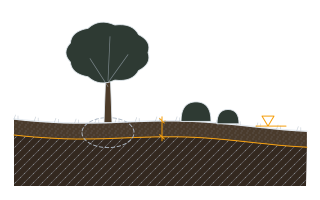
From ground level at the edge down to the lowest point of the hole. The liner is sized on this.
Measure from a straightedge laid across the top of the hole to the deepest part of the floor. The makers' rule adds twice this to each dimension: the sheet goes down one side and up the other. Shelves and sloping sides need nothing added: over a hole that steps down to its deepest point and back up, the sheet never needs more than the rule. A pond deeper than it is wide still follows the rule; its sheet is mostly sides.
Tools needed: Tape measure, Straightedge or spirit level
The depth of water averaged over the whole pond, shelves and slopes included. The water is worked from this.
Shelves for marginal plants and sloping sides make the average well less than the deepest point. A straight-sided pond with a flat floor has an average equal to its deepest point. For "a typical bowl-shaped pond", Penn State Extension estimates the average depth as 0.4 times the maximum depth.
How far the liner lies flat on the ground beyond the water's edge, at each side.
The overlap is what the edging stones or turf hold down. Pontec's rule allows 50 cm (20 in) at each edge. Anjon adds 2 ft (61 cm) to each dimension, which the page reads as 1 ft (30 cm) of overlap at each edge. A pond edged with heavy stone or a wide beach can take more, and a liner tucked into a trench under turf needs enough to reach the trench.
Pond water or liner sheet
972.5 gal
The water is the length times the width times the average depth. The liner is each side of the pond plus twice the deepest point and the overlap at both edges: the sheet the makers' rule gives, enough for any hole that steps down to its deepest point and back up, with the overlap lying on the ground all round.
- Water the pond holds
- 972.47 gal
- Water surface area
- 65 ft²
- Liner sheet length
- 18 ft
- Liner sheet width
- 14.5 ft
- Liner sheet area
- 261 ft²
They open the calculator with your figures already in it
Pond Volume and Liner Size Calculator: 972 gal — shown in imperial, US market. The link sets both, so the result they see is the one on your screen.
Show calculation logicHide calculation logic
How this was calculated
Formula source(s)
- Anjon Manufacturing (maker of LifeGuard EPDM and PolyGuard PVC pond liners), Pond Liner: Pond Length ft + (Depth ft x 2) + 2 ft = Liner Length, and Pond Width ft + (Depth ft x 2) + 2 ft = Liner Width; a finished pond 12 ft long, 7 ft wide and 3 ft deep needs a 20 x 15 ft liner; the basic formula works for all pond shapes
- Pontec (an OASE brand), Calculating the pond size: length + 2 x depth (at the deepest point of the excavation) + 2 x 50 cm = length of the liner, and width + 2 x depth (at the deepest point of the excavation) + 2 x 50 cm = width of the liner
- Penn State Extension, Bryan R. Swistock and Tom McCarty, Pond Measurements: Area, Volume and Residence Time (updated 19 May 2025): for an irregular pond, measure numerous lengths and widths and multiply their averages (typically within ±20%), or divide it into trapezoids (±5–10%), or map its edge by GPS (about 1%); "For a typical bowl-shaped pond the average depth can be estimated as 0.4 times the maximum depth"
- Geometry and units: a round pond's water surface is π/4 times its diameter squared, the volume is the plan area times the average depth, and one cubic metre is 1,000 litres
Inputs used
- Answer
- The water the pond holds
- Pond Shape
- Rectangular or square
- Pond Length
- 10 ft
- Pond Width
- 6.5 ft
- Pond Diameter
- 8 ft
- Longest Distance Across
- 13 ft
- Widest Distance Across
- 10 ft
- Average Length (of Several Measured)
- 11 ft
- Average Width (of Several Measured)
- 7 ft
- Depth at the Deepest Point
- 3 ft
- Average Water Depth
- 2 ft
- Liner Overlap at Each Edge
- 12 in
Intermediate steps
- Water the pond holds
- 972.47 gal
- Water surface area
- 65 ft²
- Liner sheet length
- 18 ft
- Liner sheet width
- 14.5 ft
- Liner sheet area
- 261 ft²
Confidence note: The water is the length times the width times the average depth. The liner is each side of the pond plus twice the deepest point and the overlap at both edges: the sheet the makers' rule gives, enough for any hole that steps down to its deepest point and back up, with the overlap lying on the ground all round.
What this calculation does not cover
- The liner is the sheet the makers' rule gives: the pond's length and width, twice the deepest point and an overlap at each edge. It is enough for any hole that steps down to its deepest point and back up, shelves included: a rope laid across such a hole, down every face and over every shelf, is never longer than the length plus twice the depth, matching it where every face is vertical and every shelf level, and shorter where the sides slope. A hole the rule does not describe can need more: a shelf with a raised lip, a wall that leans in under the edge, or edges at different heights. For one of those, lay a rope or a hose across the dug hole along its longest and widest lines, out to the overlap at each end, and measure the rope.
- The sheet is the size the hole needs, not a size anybody sells. Liners come in set widths and lengths that differ from maker to maker, so round each dimension up to the next size your supplier stocks, and keep the longer side of the sheet along the longer side of the pond.
- For an irregular pond the water is worked from the average length and the average width, the quick method Penn State Extension gives for irregular ponds and rates as typically within plus or minus 20%. Measure more lines across the pond and the average improves; for a closer figure, take the plan area from the Irregular Area Calculator's offsets method, or fill the pond through a water meter and read the volume off it.
- The average depth is yours, and it is the figure most likely to be off. Shelves for marginal plants, sloping sides and a deep zone in the middle all pull it below the deepest point. For "a typical bowl-shaped pond", Penn State Extension estimates the average depth as 0.4 times the maximum depth; a garden pond with steep walls and narrow shelves sits nearer its deepest point than that.
- The figure is the pond itself. A pump chamber, a filter box, a waterfall, a stream and the pipework between them hold more water that circulates with it, and pump turnover and any dose of treatment are worked on the whole system rather than the pond alone.
- Nothing here sizes the excavation, the underlay or the edging. The hole is dug a little larger than the finished water to take the underlay and any sand or soft blinding, the spoil bulks up once it is out of the ground, and the overlap is held down by the edging stones or turf the liner is tucked under.
Estimated cost — your price
This site holds no price list for this material — local prices vary too much to publish honestly. Enter your supplier's price and the result is costed with it.
Computed in your browser — nothing you enter is uploaded. Presented in US customary units and US trade terminology. Where a formula follows a published standard, that standard and its edition are cited beside it on this page; where none governs, the page says so. Local amendments override model codes — verify against the code in force where you build.
Sources checked 2026-10-05 · v1.0.0
Regulatory standards & verification citations4
- Anjon Manufacturing (maker of LifeGuard EPDM and PolyGuard PVC pond liners), Pond Liner: Pond Length ft + (Depth ft x 2) + 2 ft = Liner Length, and Pond Width ft + (Depth ft x 2) + 2 ft = Liner Width; a finished pond 12 ft long, 7 ft wide and 3 ft deep needs a 20 x 15 ft liner; the basic formula works for all pond shapes
- Pontec (an OASE brand), Calculating the pond size: length + 2 x depth (at the deepest point of the excavation) + 2 x 50 cm = length of the liner, and width + 2 x depth (at the deepest point of the excavation) + 2 x 50 cm = width of the liner
- Penn State Extension, Bryan R. Swistock and Tom McCarty, Pond Measurements: Area, Volume and Residence Time (updated 19 May 2025): for an irregular pond, measure numerous lengths and widths and multiply their averages (typically within ±20%), or divide it into trapezoids (±5–10%), or map its edge by GPS (about 1%); "For a typical bowl-shaped pond the average depth can be estimated as 0.4 times the maximum depth"
- Geometry and units: a round pond's water surface is π/4 times its diameter squared, the volume is the plan area times the average depth, and one cubic metre is 1,000 litres
Cite this page
Your workspace
Most jobs need more than one number. Add the calculators you need next and they open right here, underneath this one — your figures stay on screen and nothing is lost to a page change.