
SettingsSettings for this calculationUS
The maximum bending moment the beam must resist.
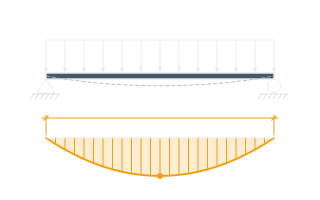
This is typically the maximum moment from your beam's load and span analysis (e.g. wL²/8 for a simply-supported uniformly loaded beam).
The beam's cross-sectional width (the narrower dimension).
The ACTUAL dressed width, not the nominal — a 2× timber is about 38 mm and calling it 50 over-states the section by a third. Width contributes linearly to bending strength while depth contributes as the square, which is why timber beams are deep and narrow and why doubling up a member is a weaker answer than a deeper one at the same volume of timber.
The beam's cross-sectional depth (the dimension parallel to the bending load).
The actual dressed depth, in the direction the load bends it — a beam laid flat is a different and far weaker member than the same timber on edge. Section modulus goes with the square of this, so 15% of depth is about 30% of strength: a beam ripped down or notched at mid-span loses capacity fast, which is what the notch calculation on this site is for.
Actual bending stress
1,442 psi
They open the calculator with your figures already in it
Timber Beam Bending Stress Calculator: 1,442 psi — shown in imperial, US market. The link sets both, so the result they see is the one on your screen.
Show calculation logicHide calculation logic
How this was calculated
Formula source(s)
- Rectangular section bending stress: fb = 6M/(b×d²), the standard flexure formula (fb = Mc/I) applied to a rectangular cross-section
Inputs used
- Applied Bending Moment
- 11.06 kip·ft
- Beam Width
- 4 in
- Beam Depth
- 11.75 in
What this calculation does not cover
- The figure returned is the stress demand on the section, not a verdict on the beam. Nothing here compares it against the bending strength of your species and grade, and none of the modification factors are applied — load duration and wet service under the NDS, kmod and the material partial factor under Eurocode 5. Under Eurocode 5 those two alone typically cut the characteristic bending strength to around 60 percent of its value, and the factors themselves are jurisdictional.
- Bending is only one of the checks a timber beam has to pass. This page does not calculate shear stress, which for a rectangular section is 3V/(2bd) and commonly governs on short heavily loaded spans, nor deflection, which usually governs on long ones and is limited by span ratios such as span/360 for imposed load depending on the jurisdiction. Bearing stress at the supports is also outside its scope.
- The flexure formula assumes the compression edge is held against sideways movement. A deep, narrow beam loaded on edge with an unrestrained compression edge can fail by lateral torsional buckling at a moment well below the one this stress figure implies is safe, which is why codes apply a beam stability factor (CL in the NDS, kcrit in Eurocode 5). No such reduction is made here.
- The calculation uses the full uncut rectangle you type in. Notches, birdsmouths, bolt holes and drilled service holes reduce the section modulus, and a notch on the tension face adds a stress concentration that simply reducing the depth does not represent, which is why code rules restrict notch depth and position. Enter actual dressed dimensions as well: a nominal 2x10 measures 1.5 by 9.25 inches (38 by 235 mm), and using the nominal figures understates the bending stress by about a third.
- Depth must be the dimension in the plane of the load, not just the larger one. Entering a 100 by 300 mm joist the wrong way round — 300 wide by 100 deep, as if laid flat — triples the reported stress, and the calculator cannot tell which orientation you meant. Every box follows the unit switch — the moment in kN·m or kip·ft, the section in millimetres or inches — and the stress comes back in MPa or psi.
Add the equipment this sizes
This result is a specification — 1,442 psi — not a quantity. Put the thing it sizes into your project: how many, what you call it, and your supplier’s price.
Computed in your browser — nothing you enter is uploaded. Presented in US customary units and US trade terminology. Where a formula follows a published standard, that standard and its edition are cited beside it on this page; where none governs, the page says so. Local amendments override model codes — verify against the code in force where you build.
Sources checked 2026-09-22 · v1.1.0
Regulatory standards & verification citations1
- Rectangular section bending stress: fb = 6M/(b×d²), the standard flexure formula (fb = Mc/I) applied to a rectangular cross-section
Cite this page
Your workspace
Most jobs need more than one number. Add the calculators you need next and they open right here, underneath this one — your figures stay on screen and nothing is lost to a page change.