
SettingsSettings for this calculationUS
The total internal volume of the medical gas pipeline being purged.
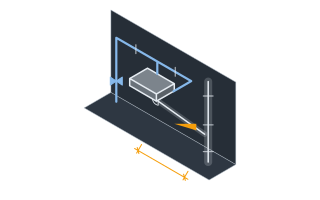
Compute this from the pipe's internal diameter and total run length across all branches being commissioned before applying the purge multiplier.
How many times the pipe's internal volume of inert gas is pushed through during the purge.
NFPA 99 medical gas and vacuum systems practice calls for purging piping with an inert gas, typically nitrogen, at several times the pipe's internal volume before placing it into service.
Nitrogen purge volume needed
25 gal
Confirm the exact purge multiplier and procedure required by NFPA 99 and your medical gas verifier for the specific system and commissioning requirements — this is a general estimating multiplier, not a substitute for the certified installer's commissioning procedure.
They open the calculator with your figures already in it
Medical Gas Pipeline Nitrogen Purge Volume Calculator: 25 gal — shown in imperial, US market. The link sets both, so the result they see is the one on your screen.
Show calculation logicHide calculation logic
How this was calculated
Formula source(s)
- Purge volume = internal pipe volume × purge multiplier, following NFPA 99 medical gas and vacuum systems practice of purging piping with an inert gas (typically nitrogen) at several times the pipe's internal volume before placing it into service
Inputs used
- Internal Pipe Volume
- 5 gal
- Purge Volume Multiplier (Typically 5-10× Pipe Volume)
- 5
Confidence note: Confirm the exact purge multiplier and procedure required by NFPA 99 and your medical gas verifier for the specific system and commissioning requirements — this is a general estimating multiplier, not a substitute for the certified installer's commissioning procedure.
What this calculation does not cover
- The purge that dominates the nitrogen order is not this one. Every medical gas joint is brazed with nitrogen flowing continuously through the tube to stop copper oxide scale forming on the inside, and that flow runs for the whole of every brazing operation across the entire installation — governed by braze hours and flow rate, not by pipe volume. On a full pipeline it is normally several times the displacement purge computed here.
- The answer is free gas at atmospheric pressure, which is not what is inside the cylinder. Nitrogen arrives compressed, so a 50-liter cylinder at 150 bar holds roughly 7,500 liters (1,981 gal) of free gas — cylinder water volume times pressure in bar. Ordering bottles straight off this figure without that conversion brings either a truckload too many or one too few.
- Any nitrogen will not do. Purge and braze gas for a medical pipeline has to be oil-free dry nitrogen of the grade the standard names, because industrial and welding nitrogen can carry oil mist and moisture — and putting that through tube that will later deliver oxygen to a patient contaminates the system in precisely the way the particulate and purity tests at verification exist to catch.
Estimated cost — your price
This site holds no price list for this material — local prices vary too much to publish honestly. Enter your supplier's price and the result is costed with it.
Computed in your browser — nothing you enter is uploaded. Presented in US customary units and US trade terminology. Where a formula follows a published standard, that standard and its edition are cited beside it on this page; where none governs, the page says so. Local amendments override model codes — verify against the code in force where you build.
Sources checked 2026-09-06 · in the site-wide review of 2026-09-06 · v1.0.1
Regulatory standards & verification citations1
- Purge volume = internal pipe volume × purge multiplier, following NFPA 99 medical gas and vacuum systems practice of purging piping with an inert gas (typically nitrogen) at several times the pipe's internal volume before placing it into service
Which documents these citations point at
Standards referenced: NFPA 99 (National Fire Protection Association, United States).
Cite this page
Your workspace
Most jobs need more than one number. Add the calculators you need next and they open right here, underneath this one — your figures stay on screen and nothing is lost to a page change.