
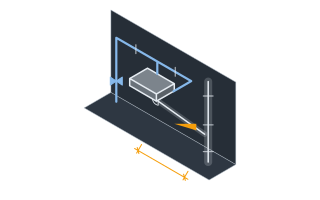
SettingsSettings for this calculationUS
The total length of the pipe run.
Measure the full length of the pipe run carrying the flow, from source to fixture or point of use.
The design flow rate through the pipe.
Use the peak or design flow rate expected in this pipe run, in the unit shown.
The pipe material's Hazen-Williams roughness coefficient.
Higher C values represent smoother pipes with less friction loss per unit length; older, corroded, or rougher pipes use a lower C value.
The pipe's actual internal (bore) diameter.
Use the pipe's internal diameter, not its nominal size or outside diameter — this can differ noticeably by pipe material and schedule.
Friction head loss
17.96 ft
They open the calculator with your figures already in it
Domestic Water Pipe Friction Loss Calculator (Hazen-Williams): 17.96 ft — shown in imperial, US market. The link sets both, so the result they see is the one on your screen.
Show calculation logicHide calculation logic
How this was calculated
Formula source(s)
- Hazen-Williams equation (SI units): hf = 10.67 × L × Q^1.852 ÷ (C^1.852 × D^4.8704), where L is pipe length (m), Q is flow rate (m³/s), C is the Hazen-Williams roughness coefficient, and D is the pipe's internal diameter (m)
Inputs used
- Pipe Length
- 165 ft
- Flow Rate
- 79 gal/min
- Hazen-Williams Coefficient C (150 for New Copper/Plastic, 140 for New Steel)
- 150
- Internal Pipe Diameter
- 2 in
What this calculation does not cover
- Hazen-Williams is an empirical fit to cold water in turbulent flow, roughly 40 to 75 °F (4 to 24 °C) at velocities in the 2 to 10 ft/s (0.6 to 3 m/s) band. Outside that it drifts: glycol-charged loops, hot recirculating mains and low-flow trickles are Darcy-Weisbach problems, where viscosity enters the calculation instead of being absorbed into a single C value. The formula still returns a number for any of them; it is just not the loss you will measure.
- Head loss is one term of the pressure the fixture actually sees. What is available is the incoming main, less the static lift to the outlet, less this friction, less the fittings, and less every device in the line — a meter, a backflow preventer, a filter and a softener can take 20 to 30 psi (207 kPa) between them. A run whose friction loss looks comfortable here can still open at a shower with nothing left.
- Velocity is not reported, and velocity is often what sizes the pipe rather than head loss. Copper is normally held near 8 ft/s cold and 5 ft/s or less on hot recirculating lines, because water moving faster erodes the inside of elbows and tees over the years and makes the pipe audible in the wall. A small pipe on a short run can pass a friction check comfortably and still be the wrong size.
Computed in your browser — nothing you enter is uploaded. Presented in US customary units and US trade terminology. Where a formula follows a published standard, that standard and its edition are cited beside it on this page; where none governs, the page says so. Local amendments override model codes — verify against the code in force where you build.
Sources checked 2026-09-06 · in the site-wide review of 2026-09-06 · v1.1.1
Regulatory standards & verification citations1
- Hazen-Williams equation (SI units): hf = 10.67 × L × Q^1.852 ÷ (C^1.852 × D^4.8704), where L is pipe length (m), Q is flow rate (m³/s), C is the Hazen-Williams roughness coefficient, and D is the pipe's internal diameter (m)
Cite this page
Your workspace
Most jobs need more than one number. Add the calculators you need next and they open right here, underneath this one — your figures stay on screen and nothing is lost to a page change.