
SettingsSettings for this calculationUS
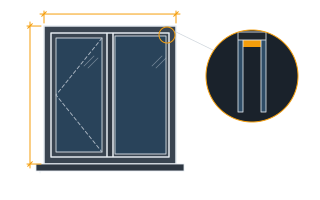
The face area of the glass panes in the sealed unit.
Use the visible glass area of one insulated glass unit — the sealed cavity spans this same area between the two panes.
The width of the sealed air/gas gap between the two panes, set by the spacer bar.
This matches the spacer bar width — a wider gap holds more argon per unit area.
Argon fill volume needed
5.032 gal
They open the calculator with your figures already in it
Insulated Glass Unit Argon Gas Fill Volume Calculator: 5.03 gal — shown in imperial, US market. The link sets both, so the result they see is the one on your screen.
Show calculation logicHide calculation logic
How this was calculated
Formula source(s)
- Argon fill volume = glass area × cavity gap thickness, the standard method for estimating inert gas fill volume in a sealed IGU cavity
Inputs used
- Glass Area (per Unit)
- 16.15 sq ft
- Cavity Gap Thickness
- 0.5 in
What this calculation does not cover
- This is one cavity. A triple-glazed unit has two, so a figure computed once is half what that unit takes — and the second gap often has a different spacer width from the first, so run the calculation twice and add rather than doubling. Nothing on the page asks how many panes the unit has.
- The fill volume is what goes in, not what stays in. Retention over the unit's life comes down to the edge seal — the primary polyisobutylene bead, the secondary sealant and how the spacer corners are formed — with standards such as EN 1279 working to roughly one percent loss a year from an initial fill of 90 percent or better. A unit that leaks its argon out over a few years drifts back toward the U-value of an air-filled cavity, and no quantity of gas ordered per unit changes that.
Estimated cost — your price
This site holds no price list for this material — local prices vary too much to publish honestly. Enter your supplier's price and the result is costed with it.
Computed in your browser — nothing you enter is uploaded. Presented in US customary units and US trade terminology. Where a formula follows a published standard, that standard and its edition are cited beside it on this page; where none governs, the page says so. Local amendments override model codes — verify against the code in force where you build.
Sources checked 2026-09-06 · in the site-wide review of 2026-09-06 · v1.0.1
Regulatory standards & verification citations1
- Argon fill volume = glass area × cavity gap thickness, the standard method for estimating inert gas fill volume in a sealed IGU cavity
Cite this page
Your workspace
Most jobs need more than one number. Add the calculators you need next and they open right here, underneath this one — your figures stay on screen and nothing is lost to a page change.