
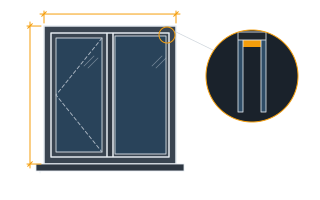
SettingsSettings for this calculationUS
The finished overall thickness of the insulated glass unit, edge to edge.
This is the total makeup thickness the frame/glazing pocket is designed for — pane + spacer + pane.
The thickness of the first glass pane (e.g. the exterior lite).
The OUTER lite, which is usually the thicker of the two because it takes the wind load and, where the opening demands safety glass, the toughening or lamination as well. Take it from the glass order rather than from the finished unit — once an insulated unit is sealed you cannot get a gauge onto either pane, and reading the wrong one through the glass is easy.
The thickness of the second glass pane (e.g. the interior lite).
The INNER lite, and if it differs from the outer that is usually deliberate rather than a mistake to correct. Two panes of identical thickness share the same coincidence frequency, which puts a dip in the unit's acoustic performance exactly where traffic noise sits; stepping one pane detunes them and moves the dip. So an asymmetric build-up is a specification, and matching the two to tidy it up undoes the reason it was ordered.
Required spacer width
0.68 in
- Glass alone
- 0.32 in
- Overall unit thickness targeted
- 1 in
They open the calculator with your figures already in it
Insulated Glass Unit (IGU) Spacer Bar Sizing Calculator: 0.68 in — shown in imperial, US market. The link sets both, so the result they see is the one on your screen.
Show calculation logicHide calculation logic
How this was calculated
Formula source(s)
- Spacer width = target overall IGU thickness − pane 1 thickness − pane 2 thickness, since the spacer bar occupies the remaining air/gas gap between the two panes
Inputs used
- Target Overall IGU Thickness
- 1 in
- Pane 1 Thickness
- 0.16 in
- Pane 2 Thickness
- 0.16 in
Intermediate steps
- Glass alone
- 0.32 in
- Overall unit thickness targeted
- 1 in
What this calculation does not cover
- Solves a two-pane makeup only. A triple unit has three lites and TWO spacers, and subtracting two pane thicknesses from its overall thickness returns a cavity that does not exist in it. A laminated lite needs its real built-up thickness entered as well — a 6.4 mm (0.25 in) laminate is two 3 mm (0.12 in) glasses plus the interlayer, not 6.
- Returns the cavity that fits the pocket, not the cavity that performs. Below roughly 12 mm (0.47 in) the two lites start conducting across the gap; above roughly 16 mm (0.63 in) the fill gas begins convecting inside it and the U-value gets worse again, so a unit thickened to suit a deeper glazing pocket can measure worse than the thinner one it replaced. Gas fill and which surface carries the low-E coating move that optimum around.
- Glass and finished units are made to tolerances this exact subtraction cannot see. Float glass is supplied to roughly a fifth of a millimeter on nominal thickness and a sealed unit to about a millimeter overall, so a spacer chosen to fill the last half-millimeter of a rebate has nothing left for either. Size the pocket for the unit's tolerance band, not for the single figure returned here.
Add the equipment this sizes
This result is a specification — 0.68 in — not a quantity. Put the thing it sizes into your project: how many, what you call it, and your supplier’s price.
Computed in your browser — nothing you enter is uploaded. Presented in US customary units and US trade terminology. Where a formula follows a published standard, that standard and its edition are cited beside it on this page; where none governs, the page says so. Local amendments override model codes — verify against the code in force where you build.
Sources checked 2026-09-06 · in the site-wide review of 2026-09-06 · v1.0.1
Regulatory standards & verification citations1
- Spacer width = target overall IGU thickness − pane 1 thickness − pane 2 thickness, since the spacer bar occupies the remaining air/gas gap between the two panes
Cite this page
Your workspace
Most jobs need more than one number. Add the calculators you need next and they open right here, underneath this one — your figures stay on screen and nothing is lost to a page change.