
SettingsSettings for this calculationUS
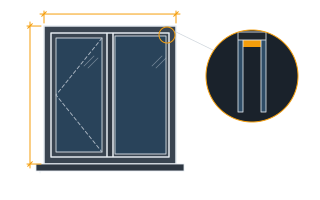
The width of a single insulated glass unit.
The GLASS, not the frame it will sit in. The spacer runs round the edge of the unit, so the perimeter follows the unit's own size, and a width taken over the surrounding framing overstates every unit in the batch by the same margin — which is how a spacer order comes out consistently long and nobody can see where it went.
The height of a single insulated glass unit.
Paired with the width above, this gives the perimeter, and for THIS calculation the two are interchangeable — the perimeter is the same either way round. For the glass they are not: once a unit is coated, patterned or has a low-e face specified, width and height are not swappable, and a batch ordered with the two transposed is a batch that cannot be installed. This page will not notice the transposition; the glazier will.
The total number of IGUs in the batch.
The units of THIS size. A curtain wall elevation almost never has one unit size, and entering the whole facade against a single width and height prices the spacer as though every opening matched — which understates the total whenever the batch includes anything larger. Run the sizes separately and add them, or accept that the answer describes a building that is not the one on the drawing.
Total spacer bar needed
360 ft
- Perimeter per unit
- 18 ft
They open the calculator with your figures already in it
Insulated Glass Unit (IGU) Spacer Bar Perimeter Calculator: 360 ft — shown in imperial, US market. The link sets both, so the result they see is the one on your screen.
Show calculation logicHide calculation logic
How this was calculated
Formula source(s)
- Total spacer bar length = unit perimeter (2×(width+height)) × number of units, the standard method for estimating IGU spacer bar material
Inputs used
- IGU Width
- 4 ft
- IGU Height
- 5 ft
- Number of Units
- 20
Intermediate steps
- Perimeter per unit
- 18 ft
What this calculation does not cover
- Multiplies the GLASS size, and the spacer bar does not run on the glass edge. It is set back inside the lite by the depth of the secondary seal — commonly 3 to 5 mm (0.12 to 0.20 in) all round — so the length actually cut is the sight-line perimeter, four setbacks smaller than the figure here. Cut bars to the glass dimension and they will not drop inside the unit at all.
- Spacer arrives in sticks of a fixed length, and this total is linear meters, not bars. A unit bent from one continuous piece at three corners needs a single stick longer than its whole perimeter, so a 1.2 x 1.5 m unit at 5.4 m of perimeter cannot be bent from a 5 m bar at any yield — the number of bars, and the bar length available, is what the order is placed in.
Estimated cost — your price
This site holds no price list for this material — local prices vary too much to publish honestly. Enter your supplier's price and the result is costed with it.
Computed in your browser — nothing you enter is uploaded. Presented in US customary units and US trade terminology. Where a formula follows a published standard, that standard and its edition are cited beside it on this page; where none governs, the page says so. Local amendments override model codes — verify against the code in force where you build.
Sources checked 2026-09-06 · in the site-wide review of 2026-09-06 · v1.0.1
Regulatory standards & verification citations1
- Total spacer bar length = unit perimeter (2×(width+height)) × number of units, the standard method for estimating IGU spacer bar material
Cite this page
Your workspace
Most jobs need more than one number. Add the calculators you need next and they open right here, underneath this one — your figures stay on screen and nothing is lost to a page change.