
SettingsSettings for this calculationUS
Waste is set to 0% by hand. Pick a tier above to replace it, or keep your own figure.
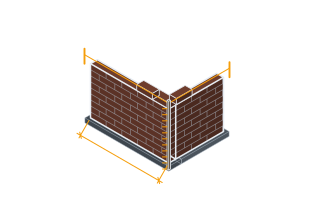
The area of one face of the wall: its length times its height, less any openings.
Measure one face only; the next field doubles it where both faces are coated. Take off doors and windows, and add returns, piers and the tops of walls that will be coated. For a basement or foundation wall parged on its outside face, measure from the footing to where the coat stops above ground.
Tools needed: Tape measure
Both faces for a dry-stacked wall, which the bonding cement holds together; one face for a parge coat.
A dry-stacked block wall has no mortar in its joints above the first course, and both makers cited here call for the bonding cement on both sides of it. A parge coat, or surface bonding cement used to waterproof or refinish a wall that is already mortared, goes on the one face that needs it.
The average thickness of the coat on each face: 3.2 mm (1/8 in) is the least both bonding cement makers cited here set.
QUIKWALL and Sakrete both ask for a surface bonding coat of at least 1/8 in (3.2 mm), and Sakrete applies its product up to 1/2 in (13 mm). A parge coat is usually laid thicker than a bonding coat, and a damp-proofing slurry far thinner; use the thickness your product's sheet gives for the job.
The area the bag says it covers, 4.65 m² (50 sq ft) for a QUIKWALL bag, read with the thickness below.
Copy the coverage line off the bag or its data sheet together with the thickness it is stated at. QUIKWALL gives 50 ft² (4.65 m²) at 1/8 in (3.2 mm) for a 50 lb (22.7 kg) bag; Sakrete gives 35 to 40 ft² (3.25 to 3.7 m²) at the same thickness for its bag of the same weight; QUIKRETE's Heavy Duty Masonry Coating gives about 180 ft² (16.7 m²) at 1/32 in (0.8 mm) for a 40 lb (18.1 kg) bag. Where a sheet gives a range, the smaller area buys more bags.
The thickness on the same coverage line, 3.2 mm (1/8 in) on QUIKWALL's and Sakrete's bags.
A coverage means nothing without its thickness: the bag's yield is the area times this thickness, and the page works in volume from there, so a coat twice as thick takes twice the bags. Enter the figure exactly as the sheet states it, even where it differs from the coat you are laying.
Extra for what falls off the trowel, stays in the mixer and fills hollows. Opens at nothing.
None of the sheets cited here publishes an allowance, and Sakrete calls its yield approximate. Add your own figure from past walls, more for a rough, open-textured block or a sprayed coat than for a trowelled one on a true wall.
Bags to buy
9 bags
The coat is the wall area times the faces coated times the thickness, and one bag makes the area its maker states at the thickness its maker states. The bags are the coat, allowance included, over what one bag makes, rounded up.
- Coat to place, every face counted
- 4.58 ft³
- One bag's yield
- 0.52 ft³
- Face one bag covers at the coat entered
- 50 ft²
They open the calculator with your figures already in it
Surface Bonding Cement and Parge Coat Calculator: 9 bags — shown in imperial, US market. The link sets both, so the result they see is the one on your screen.
Show calculation logicHide calculation logic
How this was calculated
Formula source(s)
- QUIKRETE, QUIKWALL Surface Bonding Cement (No. 1230-1231) data sheet: alkali resistant fiberglass reinforced portland cement for dry-stack concrete block walls; each 50 lb (22.7 kg) bag covers approximately 50 ft² (4.65 m²) at 1/8" (3.2 mm) thickness; applied to both sides of dry-stacked block at a minimum of 1/8" (3.2 mm); meets ASTM C887; dry-stack construction to ASTM C946
- SAKRETE Surface Bonding Cement data sheet (Rev. 04/16): a 50 lb bag covers 35 - 40 ft² (3.25 – 3.7 m²) at 1/8" (3.2 mm) thick; applied a minimum of 1/8" (3.2 mm) to 1/2" (13 mm) thick; "To determine coverage: Multiply Length (feet) x Width (feet) x Thickness (inches) and divide by 12. Then divide by the yield"; "Yield and water are approximate"
- QUIKRETE, Heavy Duty Masonry Coating data sheet: a portland cement coating for damp-proofing and resurfacing masonry; a 40 lb bag yields 0.46 cu ft (13 L) of mix and covers approximately 180 ft² (16.7 m²) at 1/32" (0.8 mm)
Inputs used
- Wall Area, One Face
- 220 sq ft
- Faces Coated
- Both faces (a dry-stacked, surface-bonded wall)
- Coat Thickness
- 0.13 in
- Area One Bag Covers (as printed)
- 50 sq ft
- Thickness That Coverage Is Stated At
- 0.13 in
- Waste / Over-Order (%)
- 0
Intermediate steps
- Coat to place, every face counted
- 4.58 ft³
- One bag's yield
- 0.52 ft³
- Face one bag covers at the coat entered
- 50 ft²
Confidence note: The coat is the wall area times the faces coated times the thickness, and one bag makes the area its maker states at the thickness its maker states. The bags are the coat, allowance included, over what one bag makes, rounded up.
What this calculation does not cover
- The yield is the maker's statement for its own bag at its own consistency, and it is approximate: Sakrete says so on its sheet. Two surface bonding cements of the same bag weight cited here differ by a quarter or more at the same thickness, so enter the figures printed on the bag being used.
- The thickness is taken as even over the whole face. Block faces, mortar joints, a rough first course and the texture worked into the finish all take material the average does not see, and a coat brought up to an even line over an uneven wall uses more than its nominal thickness.
- A dry-stacked, surface-bonded wall is a structural system, built with the bonding cement on both faces and to the maker's instructions and the practice it cites; the footing, the first course set in mortar, any reinforcement and grout, control joints and the wall's height and thickness are the design's and the building code's. This page counts the coating and nothing about the wall.
- Bonding agents, acrylic fortifier, metal lath over a painted or coated wall, and the water to mix are separate items, as are the curing and the weather limits on each sheet.
Estimated cost — your price
This site holds no price list for this material — local prices vary too much to publish honestly. Enter your supplier's price and the result is costed with it.
Computed in your browser — nothing you enter is uploaded. Presented in US customary units and US trade terminology. Where a formula follows a published standard, that standard and its edition are cited beside it on this page; where none governs, the page says so. Local amendments override model codes — verify against the code in force where you build.
Sources checked 2026-10-05 · v1.0.0
Regulatory standards & verification citations3
- QUIKRETE, QUIKWALL Surface Bonding Cement (No. 1230-1231) data sheet: alkali resistant fiberglass reinforced portland cement for dry-stack concrete block walls; each 50 lb (22.7 kg) bag covers approximately 50 ft² (4.65 m²) at 1/8" (3.2 mm) thickness; applied to both sides of dry-stacked block at a minimum of 1/8" (3.2 mm); meets ASTM C887; dry-stack construction to ASTM C946
- SAKRETE Surface Bonding Cement data sheet (Rev. 04/16): a 50 lb bag covers 35 - 40 ft² (3.25 – 3.7 m²) at 1/8" (3.2 mm) thick; applied a minimum of 1/8" (3.2 mm) to 1/2" (13 mm) thick; "To determine coverage: Multiply Length (feet) x Width (feet) x Thickness (inches) and divide by 12. Then divide by the yield"; "Yield and water are approximate"
- QUIKRETE, Heavy Duty Masonry Coating data sheet: a portland cement coating for damp-proofing and resurfacing masonry; a 40 lb bag yields 0.46 cu ft (13 L) of mix and covers approximately 180 ft² (16.7 m²) at 1/32" (0.8 mm)
Which documents these citations point at
Standards referenced: ASTM C887, ASTM C946 (ASTM International, United States).
Cite this page
Your workspace
Most jobs need more than one number. Add the calculators you need next and they open right here, underneath this one — your figures stay on screen and nothing is lost to a page change.