
SettingsSettings for this calculationUS
The standard allowance most suppliers and estimating guides assume for ordinary work.
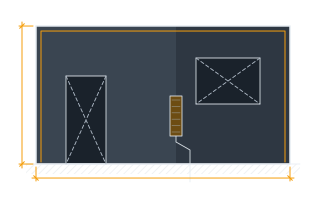
The face area of block to be filled, with openings already taken out.
Measure the block face only. Filler is not applied over previously coated smooth work, and door and window openings should come out of the total unless they are being blocked up. Both faces of a wall count separately if both are being filled.
The spread rate the data sheet quotes over a smooth, sealed substrate.
Manufacturers publish a theoretical rate at a stated dry film thickness on a non-absorbent surface. That is the number the multiplier below is applied to. If the sheet instead publishes a figure for coarse block, use that figure here and set the texture class to smooth, so the calculator does not derate an already-derated rate.
How porous and open the block face is, which decides the multiplier applied.
Rub a dry hand over the wall. A face that leaves grit on your palm and shows open pinholes under a raking light is the open class; a dense architectural unit with a closed face is light. Where you cannot decide between two classes, price the coarser one — running short mid-wall costs more than a leftover pail.
Extra carried for roller loading, spillage and cut-in touch-up.
Block filler is thick, and a heavily loaded roller sleeve holds a surprising amount that never reaches the wall. Spray application throws this higher again because of overspray and hose fill; brush and roller work sits at the lower end.
Block filler required
7.621 gal
- Effective spread rate over this block face
- 140 ft²/gal
- Quantity before the waste allowance
- 6.93 gal
- Absorption multiplier applied
- 2.5 x rated rate
They open the calculator with your figures already in it
Block Filler Coverage Calculator: 7.62 gal — shown in imperial, US market. The link sets both, so the result they see is the one on your screen.
Show calculation logicHide calculation logic
How this was calculated
Formula source(s)
- Material = area ÷ (rated spread rate ÷ texture multiplier), then the waste allowance. The texture multipliers are a STATED RULE OF THUMB, not a published table — where a product's data sheet gives its own coarse-block coverage, enter that figure and set the texture to smooth so no multiplier is applied.
- ASTM D4258, Standard Practice for Surface Cleaning Concrete for Coating, and ASTM D4259, Standard Practice for Abrading Concrete — the preparation a quoted spread rate assumes has been done
Inputs used
- Net Wall Area
- 970 sq ft
- Data Sheet Spread Rate
- 350 ft²/gal
- Block Texture Class
- Medium texture — ordinary lightweight block
- Waste Allowance (%)
- 10
Intermediate steps
- Effective spread rate over this block face
- 140 ft²/gal
- Quantity before the waste allowance
- 6.93 gal
- Absorption multiplier applied
- 2.5 x rated rate
What this calculation does not cover
- First coat only. The finish coats that follow go over a filled, closed surface and run near their own rated rate.
- Nothing here covers patching, joint pointing or the second fill pass an unusually open wall sometimes needs.
Estimated cost — your price
This site holds no price list for this material — local prices vary too much to publish honestly. Enter your supplier's price and the result is costed with it.
Part of a bigger job
This trade is one line of a job takeoff. Run the whole job and every other trade comes back with it, off the same measurements.
Computed in your browser — nothing you enter is uploaded. Presented in US customary units and US trade terminology. Where a formula follows a published standard, that standard and its edition are cited beside it on this page; where none governs, the page says so. Local amendments override model codes — verify against the code in force where you build.
Sources checked 2026-08-30 · in the site-wide review of 2026-09-06 · v1.0.0
Regulatory standards & verification citations2
- Material = area ÷ (rated spread rate ÷ texture multiplier), then the waste allowance. The texture multipliers are a STATED RULE OF THUMB, not a published table — where a product's data sheet gives its own coarse-block coverage, enter that figure and set the texture to smooth so no multiplier is applied.
- ASTM D4258, Standard Practice for Surface Cleaning Concrete for Coating, and ASTM D4259, Standard Practice for Abrading Concrete — the preparation a quoted spread rate assumes has been done
Which documents these citations point at
Standards referenced: ASTM D4258, ASTM D4259 (ASTM International, United States).
Cite this page
Your workspace
Most jobs need more than one number. Add the calculators you need next and they open right here, underneath this one — your figures stay on screen and nothing is lost to a page change.
Tools and safety for this job
To roll and cut in two coats. Generic types, no brands, no prices.
Protection this work requires
- A dust mask does nothing about solvent vapour: ventilate through, and use an organic-vapour (A1) cartridge respirator in an enclosed room.
- Most fatal falls on small jobs are from under three metres: use a tower or a ladder tied at the top, and never work off the top two rungs.
Show the 5 tools this job needsHide tools
Essential
Brushes
Dust sheets and masking
Roller frame, sleeves and tray
Recommended
Extension pole
Step ladder
Also needed as materials: masking tape, plastic sheeting, roller sleeves.
what each painting tool is for, and the spec that decides which to buy where one does.