
SettingsSettings for this calculationUS
Waste is set to 5% by hand. Pick a tier above to replace it, or keep your own figure.
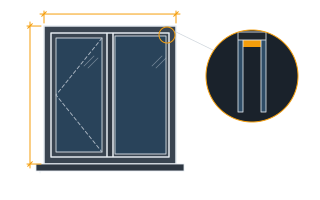
The total number of individual glass lites to be gasketed.
Lites, not frames — and on this calculation the difference is larger than it sounds. A frame containing a fixed light beside an opening vent holds two lites, each gasketed all the way round, so counting frames rather than lites halves the order on exactly the facades that are most likely to be complicated. Count what gets glazed, not what gets installed.
The perimeter of a single glass lite (2 × (width + height)).
Gasket is bought by the run, so perimeter is the figure that matters and area is not. Two lites of identical area need different amounts if their proportions differ — a long narrow light takes noticeably more gasket than a square one of the same glass, and a facade of ribbon windows consumes far more than its glazed area suggests.
Extra material to allow for cut waste and splices.
Gasket waste is mostly ends and corners rather than run. Each lite produces offcuts where the gasket is cut and mitred, so the allowance scales with the NUMBER of lites far more than with the total ordered — a facade of many small lites needs a bigger allowance than the same quantity made up of a few large ones. Sites that reuse offcuts on small lights do better than the allowance suggests; sites that do not, worse.
Total gasket needed
315 ft
They open the calculator with your figures already in it
Glazing Gasket/Wedge Linear Footage Calculator: 315 ft — shown in imperial, US market. The link sets both, so the result they see is the one on your screen.
Show calculation logicHide calculation logic
How this was calculated
Formula source(s)
- Total gasket length = number of lites × perimeter per lite × (1 + waste allowance), the standard method for estimating continuous perimeter glazing gasket/wedge material
Inputs used
- Number of Glass Lites
- 20
- Perimeter per Lite
- 15 ft
- Waste Allowance (%)
- 5
What this calculation does not cover
- The perimeter is taken exactly as entered — the calculator never sees the lite's width and height, so it cannot check that the figure is 2 × (width + height). Entering width plus height instead of the full perimeter halves the answer, and nothing on the page flags the error.
- One perimeter run is counted per lite. Glazing systems that carry both an inner and an outer gasket, or a wedge on one face with tape or a heel bead on the other, need two runs per lite, so either the perimeter or the lite count has to be doubled.
- Wedge gasket is meant to be cut slightly long and compressed into the pocket rather than stretched, because stretched material retracts and opens gaps at the corners. The waste allowance covers offcuts and splices, not that deliberate over-length: on 20 lites of 4.5 m the 5% allowance is 4.5 m, and cutting every leg 3% long consumes 2.7 m of it before a single offcut is made.
- The answer is a pooled length, not a buying quantity or a cut list. It does not know the supplied coil or roll length, so it neither rounds up to whole rolls nor accounts for the drop left at each roll end — 94.5 m (310 ft) bought in 30 m (98 ft) coils means four coils, and no single leg can bridge a coil end.
- This counts linear length only; it does not select a gasket profile. It says nothing about whether the wedge size suits the clearance between the glass edge and the frame rebate, or whether the resulting compression, edge cover and pocket depth meet the system's air and water penetration rating — an undersized wedge leaves the glass loose, an oversized one loads the glass edge.
Estimated cost — your price
This site holds no price list for this material — local prices vary too much to publish honestly. Enter your supplier's price and the result is costed with it.
Computed in your browser — nothing you enter is uploaded. Presented in US customary units and US trade terminology. Where a formula follows a published standard, that standard and its edition are cited beside it on this page; where none governs, the page says so. Local amendments override model codes — verify against the code in force where you build.
Sources checked 2026-09-02 · in the site-wide review of 2026-09-06 · v1.0.1
Regulatory standards & verification citations1
- Total gasket length = number of lites × perimeter per lite × (1 + waste allowance), the standard method for estimating continuous perimeter glazing gasket/wedge material
Cite this page
Your workspace
Most jobs need more than one number. Add the calculators you need next and they open right here, underneath this one — your figures stay on screen and nothing is lost to a page change.