
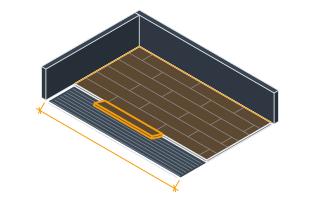
SettingsSettings for this calculationUS
The total floor area to be coated.
Measure the room's length x width, or add up multiple sections for an irregular floor.
The floor area one unit of the product covers, per coat.
Coverage rate depends on the epoxy system and application method — check the manufacturer's technical data sheet for the rated coverage per coat.
The total number of coats to be applied.
Most epoxy floor systems use a primer/base coat plus one or more topcoats — two coats is typical for a standard residential garage floor.
Epoxy coating needed
2.65 gal
Epoxy coverage is governed by the substrate's profile and porosity, not by the nominal film thickness. A shot-blasted concrete floor with an open profile absorbs far more than the theoretical rate, and it must — that profile is what the coating grips.
They open the calculator with your figures already in it
Epoxy Flooring Coating Coverage Calculator: 2.65 gal — shown in imperial, US market. The link sets both, so the result they see is the one on your screen.
Show calculation logicHide calculation logic
How this was calculated
Formula source(s)
- Material needed = (area ÷ coverage rate per coat) × number of coats, the standard method for multi-coat floor coating estimates
Inputs used
- Floor Area
- 430 sq ft
- Coverage Rate per Coat
- 325 ft²/gal
- Number of Coats
- 2
Confidence note: Epoxy coverage is governed by the substrate's profile and porosity, not by the nominal film thickness. A shot-blasted concrete floor with an open profile absorbs far more than the theoretical rate, and it must — that profile is what the coating grips.
What this calculation does not cover
- Excludes the primer, which most systems require and which is the coat that actually bonds to the concrete.
- Does not include broadcast aggregate for a slip-resistant finish, or the additional topcoat that a broadcast system needs to lock it in.
- Moisture in the slab must be tested before coating. A slab passing vapour will lift an impermeable coating regardless of how well it was applied.
Estimated cost — your price
This site holds no price list for this material — local prices vary too much to publish honestly. Enter your supplier's price and the result is costed with it.
Part of a bigger job
This trade is one line of a job takeoff. Run the whole job and every other trade comes back with it, off the same measurements.
also measuresSelf-Leveling Underlayment (SLU) Volume
Computed in your browser — nothing you enter is uploaded. Presented in US customary units and US trade terminology. Where a formula follows a published standard, that standard and its edition are cited beside it on this page; where none governs, the page says so. Local amendments override model codes — verify against the code in force where you build.
Sources checked 2026-08-27 · in the site-wide review of 2026-09-06 · v1.1.0
Regulatory standards & verification citations1
- Material needed = (area ÷ coverage rate per coat) × number of coats, the standard method for multi-coat floor coating estimates
Cite this page
Your workspace
Most jobs need more than one number. Add the calculators you need next and they open right here, underneath this one — your figures stay on screen and nothing is lost to a page change.
Tools and safety for this job
To roll and cut in two coats. Generic types, no brands, no prices.
Protection this work requires
- A dust mask does nothing about solvent vapour: ventilate through, and use an organic-vapour (A1) cartridge respirator in an enclosed room.
- Most fatal falls on small jobs are from under three metres: use a tower or a ladder tied at the top, and never work off the top two rungs.
Show the 5 tools this job needsHide tools
Essential
Brushes
Dust sheets and masking
Roller frame, sleeves and tray
Recommended
Extension pole
Step ladder
Also needed as materials: masking tape, plastic sheeting, roller sleeves.
what each painting tool is for, and the spec that decides which to buy where one does.