
SettingsSettings for this calculationUS
Waste is set to 5% by hand. Pick a tier above to replace it, or keep your own figure.
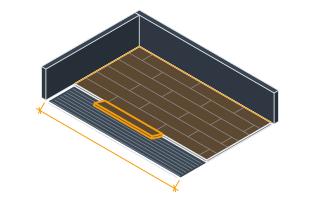
The total floor area requiring static-dissipative (ESD) flooring.
Measure the full area of the electronics assembly, cleanroom, or data-center floor requiring conductive or static-dissipative flooring.
Extra material for seams, trimming, and installation cuts.
5% is typical for a straightforward rectangular room; more complex layouts, columns, or curved boundaries may need a higher allowance.
ESD flooring material needed
1,134 sq ft
They open the calculator with your figures already in it
Static-Dissipative (ESD) Flooring Coverage Calculator: 1,134 sq ft — shown in imperial, US market. The link sets both, so the result they see is the one on your screen.
Show calculation logicHide calculation logic
How this was calculated
Formula source(s)
- Material needed = floor area × (1 + waste allowance), the standard coverage-with-waste method applied to specialty ESD flooring installation
Inputs used
- Floor Area
- 1080 sq ft
- Waste Allowance (%)
- 5
What this calculation does not cover
- Buys the area; it does not buy the performance. What gets tested at handover is resistance to ground for the whole system — flooring, conductive adhesive, a copper grid bonded to a real earth point, and the footwear people are wearing — per ANSI/ESD S20.20. A perfectly laid conductive floor walked in ordinary shoes fails the walking test, and the floor is not the thing that has to change.
- The floor stops working the day somebody polishes it. Ordinary floor finishes and waxes are insulators, and one coat over an ESD surface puts it out of range until it is stripped again, so the approved cleaner and the maintenance regime are part of the specification rather than housekeeping. This is the commonest way a compliant installation goes non-compliant inside its first year.
- Nothing here addresses what sits between the floor and the slab. Slab moisture decides whether the conductive adhesive can be used at all, and a moisture-mitigation epoxy laid to deal with it is an insulating layer, so the grounding grid has to run above it rather than below. Get that order wrong and it surfaces only when the finished floor tests open.
Estimated cost — your price
This site holds no price list for this material — local prices vary too much to publish honestly. Enter your supplier's price and the result is costed with it.
Computed in your browser — nothing you enter is uploaded. Presented in US customary units and US trade terminology. Where a formula follows a published standard, that standard and its edition are cited beside it on this page; where none governs, the page says so. Local amendments override model codes — verify against the code in force where you build.
Sources checked 2026-09-06 · in the site-wide review of 2026-09-06 · v1.0.1
Regulatory standards & verification citations1
- Material needed = floor area × (1 + waste allowance), the standard coverage-with-waste method applied to specialty ESD flooring installation
Cite this page
Your workspace
Most jobs need more than one number. Add the calculators you need next and they open right here, underneath this one — your figures stay on screen and nothing is lost to a page change.