
SettingsSettings for this calculationUS
The total number of cold-formed steel studs in the wall run.
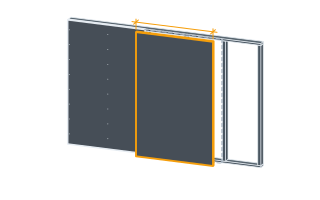
Count the studs that are actually there, which is always more than the spacing implies: jamb studs and cripples at every opening, corner and intersection assemblies, and doubled studs at panel joints. Openings ADD studs rather than removing them, so a wall priced from its length and spacing alone comes out short on exactly the walls with the most work in them.
The number of self-tapping screws used to fasten each stud to the top and bottom track.
Standard CFS framing practice uses 2 screws at the top track connection and 2 at the bottom track connection (4 total) per stud, though project specifications may call for more.
Total screws needed
104 screws
They open the calculator with your figures already in it
CFS Stud Wall Screw Count Calculator: 104 screws — shown in imperial, US market. The link sets both, so the result they see is the one on your screen.
Show calculation logicHide calculation logic
How this was calculated
Formula source(s)
- Total screws = stud count × screws per stud (typically 2 at the top track connection + 2 at the bottom track connection = 4 per stud, per standard CFS framing practice)
Inputs used
- Number of Studs
- 26
- Screws per Stud (Top + Bottom Connections)
- 4
What this calculation does not cover
- The screws at the head are where this goes wrong. Where a partition runs up to a slab or deck that moves, the stud sits in a deep-leg or slotted track and has to be free to slide in it — fasten it top and bottom alike and the wall becomes an unintended column, picking up load it was never sized for and cracking the board across the head.
- Fixing studs to track is not fixing the wall to the building. The bottom track's anchors into the slab and the top track's fixings into the deck are a different fastener at a different spacing, set by the lateral load on the wall rather than by the stud layout, and they are the connection actually keeping the wall standing.
- A total is not a capacity. A self-drilling screw has to drill the steel it goes into — heavier gauge needs a larger point and a larger diameter — and the shear value of each connection comes from that diameter working against that thickness. Four undersized screws spinning in heavy-gauge track count four in the number above and hold nothing.
Estimated cost — your price
This site holds no price list for this material — local prices vary too much to publish honestly. Enter your supplier's price and the result is costed with it.
Computed in your browser — nothing you enter is uploaded. Presented in US customary units and US trade terminology. Where a formula follows a published standard, that standard and its edition are cited beside it on this page; where none governs, the page says so. Local amendments override model codes — verify against the code in force where you build.
Sources checked 2026-09-06 · in the site-wide review of 2026-09-06 · v1.0.1
Regulatory standards & verification citations1
- Total screws = stud count × screws per stud (typically 2 at the top track connection + 2 at the bottom track connection = 4 per stud, per standard CFS framing practice)
Cite this page
Your workspace
Most jobs need more than one number. Add the calculators you need next and they open right here, underneath this one — your figures stay on screen and nothing is lost to a page change.