Materials & Quantities

Mullion Stack Joint Setting Gap Calculator

Work out the gap to set at a curtain wall stack joint against the thermometer reading on the day of installation, not against the season it happens to be.

  • Answers as you type
  • Every formula cited
  • Calculated in your browser
SettingsSettings for this calculationUS
Market
Imperial · sales tax
The length of one mullion between stack joints — usually the floor-to-floor dimension.

Measure between the stack joints, not between the slabs, because it is the extrusion between two splices that grows. A mullion spliced twice in a double-height lobby has two shorter lengths and two smaller gaps, not one long one.

The material of the mullion itself, which sets how far it moves per degree.

Aluminium moves roughly twice as far as carbon steel for the same temperature change, which is why a steel-framed wall tolerates a stack joint half the size. Where a steel back-frame carries aluminium pressure plates, size the joint on the member that is actually spliced.

The lowest temperature the mullion metal itself is expected to reach in service.

This is a metal temperature, not an air temperature. On a clear winter night a north elevation radiates to the sky and sits several degrees below ambient, and the extrusion is what shrinks.

The highest temperature the mullion metal itself is expected to reach in service.

Dark anodised or dark powder-coated aluminium in full sun runs far above air temperature — 70 °C (158 °F) is an ordinary design figure for a mid-tone finish and a dark one can be asked to take 80 °C or more. A mill finish runs cooler.

What the mullion is reading right now, on the face being installed.

The reason this calculator exists. A gap set to a seasonal assumption is wrong by the difference between that assumption and the metal in your hands — shoot the mullion with an infrared thermometer on the elevation you are working, and shoot it again after lunch if the sun has come round.

How much clearance must survive when the mullion is at its hottest and the joint is at its tightest.

Never zero in practice. The expansion sleeve, the internal splice sleeve or the gasket at the joint needs somewhere to be, and two extrusion ends bearing on each other transfer axial load into a frame designed to take none. 1.5 mm (about 1/16 in) is a common residual; the system supplier's detail governs.

Setting gap at today's temperature

0.246 in

High confidence
Total movement across the design range
0.31 in
Gap at the coldest design temperature
0.36 in
Gap at the hottest design temperature
0.06 in
Expansion still to come from today's reading
0.19 in
Contraction still to come from today's reading
0.12 in
Then change the inputs to see how far the answer moves.

Show calculation logic

How this was calculated

Formula source(s)

  • Linear thermal expansion, ΔL = α × L × ΔT — the gap set today is the residual gap at the hottest design temperature plus the expansion still to come between today's reading and that temperature
  • Coefficients of linear thermal expansion as published for each alloy family: aluminium extrusion 23.6 × 10⁻⁶ per °C (Aluminum Design Manual, The Aluminum Association), structural carbon steel 11.7 × 10⁻⁶ per °C (AISC Steel Construction Manual), austenitic stainless steel 17.3 × 10⁻⁶ per °C

Inputs used

Floor-to-Floor Mullion Length
12 ft
Mullion Alloy
Aluminium extrusion (6000 series)
Coldest Design Metal Temperature
-4 °F
Hottest Design Metal Temperature
158 °F
Metal Temperature Measured at Installation
59 °F
Residual Gap Required at the Hottest Temperature
0.06 in

Intermediate steps

Total movement across the design range
0.31 in
Gap at the coldest design temperature
0.36 in
Gap at the hottest design temperature
0.06 in
Expansion still to come from today's reading
0.19 in
Contraction still to come from today's reading
0.12 in
Final result0.25 in

What this calculation does not cover

  • Covers axial thermal movement of the mullion only. Frame shortening, creep in a concrete structure and differential slab movement all land on the same joint and none of them is temperature-driven.
  • Assumes the splice is free to slide. A stack joint pinned by a sealed gasket, a paint bridge or a fastener through the sleeve does not move, and the load goes somewhere else.

Add the equipment this sizes

This result is a specification — 0.246 in — not a quantity. Put the thing it sizes into your project: how many, what you call it, and your supplier’s price.

12 ft
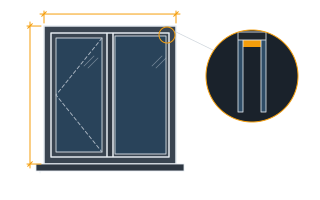
Schematic, drawn to the proportions you entered — not to scale on screen.

Computed in your browser — nothing you enter is uploaded. Presented in US customary units and US trade terminology. Where a formula follows a published standard, that standard and its edition are cited beside it on this page; where none governs, the page says so. Local amendments override model codes — verify against the code in force where you build.

Sources checked 2026-08-30 · in the site-wide review of 2026-09-06 · v1.0.0

Regulatory standards & verification citations2
  1. Linear thermal expansion, ΔL = α × L × ΔT — the gap set today is the residual gap at the hottest design temperature plus the expansion still to come between today's reading and that temperature
  2. Coefficients of linear thermal expansion as published for each alloy family: aluminium extrusion 23.6 × 10⁻⁶ per °C (Aluminum Design Manual, The Aluminum Association), structural carbon steel 11.7 × 10⁻⁶ per °C (AISC Steel Construction Manual), austenitic stainless steel 17.3 × 10⁻⁶ per °C
Cite this page

Your workspace

Most jobs need more than one number. Add the calculators you need next and they open right here, underneath this one — your figures stay on screen and nothing is lost to a page change.

Now that you have the number

These guides cover the work this quantity is for — the first ones run this calculator inside the section that raises the question.

Called something else where you work? Curtain wall — the term in each market, how close the equivalence really is, and the standard that governs it.

How to calculate mullion stack joint setting gap in 7 steps

  1. Floor-to-Floor Mullion LengthThe length of one mullion between stack joints — usually the floor-to-floor dimension.
  2. Mullion AlloyThe material of the mullion itself, which sets how far it moves per degree.
  3. Coldest Design Metal TemperatureThe lowest temperature the mullion metal itself is expected to reach in service.
  4. Hottest Design Metal TemperatureThe highest temperature the mullion metal itself is expected to reach in service.
  5. Metal Temperature Measured at InstallationWhat the mullion is reading right now, on the face being installed.
  6. Residual Gap Required at the Hottest TemperatureHow much clearance must survive when the mullion is at its hottest and the joint is at its tightest.
  7. Setting gap at today's temperatureThe tool computes the setting gap at today's temperature from those figures and shows the formula, its sources, and a confidence rating alongside it.

Setting gap at today's temperature by floor-to-floor mullion length

Page defaults, not your figures above.

Floor-to-Floor Mullion LengthSetting gap at today's temperature (in)
5 ft0.137
10 ft0.215
15 ft0.293
20 ft0.371

Frequently asked questions

Why does the gap depend on today's temperature at all?
Because the joint has a fixed total travel and today's reading decides where in that travel you are starting. Set a joint on a cold morning to the figure meant for a warm afternoon and you have spent gap you will need in August; set it the other way and the joint is still open in January when it should have taken up.
Air temperature or metal temperature?
Metal. The extrusion responds to what it is, not to what the forecast says. A south-facing mullion in spring sunshine can sit 15 to 20 degrees above shade air temperature, and using the air figure would have you set a gap on the assumption the mullion still has that expansion left to do when it has already done it.
What if the design temperature range in the specification looks too narrow?
Say so before you set the first joint. The range drives the total travel and therefore the size of the sleeve and the joint cover, and a range that ignores a dark finish in full sun is a detail that will bind. It is a design question and it belongs with the designer, not with the installer holding a feeler gauge.
Does the gap it gives me include frame shortening and slab movement?
No. Every movement figure on the page is the extrusion's own expansion — coefficient times length times temperature change — and the only other number in the sum is the residual gap you type in, so nothing here knows anything about the structure the wall hangs off. A concrete frame goes on shortening under shrinkage and creep for months and years after the pour, and that lost floor-to-floor height closes the stack joint with the thermometer sitting still; a long slab edge taking up its live load does the same over an afternoon. Get the predicted figure at your level from the structural engineer and put it into the residual gap field, which is the only way it reaches these numbers: whatever you add there raises the setting gap and both limits by exactly that amount, and the field takes up to 10 mm (about 3/8 in). Then confirm the sleeve is still engaged at the wider open limit.
What if the joint cannot actually slide once the wall is finished?
Then the number here describes a movement that is not happening. The arithmetic assumes the splice slides freely, and on site the things that stop it are ordinary: a screw driven through the sleeve to hold the stack during erection and never removed, sealant or a gasket bridging the gap and curing hard across it, touch-up paint over the joint line, swarf or mortar dropped down the pocket. The metal still grows the same millimetres — they load the anchors instead, or travel to the next joint that is free. Prove the splice slides by hand before you set it, and if two floors are pinned together, enter the whole pinned run rather than one storey — up to the 8 m (about 26 ft) the length field takes — to see the movement that now has to go somewhere else.
Does the coldest design temperature change the gap I set today?
Not on its own. The setting gap is your residual plus the expansion still owed between today's reading and the hottest design temperature, and the cold figure appears nowhere in that sum. What it fixes is the open limit — how wide the joint sits on the worst winter night — and the contraction line in the breakdown, neither of which is the number your feeler gauge is setting this morning. It only reaches the setting gap when your measured reading is colder than the coldest figure you entered: the answer is then held at the open limit and dropped to medium confidence, which is the page saying your range and your thermometer disagree.
Preliminary estimate, not certified engineering. This tool produces an indicative quantity calculation for planning purposes only — it is not a certified structural analysis, a guaranteed material takeoff, or a substitute for building department approval. Always verify measurements on-site and have a licensed contractor or structural engineer review any load-bearing, code-sensitive, or safety-critical work before purchasing materials or starting construction. Spotted an arithmetic or standards error? Report it to contact@craftquantities.com with your inputs — a confirmed fix gets a permanent check of its own, so the same mistake cannot come back.