
SettingsSettings for this calculationUS
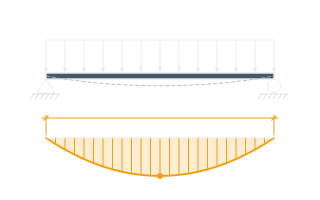
The uniform wind load applied along the mullion's length, from the tributary area of glass it supports.
The wind pressure on the glazing times the tributary width it spans onto this mullion — half the glass width either side for a mullion between two panes. The box follows the metric/imperial selector with the span and the modulus beside it, reading kN/m or lbf/ft (plf on a US submittal; 1 plf = 14.59 N/m). Corner, edge and parapet zones carry higher components-and-cladding pressures than the middle of an elevation, so a mullion in one of them needs the load for its own zone.
The unsupported span of the mullion between its structural supports.
Between the ANCHORS, which are not always the floors. A stick system spliced at every slab edge is a series of short spans; a mullion that runs past a floor unanchored spans two storeys and deflects far more than its storey height suggests. Take the span off the anchor layout rather than the elevation, because that is the drawing that knows where the member is actually held.
The mullion material's modulus of elasticity.
Aluminum extrusions typically use E ≈ 70,000 MPa (70 GPa); steel mullions use E ≈ 200,000 MPa.
The mullion cross-section's moment of inertia about the axis resisting the wind load.
Found in the mullion extrusion's published section properties.
Calculated mullion deflection
0.19 in
The deflection this mullion works out to is below the L/175 limit shown with it — The AAMA convention this page applies gives it. Being under one limit is not a design. Nothing else is checked here — not the other limit states, not the connections, not the member the load arrives from.
- L/175 allowable limit
- 0.69 in
They open the calculator with your figures already in it
Structural Glazing Mullion Wind Load Deflection Calculator: 0.1896 in — shown in imperial, US market. The link sets both, so the result they see is the one on your screen.
Show calculation logicHide calculation logic
How this was calculated
Formula source(s)
- AAMA TIR-11 / ASTM E1300: mullion deflection under uniform wind load, treated as a simply-supported beam, Δ = 5wL⁴/(384EI); standard allowable deflection limit for mullions supporting glass is L/175 (for spans up to about 4.1m/13'-6"), keeping frame deflection small enough that the glass doesn't lose edge support or over-stress
Inputs used
- Wind Line Load on Mullion
- 102.78 lbf/ft
- Mullion Span
- 10 ft
- Modulus of Elasticity E
- 10152641.64 psi
- Moment of Inertia I (×10⁶ mm⁴)
- 5
Intermediate steps
- L/175 allowable limit
- 0.69 in
Confidence note: The deflection this mullion works out to is below the L/175 limit shown with it — The AAMA convention this page applies gives it. Being under one limit is not a design. Nothing else is checked here — not the other limit states, not the connections, not the member the load arrives from.
What this calculation does not cover
- Passing L/175 is a serviceability check only and says nothing about strength. The bending stress at midspan, local buckling of the extrusion's thin walls, and the shear carried by screw splines and anchor fixings are separate checks that must pass independently, and a slender aluminium section can sit comfortably inside the deflection limit while over-stressing under the same wind load.
- The formula treats the mullion as a single simply-supported span carrying a uniform load, so it does not represent a member continuous over several floors, a stack joint with an expansion sleeve, a cantilevered head, or the rotation and slip of slotted anchor brackets at the slab edge. Anchor flexibility in particular adds end movement that 5wL⁴/(384EI) cannot see, so the real mullion can move further than the figure shown.
- Only the L/175 ratio is applied. Many specifications also cap framing deflection normal to the glass at an absolute figure, commonly 19 mm (3/4 in), with the smaller of the two governing; L/175 first exceeds 19 mm at a span of about 3.33 m, so beyond that span this page can report a pass that the absolute cap would refuse.
- The wind line load is taken as given and is not derived here. The tributary width of glass either side of the mullion must already be built into the line load, no allowance is made for the higher corner, edge or parapet components-and-cladding zones, and because deflection is a serviceability check the load should be the unfactored service wind pressure rather than the factored pressure used for the strength design.
- The moment of inertia is entered as a single published figure about the axis resisting wind, so a split or captured mullion pair only behaves as stiffly as a combined value implies when its two halves genuinely transfer shear between them. This field does not follow the unit selector, as the span, the wind line load and E do, so a section quoted in in⁴ must be multiplied by 0.416 to reach ×10⁶ mm⁴.
Add the equipment this sizes
This result is a specification — 0.19 in — not a quantity. Put the thing it sizes into your project: how many, what you call it, and your supplier’s price.
Computed in your browser — nothing you enter is uploaded. Presented in US customary units and US trade terminology. Where a formula follows a published standard, that standard and its edition are cited beside it on this page; where none governs, the page says so. Local amendments override model codes — verify against the code in force where you build.
Sources checked 2026-09-22 · v1.2.0
Regulatory standards & verification citations1
- AAMA TIR-11 / ASTM E1300: mullion deflection under uniform wind load, treated as a simply-supported beam, Δ = 5wL⁴/(384EI); standard allowable deflection limit for mullions supporting glass is L/175 (for spans up to about 4.1m/13'-6"), keeping frame deflection small enough that the glass doesn't lose edge support or over-stress
Which documents these citations point at
Standards referenced: ASTM E1300 (ASTM International, United States).
Cite this page
Your workspace
Most jobs need more than one number. Add the calculators you need next and they open right here, underneath this one — your figures stay on screen and nothing is lost to a page change.