
SettingsSettings for this calculationUS
The design wind pressure acting on the glass lite.
Use the project's code-required design wind pressure for the glazing location and height.
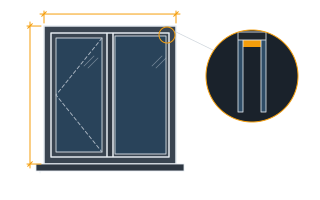
The shorter of the glass lite's two edge dimensions.
The tributary-load method sizes the bite off the lite's short span, which carries the larger share of a two-way plate's edge reaction.
The long-term allowable tensile stress for the structural silicone sealant — the GANA consensus standard is 138 kPa (20 psi).
138 kPa (20 psi) is the widely-used GANA consensus long-term allowable — confirm the value against your specific sealant manufacturer's tested allowable.
Required silicone bite width
0.255 in
This is the standard ASTM C1401/GANA tributary-load simplification (ignoring two-way plate action and aspect ratio) — a licensed structural/facade engineer should verify final bite width, especially for high-aspect-ratio lites where FEA-based methods may justify a different allowable stress.
They open the calculator with your figures already in it
Structural Silicone Glazing (SSG) Bite Width Calculator: 0.2554 in — shown in imperial, US market. The link sets both, so the result they see is the one on your screen.
Show calculation logicHide calculation logic
How this was calculated
Formula source(s)
- ASTM C1401 / GANA Structural Sealant Glazing Manual: Bite = W×d / (2×Fa), where W is design wind load, d is the glass lite's short-span dimension, and Fa is the allowable silicone sealant stress — industry standard long-term allowable is 138 kPa (20 psi) per GANA consensus safety factor
Inputs used
- Design Wind Load
- 31.33 psf
- Glass Lite Short-Span Dimension
- 47 in
- Allowable Silicone Stress
- 20.02 psi
Confidence note: This is the standard ASTM C1401/GANA tributary-load simplification (ignoring two-way plate action and aspect ratio) — a licensed structural/facade engineer should verify final bite width, especially for high-aspect-ratio lites where FEA-based methods may justify a different allowable stress.
What this calculation does not cover
- Bite is one of two dimensions in the joint, and only the wind-resisting one is sized here. The glueline THICKNESS — the gap between glass and frame — is what absorbs the differential movement as the metal grows and the glass does not, and practice keeps the bite to no more than about three times it, with neither dropping much below 6 mm (0.24 in) however small the arithmetic comes out. Correct bite in too thin a glueline does not fail in a storm; it tears quietly through the first hot summer.
- Nothing here carries the weight of the glass. Structural silicone's allowable stress under permanent load is a small fraction of the 138 kPa (20 psi) used for wind — of the order of 7 kPa (1 psi) — so on all but the smallest lites the dead load belongs on setting blocks, and a lite genuinely hung in sealant needs its own, far larger, calculation.
- The pressure entered should be the SUCTION peak for the lite's zone, not the positive one. The bite goes into tension when wind pulls the glass off the frame, and negative pressures at corners, parapets and the upper storeys of a tall building run well above the field figure quoted for the wall. Take the wrong line out of the wind schedule and the bite is undersized precisely where the building is worst loaded.
Add the equipment this sizes
This result is a specification — 0.255 in — not a quantity. Put the thing it sizes into your project: how many, what you call it, and your supplier’s price.
Computed in your browser — nothing you enter is uploaded. Presented in US customary units and US trade terminology. Where a formula follows a published standard, that standard and its edition are cited beside it on this page; where none governs, the page says so. Local amendments override model codes — verify against the code in force where you build.
Sources checked 2026-09-06 · in the site-wide review of 2026-09-06 · v1.1.1
Regulatory standards & verification citations1
- ASTM C1401 / GANA Structural Sealant Glazing Manual: Bite = W×d / (2×Fa), where W is design wind load, d is the glass lite's short-span dimension, and Fa is the allowable silicone sealant stress — industry standard long-term allowable is 138 kPa (20 psi) per GANA consensus safety factor
Which documents these citations point at
Standards referenced: ASTM C1401 (ASTM International, United States).
Cite this page
Your workspace
Most jobs need more than one number. Add the calculators you need next and they open right here, underneath this one — your figures stay on screen and nothing is lost to a page change.