
SettingsSettings for this calculationUS
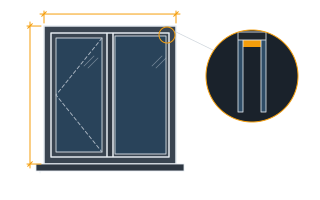
The total face area of the glass panel.
The face area of ONE panel, measured over the glass. For an insulated unit that same face area carries two lites and a spacer, so doubling the glass without changing the area is exactly what an insulated unit does — check which the calculation is being asked for before trusting a comparison between a single glazed and a double glazed panel. Area is also the first thing that decides whether a panel can be handled by hand at all.
The nominal thickness of the glass panel.
For laminated or insulated units, use the combined effective thickness of all glass plies (excluding air/gas gaps).
The glass material's density.
Standard soda-lime float glass is about 2500 kg/m³.
Glass panel weight
162.3 lb
They open the calculator with your figures already in it
Architectural Glass Weight Calculator: 162 lb — shown in imperial, US market. The link sets both, so the result they see is the one on your screen.
Show calculation logicHide calculation logic
How this was calculated
Formula source(s)
- Glass weight = area × thickness × glass density (2500 kg/m³ for standard soda-lime float glass)
Inputs used
- Glass Panel Area
- 32 sq ft
- Glass Thickness
- 0.39 in
- Glass Density
- 156.07 pcf
What this calculation does not cover
- Area and a single thickness are the only geometry in the arithmetic, so drilled holes, patch-fitting cut-outs and notched corners are still counted as solid glass and the panel comes out heavier here than it does on the weighbridge.
- The thickness field accepts 3 mm (0.12 in) to 25 mm (1 in), which covers one lite or a modest two-ply laminate; a heavier build-up such as three 12 mm (0.47 in) plies exceeds that ceiling, so each ply has to be run separately and the answers added together.
- Nothing but glass is weighed — the PVB or other interlayer, a sealed unit's spacer bar and desiccant, gaskets, glazing beads and framing all sit outside the formula, so a finished assembly arrives on site heavier than the figure shown.
- Density is confined to the 2400–2600 kg/m³ (150 – 162 pcf) soda-lime float band, so a specialty glass whose density falls outside that range cannot be entered and its weight has to come from the manufacturer's own data sheet.
- Panel area is limited to 30 m² (323 sq ft), and the answer is the glass by itself: the stillage or A-frame, the crate and the vacuum lifter's own mass all still have to be added before a load is matched against a crane or lifter rating.
Computed in your browser — nothing you enter is uploaded. Presented in US customary units and US trade terminology. Where a formula follows a published standard, that standard and its edition are cited beside it on this page; where none governs, the page says so. Local amendments override model codes — verify against the code in force where you build.
Sources checked 2026-09-05 · in the site-wide review of 2026-09-06 · v1.1.1
Regulatory standards & verification citations1
- Glass weight = area × thickness × glass density (2500 kg/m³ for standard soda-lime float glass)
Cite this page
Your workspace
Most jobs need more than one number. Add the calculators you need next and they open right here, underneath this one — your figures stay on screen and nothing is lost to a page change.