
SettingsSettings for this calculationUS
The standard allowance most suppliers and estimating guides assume for ordinary work.
The total length of ridge and hip lines needing cap shingles.
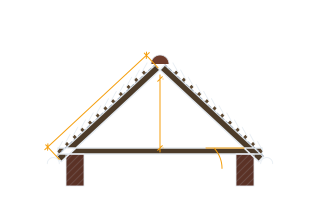
Measure along the top ridge and any hip lines (the sloped edges where two roof planes meet) and add them together.
Tools needed: Tape measure or measuring wheel, Ladder
Extra cap for the pieces cut where hips meet the ridge and at the end of each run.
Each separate run starts and stops with a cut cap, and every hip meeting the ridge takes a mitred or overlapped piece. One long ridge loses little; a hipped roof with several short runs loses a cap or two at every junction, so give it more.
Ridge cap bundles needed
2 bundles
- Ridge/hip length (with waste)
- 42.9 linear ft
They open the calculator with your figures already in it
Roof Ridge Cap Calculator: 2 bundles — shown in imperial, US market. The link sets both, so the result they see is the one on your screen.
Show calculation logicHide calculation logic
How this was calculated
Formula source(s)
- A standard bundle of ridge cap shingles covers approximately 33 linear ft, per common asphalt shingle manufacturer specs
Inputs used
- Total Ridge & Hip Length
- 39 ft
- Cut-End Allowance (%)
- 10
Intermediate steps
- Ridge/hip length (with waste)
- 42.9 linear ft
What this calculation does not cover
- Every bundle is counted as 33 linear feet (10 m) laid at the exposure the maker intends, the single coverage figure the source gives; there is no field for the rating printed on your own wrapper, and no way to tell the arithmetic you plan to lay the caps tighter or wider than that.
- Hip lines have to be measured along the slope and added into the one total yourself — no pitch is asked for anywhere, so a hip scaled off a plan-view drawing goes in short and the bundle count follows it down.
- The allowance is one percentage of whatever total you type, so at the same setting three short hips adding up to sixty feet and one unbroken sixty-foot ridge return exactly the same figure, even though each extra run adds two more cut ends; raise it for a roof of many hips.
- Bundles are rounded up to whole packs, so a 35-foot run and a 59-foot one both come back as two, with the first leaving well over half of the second bundle unused and no remainder reported anywhere in the output.
- Fixings and sealant sit outside the result entirely: the calculation returns a bundle count and nothing else, so nails for the caps still have to be worked out from the same ridge length.
Estimated cost — your price
This site holds no price list for this material — local prices vary too much to publish honestly. Enter your supplier's price and the result is costed with it.
Part of bigger jobs
This trade is one line of several job takeoffs. Run the whole job and every other trade comes back with it, off the same measurements.
also measuresRoofing ShingleRoofing UnderlaymentRoof Eave Ice Dam Protection Membrane Footprint (and Valley Lining)Ridge Vent Linear FootageRoof Truss Spacing & Count
also measures10 other trades
Computed in your browser — nothing you enter is uploaded. Presented in US customary units and US trade terminology. Where a formula follows a published standard, that standard and its edition are cited beside it on this page; where none governs, the page says so. Local amendments override model codes — verify against the code in force where you build.
Sources checked 2026-09-17 · v1.1.0
Regulatory standards & verification citations1
- A standard bundle of ridge cap shingles covers approximately 33 linear ft, per common asphalt shingle manufacturer specs
Cite this page
Your workspace
Most jobs need more than one number. Add the calculators you need next and they open right here, underneath this one — your figures stay on screen and nothing is lost to a page change.
Tools and safety for this job
To lay shingles. Generic types, no brands, no prices.
Protection this work requires
- Most fatal falls on small jobs are from under three metres: use a tower or a ladder tied at the top, and never work off the top two rungs.
- Knives cause more site injuries than any power tool: cut away from your body, change blades often, and wear cut-resistant gloves to EN 388 level C for repeated cutting.
Lay shingles: Roof work is the commonest cause of serious fall injury on domestic sites. Edge protection or a properly erected tower is the equipment that matters most here, and a roof that is steep, high, brittle or wet is a job for a roofer with the right access, not a longer ladder.
Show the 6 tools this job needsHide tools
Essential
Chalk line
Claw hammer
Extension ladder
Tape measure
Tower scaffold or trestles
Utility knife
Also needed as materials: chalk refill, replacement blades.
what each roofing tool is for, and the spec that decides which to buy where one does.