
SettingsSettings for this calculationUS
The interior length of the pool.
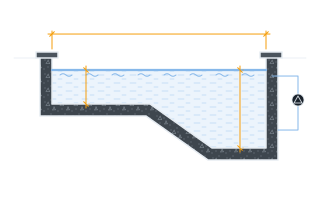
Measure the pool's interior length at the water-line, the same figure you'd use for the water-volume calculator.
The interior width of the pool.
Measure perpendicular to the length, at the water-line.
The average height of the shell wall, from floor to top edge.
This is the water depth plus freeboard (the wall height above the water line to the coping), averaged if the pool has a sloped floor.
The thickness of the gunite/shotcrete shell.
Confirm the exact thickness and reinforcement schedule with the pool designer's structural drawings — this varies with soil conditions and pool design.
Concrete shell volume needed
19.3 yd³
This assumes a simple rectangular pool with uniform shell thickness — freeform, vinyl-lined, fiberglass, or stepped/sloped-floor pools need a detailed shape-specific takeoff from the pool designer's shop drawings. Shell thickness and reinforcement requirements should come from a structural engineer familiar with local soil conditions and pool design standards.
- Shell surface area (floor + walls)
- 1,039.5 sq ft
They open the calculator with your figures already in it
In-Ground Concrete Pool Shell Volume Calculator: 19.25 yd³ — shown in imperial, US market. The link sets both, so the result they see is the one on your screen.
Show calculation logicHide calculation logic
How this was calculated
Formula source(s)
- Shell surface area = floor area + wall area = (Length x Width) + 2x(Length + Width) x Wall Height; Shell volume = Shell surface area x Shell thickness — a standard method for estimating gunite/shotcrete shell material for a simple rectangular pool. This is DISTINCT from this site's existing pool-volume-calculator, which computes the pool's WATER capacity for chemical dosing, not the concrete shell structure itself.
Inputs used
- Pool Length
- 33 ft
- Pool Width
- 16.5 ft
- Average Wall/Shell Height (Water Depth + Freeboard)
- 5 ft
- Shell Thickness
- 6 in
Intermediate steps
- Shell surface area (floor + walls)
- 1,039.5 sq ft
Confidence note: This assumes a simple rectangular pool with uniform shell thickness — freeform, vinyl-lined, fiberglass, or stepped/sloped-floor pools need a detailed shape-specific takeoff from the pool designer's shop drawings. Shell thickness and reinforcement requirements should come from a structural engineer familiar with local soil conditions and pool design standards.
What this calculation does not cover
- No allowance for rebound, overspray or over-shooting. This is the in-place geometry of the shell only; a gunite or shotcrete crew loses material to rebound at the nozzle and habitually shoots proud of the nominal thickness, so the quantity actually pumped is larger. Order against the contractor's own shoot quantity, not this figure.
- Areas are taken at the pool's inside face and one thickness is applied everywhere. The extra concrete in the four corners, in the wall-to-floor junction, in a thickened floor and in the bond beam is not added, and real shells are normally thicker at the floor and at the beam than at the walls.
- Nothing attached to or sitting on the shell is counted: steps, benches, swim-outs, tanning ledges, spa walls, skimmer, light and return niches, and the coping and deck. Deep-end hopper walls and slopes are not modelled either.
- This is a material take-off, not a structural design. Shell thickness, reinforcement, waterproofing, hydrostatic relief and the detailing for a high water table, expansive soil or seismic zone come from the engineer of record and the pool designer's shop drawings, and none of them is checked here.
- The excavation is not sized. The dig is larger than the shell in every direction, and this returns neither the excavation volume nor the spoil to cart away. It is also not the water capacity — use the pool volume calculator for chemical dosing.
Estimated cost — your price
This site holds no price list for this material — local prices vary too much to publish honestly. Enter your supplier's price and the result is costed with it.
Computed in your browser — nothing you enter is uploaded. Presented in US customary units and US trade terminology. Where a formula follows a published standard, that standard and its edition are cited beside it on this page; where none governs, the page says so. Local amendments override model codes — verify against the code in force where you build.
Sources checked 2026-09-02 · in the site-wide review of 2026-09-06 · v1.0.1
Regulatory standards & verification citations1
- Shell surface area = floor area + wall area = (Length x Width) + 2x(Length + Width) x Wall Height; Shell volume = Shell surface area x Shell thickness — a standard method for estimating gunite/shotcrete shell material for a simple rectangular pool. This is DISTINCT from this site's existing pool-volume-calculator, which computes the pool's WATER capacity for chemical dosing, not the concrete shell structure itself.
Cite this page
Your workspace
Most jobs need more than one number. Add the calculators you need next and they open right here, underneath this one — your figures stay on screen and nothing is lost to a page change.