
SettingsSettings for this calculationUS
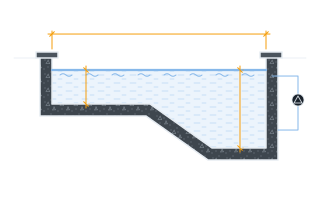
Water volume, worked out from the pool's dimensions.
The salt is directly proportional to it. A volume that is a fifth too high is a fifth too much salt, and salt is the one chemical that only a partial drain takes back out, so it is worth working the volume from the length, width and average depth rather than from memory.
Zero for a pool being converted; otherwise a test reading.
The cell's own display is an estimate from conductivity and temperature and can drift, so check it with a salt test before adding a large amount. Salt is not lost to evaporation — only water leaving the pool takes it: splash-out, backwashing, and draining after rain.
The level in the manual for your cell — the makers differ.
Hayward's AquaRite manual gives 2,700 to 3,400 ppm with 3,200 optimal; Pentair's IntelliChlor guide recommends 3,000 to 3,500 and turns the cell off below 2,600. Take the figure from the manual of the cell you actually have. Aim for the middle rather than the top: salt is easy to add and slow to remove.
From the bag. Pentair asks for at least 99.8%, Hayward over 99%.
Evaporated, granulated salt with no additives is what both makers ask for. Avoid rock salt, iodised salt and anything with an anti-caking agent — sodium ferrocyanide, sold as YPS or yellow prussiate of soda — which can discolour fittings and surfaces. Water-softener pellets of the right purity are acceptable but dissolve more slowly.
Only used to count bags; the weight is the answer.
Pool salt is sold by the bag, so the count is rounded up to whole bags. Where the last bag would be mostly spare, add the weight rather than the count and keep the rest dry for the next top-up.
Salt to add
353 lb
A rise of 3,200 ppm. Add it in two stages and test between them — salt only comes back out by draining.
- Rise asked for
- 3,200 ppm
- 40 lb bags
- 9 bags
- Share of the pool to drain, if lowering
- 0 %
- Salt per 10,000 gal per 100 ppm
- 8.36 lb
They open the calculator with your figures already in it
Pool Salt Calculator (Salt Chlorine Generator): 353 lb — shown in imperial, US market. The link sets both, so the result they see is the one on your screen.
Show calculation logicHide calculation logic
How this was calculated
Formula source(s)
- Salt is read as parts per million of sodium chloride, which is milligrams per litre, so the salt to add is the rise times the pool's litres divided by the salt's purity — the basis of the makers' own addition tables
- Hayward AquaRite Operation and Installation Manual: ideal salt 2,700 to 3,400 ppm with 3,200 optimal; salt begins to be tasted at about 3,500 to 4,000 ppm; use sodium chloride over 99% pure, never rock salt, salt with yellow prussiate of soda, anti-caking additives or iodised salt; the only way to lower salt is to partially drain and refill
- Pentair IntelliChlor IC15 Installation and User's Guide: 3,000 to 3,500 ppm recommended for optimum water conditions; below 2,600 ppm the unit turns off; above 4,500 ppm may cause excessive corrosion; use salt at least 99.8% pure sodium chloride, with no anti-caking agent (sodium ferrocyanide, YPS)
Inputs used
- Pool volume
- 13210 gal
- Current salt level (ppm)
- 0
- Target salt level (ppm)
- 3200
- Salt purity (% sodium chloride)
- 99.8
- Bag size
- 40 lb bag
Intermediate steps
- Rise asked for
- 3,200 ppm
- 40 lb bags
- 9 bags
- Share of the pool to drain, if lowering
- 0 %
- Salt per 10,000 gal per 100 ppm
- 8.36 lb
Confidence note: A rise of 3,200 ppm. Add it in two stages and test between them — salt only comes back out by draining.
What this calculation does not cover
- The range is the cell maker's, and the makers do not agree: Hayward's AquaRite wants 2,700 to 3,400 ppm with 3,200 optimal, Pentair's IntelliChlor 3,000 to 3,500 for best results and 4,500 at most. Too little and the cell produces less chlorine or shuts down; too much and it can also shut down, and water starts to taste salty from about 3,500 to 4,000 ppm. The manual for the cell you own is the authority.
- Salt only goes one way. Nothing but draining brings it down, so add it in two stages — most of it, circulate and test, then the rest — rather than all at once on an estimated volume.
- Brush it around and do not let it pile on the floor, run the pump for a day with the suction from the main drain, and expect the cell's display to take up to 24 hours to catch up. A new plaster pool should cure for 10 to 14 days before salt goes in.
- Use sodium chloride of the purity the maker asks for. Rock salt, iodised salt and salt with an anti-caking agent (sodium ferrocyanide, YPS) are all excluded by both makers' manuals.
- Salt raises the water's total dissolved solids, and a TDS test on a salt pool reads the salt too. Whoever tests for TDS needs to know the pool is salt-chlorinated and subtract the salinity.
- Stabiliser is lost with the same water as salt, so the two usually fall together. Test cyanuric acid whenever you top up salt.
Estimated cost — your price
This site holds no price list for this material — local prices vary too much to publish honestly. Enter your supplier's price and the result is costed with it.
Computed in your browser — nothing you enter is uploaded. Presented in US customary units and US trade terminology. Where a formula follows a published standard, that standard and its edition are cited beside it on this page; where none governs, the page says so. Local amendments override model codes — verify against the code in force where you build.
Sources checked 2026-09-25 · v1.0.0
Regulatory standards & verification citations3
- Salt is read as parts per million of sodium chloride, which is milligrams per litre, so the salt to add is the rise times the pool's litres divided by the salt's purity — the basis of the makers' own addition tables
- Hayward AquaRite Operation and Installation Manual: ideal salt 2,700 to 3,400 ppm with 3,200 optimal; salt begins to be tasted at about 3,500 to 4,000 ppm; use sodium chloride over 99% pure, never rock salt, salt with yellow prussiate of soda, anti-caking additives or iodised salt; the only way to lower salt is to partially drain and refill
- Pentair IntelliChlor IC15 Installation and User's Guide: 3,000 to 3,500 ppm recommended for optimum water conditions; below 2,600 ppm the unit turns off; above 4,500 ppm may cause excessive corrosion; use salt at least 99.8% pure sodium chloride, with no anti-caking agent (sodium ferrocyanide, YPS)
Cite this page
Your workspace
Most jobs need more than one number. Add the calculators you need next and they open right here, underneath this one — your figures stay on screen and nothing is lost to a page change.