
SettingsSettings for this calculationUS
Water volume, worked out from the pool's dimensions.
The water to replace is a share of it, so the volume sets the answer directly. A pool 10 by 5 metres at 1.5 m average depth holds 75 m³ — about 19,800 US gallons.
The reading that is too high: stabiliser, salt or calcium.
Anything dissolved that the pool does not consume behaves the same way — cyanuric acid, salt, calcium hardness, total dissolved solids — so one page serves all of them. Use a fresh test, since the answer is only as good as the reading.
Where you want the same figure to end up.
Aim a little below the level you actually want to hold: stabilised chlorine keeps adding stabiliser, hard fill water keeps adding calcium, and a pool drained exactly to target is back above it at the first top-ups.
The same figure in the water you refill with. Test it.
Mains water carries essentially no stabiliser and little salt, but its calcium hardness can be anything from nearly none to more than your target. The share to drain grows sharply as the fill water approaches the target, and at the target it becomes impossible.
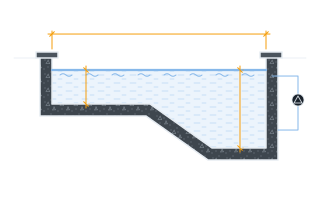
Length times width at the water line. Used only for how far the level drops.
Water leaves from the top, so the level falls by the drained volume over the surface area — while the walls are vertical. Once the level reaches the shallow end's floor the surface shrinks and the level falls faster than this figure.
Water to drain and replace
6,605 gallons
Replace 33.3% of the pool, or 18.4% twice with a test between.
- Share of the pool to replace
- 33.33 %
- Share for each of two equal stages
- 18.35 %
- Extra water if drained and filled at once
- 21.64 %
- Level drop over the surface
- 19.62 in
- Water used if drained and filled at once
- 8,034.29 gallons
They open the calculator with your figures already in it
Pool Partial Drain and Refill Calculator: 6,605 gallons — shown in imperial, US market. The link sets both, so the result they see is the one on your screen.
Show calculation logicHide calculation logic
How this was calculated
Formula source(s)
- Dilution by replacement is a mass balance: draining a share f and refilling with water at level F takes a pool from C to (1 - f)C + fF, so f = (C - T) / (C - F); replacing water continuously, perfectly mixed, needs V x ln((C - F) / (T - F)) of fill water instead
- Hayward AquaRite Operation and Installation Manual: the only way to lower the salt concentration is to partially drain the pool and refill with fresh water; salt is lost only with water leaving the pool, not to evaporation
- CDC Model Aquatic Health Code, 2023, 5.7.3.1.3.2: the CYA level at all aquatic venues shall remain at or below 90 ppm — a limit that, once exceeded, is met by replacing water
Inputs used
- Pool volume
- 19815 gal
- Current level (ppm)
- 120
- Target level (ppm)
- 80
- Fill water level (ppm)
- 0
- Water surface area
- 540 sq ft
Intermediate steps
- Share of the pool to replace
- 33.33 %
- Share for each of two equal stages
- 18.35 %
- Extra water if drained and filled at once
- 21.64 %
- Level drop over the surface
- 19.62 in
- Water used if drained and filled at once
- 8,034.29 gallons
Confidence note: Replace 33.3% of the pool, or 18.4% twice with a test between.
What this calculation does not cover
- Everything dissolved falls by the same share, not just the figure you are fixing. Replacing a third of the pool takes a third of the salt, stabiliser, calcium and alkalinity with it, and the fill water brings its own pH and alkalinity in. Test everything after refilling and re-dose what you wanted to keep.
- The page does not say whether your pool can be lowered this far. An emptied in-ground shell can be pushed up by groundwater, and a vinyl liner can move or shrink out of water, so how low a pool may go is the builder's or manufacturer's instruction to follow. Where it cannot go far, drain in stages: the page shows the share for two equal stages.
- Draining while filling uses more water than draining first. Perfectly mixed, it takes the volume times the natural log of the ratio — a third off costs about 22% more water than draining a third and refilling — and in practice incoming water often short-circuits to the drain, which costs more again.
- The level drop assumes vertical walls over the whole surface. Below the shallow end's floor the surface shrinks and the level falls faster, and a pool with a sloping floor reaches that point sooner than its average depth suggests.
- Where drained water may go is a local rule. Chlorinated and salt water are often restricted from storm drains, and salt water can harm lawns and planting where it soaks in.
Estimated cost — your price
This site holds no price list for this material — local prices vary too much to publish honestly. Enter your supplier's price and the result is costed with it.
Computed in your browser — nothing you enter is uploaded. Presented in US customary units and US trade terminology. Where a formula follows a published standard, that standard and its edition are cited beside it on this page; where none governs, the page says so. Local amendments override model codes — verify against the code in force where you build.
Sources checked 2026-09-25 · v1.0.0
Regulatory standards & verification citations3
- Dilution by replacement is a mass balance: draining a share f and refilling with water at level F takes a pool from C to (1 - f)C + fF, so f = (C - T) / (C - F); replacing water continuously, perfectly mixed, needs V x ln((C - F) / (T - F)) of fill water instead
- Hayward AquaRite Operation and Installation Manual: the only way to lower the salt concentration is to partially drain the pool and refill with fresh water; salt is lost only with water leaving the pool, not to evaporation
- CDC Model Aquatic Health Code, 2023, 5.7.3.1.3.2: the CYA level at all aquatic venues shall remain at or below 90 ppm — a limit that, once exceeded, is met by replacing water
Cite this page
Your workspace
Most jobs need more than one number. Add the calculators you need next and they open right here, underneath this one — your figures stay on screen and nothing is lost to a page change.