
SettingsSettings for this calculationUS
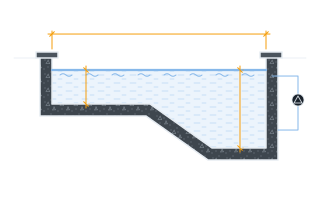
Water volume, worked out from the pool's dimensions.
The dose is directly proportional to it. Calcium, like salt and stabiliser, only comes down again with water leaving the pool, so an overestimate is corrected with a drain rather than a dose.
A calcium hardness test, not total hardness.
Total hardness counts magnesium as well; the pool ranges refer to calcium alone, reported as calcium carbonate. Test the fill water too — in a hard-water area it may already be near the target, and every top-up adds more.
From the equipment or finish maker. Pentair gives 200 to 300 for pools.
Pentair's salt cell guide gives 200 to 300 ppm for pools and 150 to 200 for spas; Hayward's gives 200 to 400. Too little and the water tends to take calcium from plaster, grout and stone; too much and it tends to lay scale, on the salt cell first. Where the two ends sit also depends on pH, alkalinity and temperature together, which is what a saturation index weighs and this page does not.
From the label: pellets are commonly 94 to 97%, flake less.
Anhydrous pellets carry 94 to 97% calcium chloride; flake contains water of crystallisation and so less calcium chloride in every bag — the dihydrate is 75.49% by composition. A product labelled 77% needs about a fifth more by weight than one labelled 94% for the same rise.
Calcium chloride to add
13 lb
A rise of 100 ppm with 94% calcium chloride.
- Rise asked for
- 100 ppm
- Calcium chloride per litre per ppm (pure)
- 1.11 mg
- Product per 10,000 gal per 10 ppm
- 0.98 lb
They open the calculator with your figures already in it
Pool Calcium Hardness Increaser Calculator: 13.01 lb — shown in imperial, US market. The link sets both, so the result they see is the one on your screen.
Show calculation logicHide calculation logic
How this was calculated
Formula source(s)
- Calcium hardness is reported as ppm of calcium carbonate (100.086 g/mol); one mole of calcium chloride supplies one mole of calcium, so 110.99 / 100.086 = 1.1089 mg of calcium chloride raises hardness by 1 ppm in a litre
- OxyChem Calcium Chloride Handbook: molecular weight 110.99 for anhydrous CaCl2 and 147.02 for the dihydrate, which is 75.49% CaCl2; commercial grades include 94 to 97% anhydrous pellets and 83 to 87% flake; calcium chloride has an exothermic heat of solution and solid products release a large amount of heat when dissolved
- Pentair IntelliChlor IC15 Installation and User's Guide: calcium hardness 200 to 300 ppm for pools and 150 to 200 for spas; saturation index -0.3 to +0.3
- Hayward AquaRite Operation and Installation Manual: calcium 200 to 400 ppm; calcium scale on the cell usually comes from old pool water and a high calcium level
Inputs used
- Pool volume
- 13210 gal
- Current calcium hardness (ppm)
- 150
- Target calcium hardness (ppm)
- 250
- Calcium chloride content (%)
- 94
Intermediate steps
- Rise asked for
- 100 ppm
- Calcium chloride per litre per ppm (pure)
- 1.11 mg
- Product per 10,000 gal per 10 ppm
- 0.98 lb
Confidence note: A rise of 100 ppm with 94% calcium chloride.
What this calculation does not cover
- Calcium chloride gets hot as it dissolves — the handbook calls it a large amount of heat. Dissolve it in a bucket of pool water, adding the product to the water and not the water to the product, then pour it in around the pool with the pump running, rather than broadcasting dry product onto the floor.
- Only raising is a dose. Nothing added brings calcium down; lowering it means replacing part of the pool with water softer than the target, and in a hard-water area the fill water may not be soft enough to do it. The drain-and-refill calculator includes the fill water's own hardness.
- Hardness is one of four figures, not a verdict. Whether water scales or dissolves plaster depends on calcium, alkalinity, pH and temperature together — a saturation index — and a pool balanced on hardness alone can still be aggressive. Pentair's guide asks for an index between -0.3 and +0.3.
- Dose in stages. Add most of it, circulate a full turnover, test, then add the rest: hardness is slow to fix once it overshoots, and the arithmetic assumes the volume is right.
- Product strength varies widely between grades. The page divides by the percentage you enter; a flake product of lower content needs proportionally more weight than a pellet for the same rise.
Estimated cost — your price
This site holds no price list for this material — local prices vary too much to publish honestly. Enter your supplier's price and the result is costed with it.
Computed in your browser — nothing you enter is uploaded. Presented in US customary units and US trade terminology. Where a formula follows a published standard, that standard and its edition are cited beside it on this page; where none governs, the page says so. Local amendments override model codes — verify against the code in force where you build.
Sources checked 2026-09-25 · v1.0.0
Regulatory standards & verification citations4
- Calcium hardness is reported as ppm of calcium carbonate (100.086 g/mol); one mole of calcium chloride supplies one mole of calcium, so 110.99 / 100.086 = 1.1089 mg of calcium chloride raises hardness by 1 ppm in a litre
- OxyChem Calcium Chloride Handbook: molecular weight 110.99 for anhydrous CaCl2 and 147.02 for the dihydrate, which is 75.49% CaCl2; commercial grades include 94 to 97% anhydrous pellets and 83 to 87% flake; calcium chloride has an exothermic heat of solution and solid products release a large amount of heat when dissolved
- Pentair IntelliChlor IC15 Installation and User's Guide: calcium hardness 200 to 300 ppm for pools and 150 to 200 for spas; saturation index -0.3 to +0.3
- Hayward AquaRite Operation and Installation Manual: calcium 200 to 400 ppm; calcium scale on the cell usually comes from old pool water and a high calcium level
Cite this page
Your workspace
Most jobs need more than one number. Add the calculators you need next and they open right here, underneath this one — your figures stay on screen and nothing is lost to a page change.