
SettingsSettings for this calculationUS
Water volume, worked out from the pool rather than remembered.
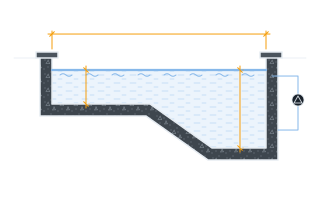
Every dose on this page is directly proportional to it, so a volume that is twenty per cent out is a dose that is twenty per cent out, every time, in the same direction. Work it from the actual dimensions and the average depth — a pool with a deep end is not its deepest measurement times its area.
Measured today, by titration, not read off last week's log.
Test strips are a rough guide for alkalinity and a titration kit is not expensive; the difference between 60 and 90 on a strip is a colour judgement, and it is the difference between a dose that works and one that overshoots. Take the sample elbow-deep away from a return jet, where the water is mixed.
Where you want the buffer to sit.
The usual range is 80 to 120 ppm and the two ends cost different things. Low alkalinity lets pH wander on every rainfall and every dose, and leaves the water hungry for calcium it will take out of plaster and grout. High alkalinity holds pH up stubbornly, so it climbs back after every acid dose and the water tends to cloud and scale. A salt-chlorinated pool usually sits nearer the lower end, because the cell itself pushes pH up all day.
The stabiliser reading. Enter 0 for an indoor or unstabilised pool.
This does not change the dose, and it changes how the reading should be read. Cyanurate is itself a weak buffer and a titration counts it, so a stabilised pool's measured alkalinity overstates the CARBONATE alkalinity — the part that actually holds pH — by roughly a third of the cyanuric acid present. At 80 ppm of stabiliser, a test reading 100 is carbonate 73, which is a different pool from the one the number suggests. The page shows both.
What you actually have. One raises, two lower.
Sodium bicarbonate is baking soda and the pool-grade product is the same chemical in a bigger bag. Between the two acids: muriatic works out cheaper per unit of effect and is poured, which means fumes and splashes and a container that has to be stored properly; dry acid is a granule that is easier and safer to handle and leaves sulfate behind, which accumulates in a pool that is rarely drained.
Product to add
7.4 lb
A 40 ppm raise on a measured 60 ppm. Cyanurate accounts for about 22% of that reading.
- Change asked for
- 40 ppm
- Carbonate alkalinity, cyanurate removed
- 46.67 ppm
- Alkalinity the cyanuric acid is reading as
- 13.33 ppm
- Dose per 10,000 gal per ppm
- 0.14 lb
They open the calculator with your figures already in it
Pool Total Alkalinity Adjustment Calculator: 7.4 lb — shown in imperial, US market. The link sets both, so the result they see is the one on your screen.
Show calculation logicHide calculation logic
How this was calculated
Formula source(s)
- Total alkalinity is reported as ppm of calcium carbonate, whose equivalent weight is 50.043 g/eq; a reagent carrying one equivalent per mole moves alkalinity by its molar mass over that figure
- Sodium bicarbonate (84.007 g/mol) raises alkalinity strongly and pH only slightly, which is why alkalinity is set before pH rather than after it
- Acid removes alkalinity and pH together in fixed proportion; aeration drives off dissolved carbon dioxide and raises pH without restoring alkalinity, which is how the two are separated in practice
- Cyanuric acid contributes to a titrated alkalinity reading — roughly a third of the cyanurate concentration near pH 7.5 — so a stabilised pool's carbonate alkalinity is lower than its test kit says
Inputs used
- Pool volume
- 13210 gal
- Current total alkalinity (ppm)
- 60
- Target total alkalinity (ppm)
- 100
- Cyanuric acid (ppm)
- 40
- Product
- Sodium bicarbonate — raises alkalinity
Intermediate steps
- Change asked for
- 40 ppm
- Carbonate alkalinity, cyanurate removed
- 46.67 ppm
- Alkalinity the cyanuric acid is reading as
- 13.33 ppm
- Dose per 10,000 gal per ppm
- 0.14 lb
Confidence note: A 40 ppm raise on a measured 60 ppm. Cyanurate accounts for about 22% of that reading.
What this calculation does not cover
- ACID LOWERS ALKALINITY AND pH TOGETHER and nothing in the chemistry separates them. Dose until the alkalinity is right and the pH is now too low; dose until the pH is right and the alkalinity has hardly moved. The way out is not another product: add the acid, then AERATE — a fountain, a spa jet, the returns angled up — which drives off carbon dioxide and lifts pH while leaving alkalinity where the acid put it. Expect to repeat it over days rather than in one afternoon.
- Bicarbonate raises pH as well, by a small amount, so set alkalinity FIRST and read the pH afterwards. Doing it the other way round means adjusting pH twice.
- Dose in stages and re-test. Half the calculated amount, circulate for a full turnover, test again: the arithmetic assumes the product dissolves and distributes completely, and a pool that has been sitting will not mix as fast as one that has been running.
- A titration counts cyanurate as alkalinity, so a stabilised pool's carbonate alkalinity — the part that actually buffers pH — is below the measured figure. The page reports both and doses on the measured one, because that is what published ranges refer to and what the next test will read.
- Nothing here covers calcium hardness, which decides with alkalinity whether the water scales or dissolves what it touches — the calcium hardness calculator sets it — and nothing here is a saturation index. A pool balanced on these two figures alone can still be aggressive to plaster.
- Product strengths vary. Dry acid is taken at 93% sodium bisulfate and muriatic at 31.45% — the common 20 degrees Baumé grade. A 14.5% or 34.6% bottle is a different dose, and the label is the authority.
Estimated cost — your price
This site holds no price list for this material — local prices vary too much to publish honestly. Enter your supplier's price and the result is costed with it.
Computed in your browser — nothing you enter is uploaded. Presented in US customary units and US trade terminology. Where a formula follows a published standard, that standard and its edition are cited beside it on this page; where none governs, the page says so. Local amendments override model codes — verify against the code in force where you build.
Sources checked 2026-09-23 · v1.0.0
Regulatory standards & verification citations4
- Total alkalinity is reported as ppm of calcium carbonate, whose equivalent weight is 50.043 g/eq; a reagent carrying one equivalent per mole moves alkalinity by its molar mass over that figure
- Sodium bicarbonate (84.007 g/mol) raises alkalinity strongly and pH only slightly, which is why alkalinity is set before pH rather than after it
- Acid removes alkalinity and pH together in fixed proportion; aeration drives off dissolved carbon dioxide and raises pH without restoring alkalinity, which is how the two are separated in practice
- Cyanuric acid contributes to a titrated alkalinity reading — roughly a third of the cyanurate concentration near pH 7.5 — so a stabilised pool's carbonate alkalinity is lower than its test kit says
Cite this page
Your workspace
Most jobs need more than one number. Add the calculators you need next and they open right here, underneath this one — your figures stay on screen and nothing is lost to a page change.