
SettingsSettings for this calculationUS
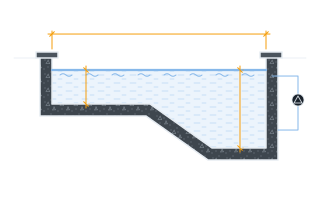
Water volume, worked out from the pool's dimensions.
The dose is directly proportional to it, and stabiliser — like salt — only comes back out with water, so an overestimated volume becomes a stabiliser level you then have to drain away.
Zero for fresh water; otherwise a test reading.
Test it rather than assume it. A pool dosed with trichlor tablets or dichlor granules gains stabiliser with every dose, and after a season it is often far higher than anyone added on purpose.
Where you want it. Public venues under the MAHC stay at or below 90 ppm.
Pentair's guide keeps 30 to 50 ppm with a salt chlorine generator; Hayward's AquaRite manual gives 60 to 80. Higher protects chlorine from the sun better and binds more of it, so every step up needs more free chlorine to do the same work — the page shows how much the 45:1 ratio implies. Indoor pools and spas: see the notes before adding any.
From the label. Granular stabiliser is sold at 99 to 100%.
A liquid or pre-dissolved stabiliser is a different product at a different strength — enter what its label states, or the dose will be several times too small.
Only used to show how fast the level climbs on its own.
Trichlor and dichlor are stabilised chlorine: the cyanuric acid is part of the molecule and stays in the water when the chlorine is used up. The page shows how much each 10 ppm of chlorine from them leaves behind, which is what decides how often a tablet pool ends up being drained.
Stabiliser to add
4.45 lb
A rise of 40 ppm. At 40 ppm the 45:1 ratio needs at least 2.0 ppm of free chlorine.
- Rise asked for
- 40 ppm
- Least free chlorine at this level (45:1, and 2.0 ppm floor)
- 2 ppm
- Stabiliser added by each 10 ppm of chlorine from your source
- 0 ppm
- Share of the pool to drain, if lowering
- 0 %
- Stabiliser per 10,000 gal per 10 ppm
- 0.84 lb
They open the calculator with your figures already in it
Pool Stabilizer (Cyanuric Acid) Calculator: 4.45 lb — shown in imperial, US market. The link sets both, so the result they see is the one on your screen.
Show calculation logicHide calculation logic
How this was calculated
Formula source(s)
- Cyanuric acid is read in ppm, which is milligrams per litre, so the stabiliser to add is the rise times the pool's litres divided by the product's cyanuric acid content
- CDC Model Aquatic Health Code, 2023: 5.7.3.1.3.2, the CYA level at all aquatic venues shall remain at or below 90 ppm; 5.7.3.1.1.2.2, venues using CYA maintain free chlorine of at least 2.0 ppm; 5.7.3.1.3.1, no CYA in spas and therapy pools for new construction; 6.6.3, a CYA to free chlorine ratio above 45:1 is an imminent health hazard
- Pentair IntelliChlor IC15 Installation and User's Guide: cyanuric acid is needed in outdoor pools; 90% of unstabilised chlorine is destroyed by the sun's UV within two hours; keep 30 to 50 ppm with a salt chlorine generator; do not use cyanuric acid in indoor pools
- Stabilised chlorine carries cyanuric acid in: one mole of trichloroisocyanuric acid releases three moles of chlorine (as Cl2, 70.906 g/mol) and one of cyanuric acid (129.07 g/mol); sodium dichloroisocyanurate releases two and one
Inputs used
- Pool volume
- 13210 gal
- Current cyanuric acid (ppm)
- 0
- Target cyanuric acid (ppm)
- 40
- Cyanuric acid content (%)
- 99
- Everyday chlorine
- Liquid chlorine, cal-hypo or a salt cell — adds no stabiliser
Intermediate steps
- Rise asked for
- 40 ppm
- Least free chlorine at this level (45:1, and 2.0 ppm floor)
- 2 ppm
- Stabiliser added by each 10 ppm of chlorine from your source
- 0 ppm
- Share of the pool to drain, if lowering
- 0 %
- Stabiliser per 10,000 gal per 10 ppm
- 0.84 lb
Confidence note: A rise of 40 ppm. At 40 ppm the 45:1 ratio needs at least 2.0 ppm of free chlorine.
What this calculation does not cover
- Stabiliser does not break down in ordinary pool use, so the dependable way to lower it is to replace part of the water — which is why it is worth adding in stages and testing between them rather than correcting an overshoot afterwards.
- Every ppm of stabiliser binds some chlorine. A higher level protects chlorine from the sun and leaves less of it active, so the free chlorine that does the same work rises with it. The Model Aquatic Health Code holds public venues to a CYA to free chlorine ratio of no more than 45:1 and a free chlorine of at least 2.0 ppm wherever stabiliser is used.
- Trichlor and dichlor add stabiliser with every dose: about 6 ppm for every 10 ppm of chlorine from trichlor and about 9 ppm from dichlor. A pool run on them all season climbs whether anyone adds stabiliser or not.
- Not for indoor pools, spas or therapy pools. Stabiliser protects chlorine from sunlight and does nothing indoors but bind it; Pentair's guide says not to use it in indoor pools, and the MAHC excludes it from new spas and therapy pools.
- Granular cyanuric acid dissolves slowly. A test taken the same day reads low, and dosing again on that reading is how pools overshoot — wait until it has fully dissolved, which can take days, before testing and topping up.
- The 90 ppm figure is the MAHC's for public aquatic venues; local codes and a private pool's own practice may set other limits, and the page shows the target you enter against the ratio rather than approving it.
Estimated cost — your price
This site holds no price list for this material — local prices vary too much to publish honestly. Enter your supplier's price and the result is costed with it.
Computed in your browser — nothing you enter is uploaded. Presented in US customary units and US trade terminology. Where a formula follows a published standard, that standard and its edition are cited beside it on this page; where none governs, the page says so. Local amendments override model codes — verify against the code in force where you build.
Sources checked 2026-09-25 · v1.0.0
Regulatory standards & verification citations4
- Cyanuric acid is read in ppm, which is milligrams per litre, so the stabiliser to add is the rise times the pool's litres divided by the product's cyanuric acid content
- CDC Model Aquatic Health Code, 2023: 5.7.3.1.3.2, the CYA level at all aquatic venues shall remain at or below 90 ppm; 5.7.3.1.1.2.2, venues using CYA maintain free chlorine of at least 2.0 ppm; 5.7.3.1.3.1, no CYA in spas and therapy pools for new construction; 6.6.3, a CYA to free chlorine ratio above 45:1 is an imminent health hazard
- Pentair IntelliChlor IC15 Installation and User's Guide: cyanuric acid is needed in outdoor pools; 90% of unstabilised chlorine is destroyed by the sun's UV within two hours; keep 30 to 50 ppm with a salt chlorine generator; do not use cyanuric acid in indoor pools
- Stabilised chlorine carries cyanuric acid in: one mole of trichloroisocyanuric acid releases three moles of chlorine (as Cl2, 70.906 g/mol) and one of cyanuric acid (129.07 g/mol); sodium dichloroisocyanurate releases two and one
Cite this page
Your workspace
Most jobs need more than one number. Add the calculators you need next and they open right here, underneath this one — your figures stay on screen and nothing is lost to a page change.