
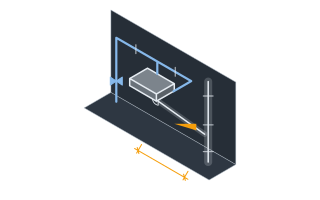
SettingsSettings for this calculationUS
The density of the fluid in the closed loop.
Water at typical hydronic operating temperatures is close to 1000 kg/m³; glycol mixtures run somewhat higher.
The speed the pressure wave travels through the fluid-filled pipe — roughly 1200 m/s (about 3,900 ft/s) in rigid pipe, and 300-900 m/s (about 1,000-3,000 ft/s) in plastic pipe.
Rigid pipe (steel, copper) transmits the pressure wave much faster than flexible plastic pipe, which absorbs some of the surge through pipe wall expansion.
The sudden change in flow velocity, e.g. from a fast-closing valve.
A near-instantaneous valve closure produces the full Joukowsky surge; slower valve closures reduce the effective velocity change and resulting surge.
Surge pressure
261 psi
This calculates the theoretical instantaneous Joukowsky surge pressure only — actual surge arrester/expansion chamber sizing to absorb this energy requires the manufacturer's sizing charts for your specific pipe size and system pressure rating.
They open the calculator with your figures already in it
Closed-Loop Hydronic Water Hammer Surge Pressure Calculator: 261 psi — shown in imperial, US market. The link sets both, so the result they see is the one on your screen.
Show calculation logicHide calculation logic
How this was calculated
Formula source(s)
- Joukowsky equation: ΔP = ρ × a × Δv, where ρ is fluid density, a is the pressure wave propagation speed in the pipe, and Δv is the sudden change in flow velocity — the standard method for estimating instantaneous water hammer surge pressure from rapid valve closure
Inputs used
- Fluid Density
- 62.43 pcf
- Pressure Wave Speed
- 3937.01 ft/s
- Change in Flow Velocity
- 4.92 ft/s
Confidence note: This calculates the theoretical instantaneous Joukowsky surge pressure only — actual surge arrester/expansion chamber sizing to absorb this energy requires the manufacturer's sizing charts for your specific pipe size and system pressure rating.
What this calculation does not cover
- This is a pressure RISE, not the pressure the pipe sees. The surge adds to whatever the system is already sitting at, so what gets checked against the rating of the pipe, the fittings and the equipment on the loop is operating pressure plus this figure. The wave also has a negative half: the down-surge behind it can pull toward vapor pressure, and if the water column separates and then rejoins, the slam when it does can exceed the rise calculated here.
- Whether a closure counts as sudden depends on the length of the run, which is never entered. The full Joukowsky value applies only when the valve shuts faster than the wave can travel to the end of the pipe and back — twice the length divided by the wave speed. On a 300 m (984 ft) run at 1,200 m/s that window is half a second, so nearly any quick-acting valve produces the full surge; on a 6 m (20 ft) branch it is a hundredth of a second, and a solenoid that feels instantaneous is slow enough that the real surge sits well below this.
- Wave speed is not a property of the pipe material alone. It falls with thinner walls and larger diameters that let the pipe flex, it changes with how the run is anchored, and it drops sharply with entrained air — a few percent of air in the line can halve it, and take the surge down with it. That is why a system commissioned before it is properly vented behaves nothing like the same system a month later.
Add the equipment this sizes
This result is a specification — 261 psi — not a quantity. Put the thing it sizes into your project: how many, what you call it, and your supplier’s price.
Computed in your browser — nothing you enter is uploaded. Presented in US customary units and US trade terminology. Where a formula follows a published standard, that standard and its edition are cited beside it on this page; where none governs, the page says so. Local amendments override model codes — verify against the code in force where you build.
Sources checked 2026-09-06 · in the site-wide review of 2026-09-06 · v1.2.1
Regulatory standards & verification citations1
- Joukowsky equation: ΔP = ρ × a × Δv, where ρ is fluid density, a is the pressure wave propagation speed in the pipe, and Δv is the sudden change in flow velocity — the standard method for estimating instantaneous water hammer surge pressure from rapid valve closure
Cite this page
Your workspace
Most jobs need more than one number. Add the calculators you need next and they open right here, underneath this one — your figures stay on screen and nothing is lost to a page change.