Materials & Quantities

Backflow Preventer Discharge Velocity Calculator

Calculate the water velocity through a backflow preventer's pipe connection at a given flow rate.

  • Answers as you type
  • Every formula cited
  • Calculated in your browser
SettingsSettings for this calculationUS
Market
Imperial · sales tax
The design flow rate through the backflow preventer.

Use the peak or design flow rate expected through this connection, in the unit shown.

The internal diameter of the pipe at the backflow preventer connection.

Use the actual internal diameter of the pipe connection, matching the backflow preventer's port size.

Flow velocity

484.1 ft/min

High confidence
Then change the inputs to see how far the answer moves.

Show calculation logic

How this was calculated

Formula source(s)

  • Velocity = flow rate ÷ pipe cross-sectional area, the standard method for checking flow velocity through a backflow preventer assembly against the manufacturer's rated maximum velocity

Inputs used

Flow Rate
79 gal/min
Pipe Diameter
2 in
Final result484.07 ft/min

What this calculation does not cover

  • The relief port is the flow that floods plant rooms, and it is not this one. A reduced-pressure assembly is built to dump water to atmosphere when a check fouls or downstream pressure rises, and the rate at full relief can be a large fraction of line flow — far more than a routine floor drain and air-gap fitting will swallow. That receptor is sized from the manufacturer's published relief discharge for the specific model and size, and it is what decides whether a failure is a puddle or a ceiling coming down on the floor below.
  • The velocity limit that bites first usually belongs to the pipe, not the assembly. Copper thins by erosion-corrosion above roughly 8 ft/s (2.4 m/s) cold and about half that on hot recirculating lines, and it thins at the elbow and tee immediately downstream where the flow is still disturbed by the device — with plumbing codes capping velocity for noise on top of that. A figure comfortably inside the assembly's rating can still be outside what the pipe carrying it will survive.

Add the equipment this sizes

This result is a specification — 484.1 ft/min — not a quantity. Put the thing it sizes into your project: how many, what you call it, and your supplier’s price.

2 in
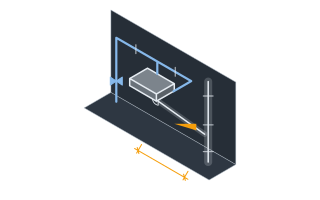
Schematic, drawn to the proportions you entered — not to scale on screen.

Computed in your browser — nothing you enter is uploaded. Presented in US customary units and US trade terminology. Where a formula follows a published standard, that standard and its edition are cited beside it on this page; where none governs, the page says so. Local amendments override model codes — verify against the code in force where you build.

Sources checked 2026-09-06 · in the site-wide review of 2026-09-06 · v1.1.1

Regulatory standards & verification citations1
  1. Velocity = flow rate ÷ pipe cross-sectional area, the standard method for checking flow velocity through a backflow preventer assembly against the manufacturer's rated maximum velocity
Cite this page

Your workspace

Most jobs need more than one number. Add the calculators you need next and they open right here, underneath this one — your figures stay on screen and nothing is lost to a page change.

Now that you have the number

These guides cover the work this quantity is for — the first ones run this calculator inside the section that raises the question.

  • Matched precipitation rate governs every irrigation zone: group heads by output before layout, then set turf and run times to the rate you measured.

  • Turnover time sets pump duty, filter area, pipe size, chemical demand and running cost — size it once, honestly, and the rest of the plantroom follows.

  • The wait at the furthest tap is a pipe volume divided by a flow rate, and every method of shortening it costs heat around the clock.

Called something else where you work? Trap and water seal — the term in each market, how close the equivalence really is, and the standard that governs it.

Already gone wrong? There is a smell of drains in the house

How to calculate backflow preventer discharge velocity in 3 steps

  1. Flow RateThe design flow rate through the backflow preventer.
  2. Pipe DiameterThe internal diameter of the pipe at the backflow preventer connection.
  3. Flow velocityThe tool computes the flow velocity from those figures and shows the formula, its sources, and a confidence rating alongside it.

Flow velocity by flow rate

Page defaults, not your figures above.

Flow RateFlow velocity (ft/min)
40 gal/min253
60 gal/min380
80 gal/min506
100 gal/min633
120 gal/min759
140 gal/min886

Frequently asked questions

Why does flow velocity matter for a backflow preventer?
Manufacturers rate backflow preventers for a maximum flow velocity through their internal components; exceeding it can cause excessive pressure loss, valve chatter, or accelerated wear on internal seals and check mechanisms.
How do I check this against the manufacturer's rating?
Compare the calculated velocity to the maximum velocity stated in the manufacturer's technical data for that specific model and size — if the calculated velocity exceeds it, a larger assembly size is typically needed even if the pipe size otherwise matches.
Does this calculation include pressure loss through the assembly?
No — this calculates flow velocity only, from the flow rate and pipe cross-sectional area. Pressure loss through the backflow preventer itself must be read from the manufacturer's flow-versus-pressure-drop curve for that model.
Preliminary estimate, not certified engineering. This tool produces an indicative quantity calculation for planning purposes only — it is not a certified structural analysis, a guaranteed material takeoff, or a substitute for building department approval. Always verify measurements on-site and have a licensed contractor or structural engineer review any load-bearing, code-sensitive, or safety-critical work before purchasing materials or starting construction. Spotted an arithmetic or standards error? Report it to contact@craftquantities.com with your inputs — a confirmed fix gets a permanent check of its own, so the same mistake cannot come back.