
SettingsSettings for this calculationUS
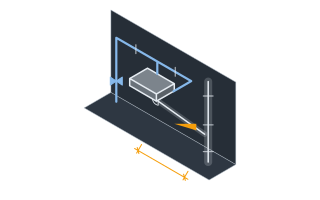
The number of floor drain traps this trap primer distribution system serves.
Count every floor drain trap connected to the trap primer distribution line that needs periodic water replenishment to maintain its trap seal.
The water flow rate delivered to each individual fixture by the trap primer.
Check the trap primer manufacturer's rated flow rate per outlet/fixture — commonly around 0.06 L/s (1 gal/min) per outlet.
Total trap primer flow needed
4 gal/min
They open the calculator with your figures already in it
Trap Primer Flow Rate Calculator: 4 gal/min — shown in imperial, US market. The link sets both, so the result they see is the one on your screen.
Show calculation logicHide calculation logic
How this was calculated
Formula source(s)
- Total trap primer flow = number of fixtures served × flow rate per fixture, the standard method for sizing a trap primer distribution system's total demand
Inputs used
- Number of Floor Drain Traps Served
- 4
- Flow Rate per Fixture
- 1 gal/min
What this calculation does not cover
- Totals a flow rate, and a trap seal is kept alive by VOLUME and INTERVAL. What matters at each trap is a small charge of water — enough to top the seal back up — arriving often enough to beat evaporation in that room, and a warm plant room or one under constant extract dries a seal far faster than a cool corridor. The right flow on a primer that cycles too rarely still ends with a dry trap and sewer gas in the room.
- Multiplies as though every outlet receives the full rate at the same moment. Most installations run one primer valve into a distribution unit that splits a single charge between its outlets, and those units are built for a handful of ports, not the fifty this page will accept. Split one charge too many ways and every trap on the manifold gets a share too small to make a seal.
- The thing that fails an inspection is not in the arithmetic: a primer ties potable water to the drainage system. The device itself has to be a listed type — ASSE 1018 for a potable-supplied primer valve, ASSE 1044 for drainage-type and electronic devices — carrying the air gap or backflow protection that listing requires. No flow figure substitutes for the right valve.
Add the equipment this sizes
This result is a specification — 4 gal/min — not a quantity. Put the thing it sizes into your project: how many, what you call it, and your supplier’s price.
Computed in your browser — nothing you enter is uploaded. Presented in US customary units and US trade terminology. Where a formula follows a published standard, that standard and its edition are cited beside it on this page; where none governs, the page says so. Local amendments override model codes — verify against the code in force where you build.
Sources checked 2026-09-06 · in the site-wide review of 2026-09-06 · v1.0.1
Regulatory standards & verification citations1
- Total trap primer flow = number of fixtures served × flow rate per fixture, the standard method for sizing a trap primer distribution system's total demand
Cite this page
Your workspace
Most jobs need more than one number. Add the calculators you need next and they open right here, underneath this one — your figures stay on screen and nothing is lost to a page change.