
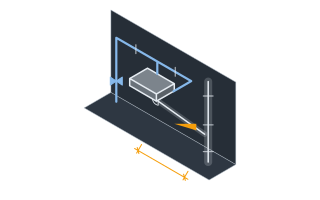
SettingsSettings for this calculationUS
The sump pump's rated discharge flow rate.
Use the pump's rated capacity at your actual total dynamic head, not just its maximum open-flow rating — check the manufacturer's pump curve.
The maximum velocity allowed in the discharge pipe to limit friction loss and water hammer risk — commonly around 1.5 m/s (about 5 ft/s).
Around 1.5 m/s (roughly 5 ft/s) is a commonly used practical ceiling for sump discharge lines — higher velocities increase friction loss and the risk of water hammer when the pump or a check valve closes.
Minimum discharge pipe diameter
1.822 in
They open the calculator with your figures already in it
Sump Pump Discharge Pipe Sizing Calculator: 1.82 in — shown in imperial, US market. The link sets both, so the result they see is the one on your screen.
Show calculation logicHide calculation logic
How this was calculated
Formula source(s)
- Minimum pipe diameter = √(4×flow rate ÷ (π×maximum velocity)), derived from the pipe flow area equation, keeping discharge velocity within a safe range to avoid excessive friction loss and water hammer
Inputs used
- Pump Flow Rate
- 40 gal/min
- Maximum Discharge Velocity
- 4.92 ft/s
What this calculation does not cover
- Returns an INSIDE diameter, and pipe is sold by nominal size. Wall thickness is the difference: a heavier schedule at the same nominal size has a smaller bore, so stepping up one nominal size can still leave you under the diameter calculated here. Check the published inside diameter for the material and schedule being bought, not the size printed on the pipe.
- Can return a diameter smaller than the pump's own discharge tapping, and that is not permission to reduce it. The port size is set for the impeller behind it, so necking a 1-1/2 in (38 mm) outlet into a 1-1/4 in (32 mm) line adds head the pump was never rated against and runs it off its curve. Treat the port size as the floor this result sits on top of.
Add the equipment this sizes
This result is a specification — 1.822 in — not a quantity. Put the thing it sizes into your project: how many, what you call it, and your supplier’s price.
Computed in your browser — nothing you enter is uploaded. Presented in US customary units and US trade terminology. Where a formula follows a published standard, that standard and its edition are cited beside it on this page; where none governs, the page says so. Local amendments override model codes — verify against the code in force where you build.
Sources checked 2026-09-06 · in the site-wide review of 2026-09-06 · v1.1.1
Regulatory standards & verification citations1
- Minimum pipe diameter = √(4×flow rate ÷ (π×maximum velocity)), derived from the pipe flow area equation, keeping discharge velocity within a safe range to avoid excessive friction loss and water hammer
Cite this page
Your workspace
Most jobs need more than one number. Add the calculators you need next and they open right here, underneath this one — your figures stay on screen and nothing is lost to a page change.
Tools and safety for this job
To cut and join plastic pipe. Generic types, no brands, no prices.
Protection this work requires
- Knives cause more site injuries than any power tool: cut away from your body, change blades often, and wear cut-resistant gloves to EN 388 level C for repeated cutting.
Cut and join plastic pipe: Push-fit and solvent-weld plumbing is within reach of a competent DIYer. The regulated parts of the system — gas, unvented hot water, and anything notifiable — are not, whatever tools are to hand.
Show the 3 tools this job needsHide tools
Essential
Plastic pipe shears
Tape measure
Recommended
Deburring tool and wire wool
what each plumbing tool is for, and the spec that decides which to buy where one does.