
SettingsSettings for this calculationUS
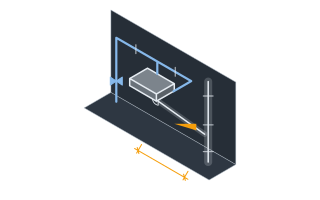
The inside diameter of the sump basin/pit.
18-24 in (46-61 cm) is a common residential sump basin diameter.
The depth of water the basin fills before the pump should activate and clear it.
This is the distance between the pump's 'on' and 'off' float switch levels, not the basin's total depth.
How quickly the basin fills to the 'on' level during heavy inflow.
A faster fill time (heavier expected inflow, like a high water table or storm surge) requires a higher-GPM pump to keep up.
Minimum pump capacity, GPM
6.47 GPM (minimum)
This sizes for the basin's fill rate only — also check the pump's rated GPM at your actual vertical lift height (to the discharge point), since GPM drops as lift height increases on every pump's performance curve.
- Basin volume at fillable depth
- 12.94 gal
- Same flow in L/min
- 24.5 L/min
They open the calculator with your figures already in it
Sump Pump GPM Calculator: 6.47 GPM (minimum) — shown in imperial, US market. The link sets both, so the result they see is the one on your screen.
Show calculation logicHide calculation logic
How this was calculated
Formula source(s)
- Basin volume = pi x radius² x fillable depth, converted to US gallons at 1728 ÷ 231 = 7.4805 per cubic foot (a cubic foot is 1,728 cubic inches and a US gallon 231 exactly); required pump GPM = basin volume in gallons / target fill time in minutes
Inputs used
- Basin Diameter
- 18 in
- Fillable Depth
- 11.75 in
- Target Fill Time
- 2
Intermediate steps
- Basin volume at fillable depth
- 12.94 gal
- Same flow in L/min
- 24.5 L/min
Confidence note: This sizes for the basin's fill rate only — also check the pump's rated GPM at your actual vertical lift height (to the discharge point), since GPM drops as lift height increases on every pump's performance curve.
What this calculation does not cover
- The number is an inflow rate, not a flow a pump will deliver. Vertical lift, discharge-pipe friction, elbows and the check valve all cut into a pump's rated output, and only the lift is even mentioned on this page. Size from the pump's performance curve at your actual total head, never from its headline GPM.
- The basin is modelled as a bare cylinder. The pump body, the float, the check valve and any gravel in the pit bottom all displace water, so the real volume between the float levels is smaller than the volume shown — and an inflow rate worked back from a timed fill in a real pit is lower than what this returns.
- No margin is added. A pump rated at exactly this flow only breaks even with the inflow: it never gains on the water and never shuts off. The model also says nothing about cycle rate or how long the motor can run continuously.
- The fill time is an assumption you supply, not a derived quantity. Nothing here reads rainfall intensity, the footing-drain or roof area feeding the pit, or a rising water table, so the answer is only as good as the worst-case fill time you entered.
- This is not a drainage or waterproofing design and not a backup-power calculation. It does not cover where the discharge may legally terminate — that is set locally and sanitary-sewer discharge is restricted in many places — nor freeze protection on the discharge line, backflow prevention, or the capacity you need when mains power fails during the storm that caused the inflow.
Add the equipment this sizes
This result is a specification — 6.47 GPM (minimum) — not a quantity. Put the thing it sizes into your project: how many, what you call it, and your supplier’s price.
Computed in your browser — nothing you enter is uploaded. Presented in US customary units and US trade terminology. Where a formula follows a published standard, that standard and its edition are cited beside it on this page; where none governs, the page says so. Local amendments override model codes — verify against the code in force where you build.
Sources checked 2026-10-05 · v1.1.0
Regulatory standards & verification citations1
- Basin volume = pi x radius² x fillable depth, converted to US gallons at 1728 ÷ 231 = 7.4805 per cubic foot (a cubic foot is 1,728 cubic inches and a US gallon 231 exactly); required pump GPM = basin volume in gallons / target fill time in minutes
Cite this page
Your workspace
Most jobs need more than one number. Add the calculators you need next and they open right here, underneath this one — your figures stay on screen and nothing is lost to a page change.