
SettingsSettings for this calculationUS
Which fuel the system carries — it changes the required flow by a factor of nearly two and a half.
Propane carries roughly two and a half times the energy per cubic foot, so the same appliance load needs far less volume flow and therefore smaller pipe. It is also heavier than air, which changes where a leak collects and how the system must be tested, and it uses its own capacity tables computed at 1.50 specific gravity.
Add the input rating of every gas appliance the section of pipe serves.
Use the INPUT rating from each appliance's rating plate, not the output or the efficiency-adjusted figure. A 100,000 BTU/h furnace, a 40,000 BTU/h water heater, a 65,000 BTU/h range and a 30,000 BTU/h dryer come to 235,000. The longest-length method sizes on connected load with no diversity allowance — unlike a water system, gas appliances are assumed capable of running together.
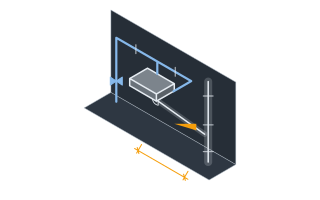
The measured run of pipe from the point of delivery to the furthest appliance.
Measure along the pipe as it will actually be installed — up and over, around the obstruction, down the wall — not the straight-line distance. This one length sizes every section of the system under the longest-length method, including the short branches near the meter.
Which capacity table the flow figure has to be read against.
Material does not change the required flow, only which table gives the diameter. The materials are not interchangeable on a table: copper is sized on tube size rather than nominal iron pipe size, and CSST capacities are specific to the manufacturer's own listing rather than to a generic code table.
The pressure the system runs at — it selects an entirely different capacity table.
Standard residential supply is about 7 inches of water column, a quarter of a psi. A two-pound system with line regulators at each appliance carries much more through the same pipe, which is why it is used to serve a large house on a small main. The pressure and the allowable drop together choose the table; getting either wrong selects a table that can be out by a factor of several.
How much pressure the design allows the pipe to lose between the meter and the furthest appliance.
Residential low-pressure systems are conventionally sized on a 0.3 inch water column drop, which leaves the appliance enough of its 7 inches to fire correctly. A larger allowable drop lets a smaller pipe carry the same load and leaves less margin at the appliance — it is a design decision the authority having jurisdiction may constrain.
Required capacity (CFH)
243 CFH
Read 243 CFH against the 60 ft row of the schedule 40 metallic pipe table for your inlet pressure and allowable drop, and take the first diameter whose capacity equals or exceeds it. The flow and the row are exact; the diameter is the table's to give.
- Table row to read — next tabulated length at or above the measured run
- 60 ft
- Measured developed length
- 60 ft
- Heating value used (BTU per ft³)
- 1,030 BTU per ft³
- Gas specific gravity the table must be computed at
- 0.6
- Same flow in cubic metres an hour
- 6.87 m³/h
They open the calculator with your figures already in it
Gas Pipe Sizing Calculator (Longest-Length Method): 243 CFH — shown in imperial, US market. The link sets both, so the result they see is the one on your screen.
Show calculation logicHide calculation logic
How this was calculated
Formula source(s)
- NFPA 54 / IFGC longest-length method: every section of the piping system is sized from the total developed length of the run to the most remote outlet, using the total connected load carried by that section
- NFPA 54 6.2: where the measured length falls between two tabulated lengths, the next longer length is used
- Capacity in cubic feet per hour = connected load in BTU/h ÷ the gas heating value per cubic foot. Planning values: natural gas commonly 1,000–1,050 BTU/ft³, commercial propane about 2,500 BTU/ft³ — the supplier's published figure governs
- Standard table bases: natural gas at 0.60 specific gravity, propane at 1.50. A table computed for one gas does not apply to the other
Inputs used
- Fuel
- Natural gas (0.60 specific gravity)
- Total connected load (BTU/h)
- 250000
- Developed length to the most remote outlet
- 60 ft
- Pipe material
- Black iron, schedule 40
- Supply pressure at the meter or regulator
- Low pressure — about 7 in w.c. (standard residential)
- Allowable pressure drop
- 0.3 in w.c. (the usual residential basis)
Intermediate steps
- Table row to read — next tabulated length at or above the measured run
- 60 ft
- Measured developed length
- 60 ft
- Heating value used (BTU per ft³)
- 1,030 BTU per ft³
- Gas specific gravity the table must be computed at
- 0.6
- Same flow in cubic metres an hour
- 6.87 m³/h
Confidence note: Read 243 CFH against the 60 ft row of the schedule 40 metallic pipe table for your inlet pressure and allowable drop, and take the first diameter whose capacity equals or exceeds it. The flow and the row are exact; the diameter is the table's to give.
What this calculation does not cover
- The diameter is not computed here, deliberately. It comes from NFPA 54 Table 6.2 or IFGC Table 402.4 — a different table for each combination of material, supply pressure, allowable drop and gas — and those tables are not reproduced on this page. An approximation of a fuel gas capacity table is a number that can be wrong in the direction that starves a burner, and no formula offered here would be the one your inspector checks against.
- The longest-length method sizes every section from the same length. A short branch that serves a dryer is still sized on the run to the most remote outlet, not on its own length, because the method's whole basis is that the pressure drop budget is spent along the longest path. Sizing branches on their own lengths is the commonest way a system passes on paper and starves an appliance in practice.
- CSST is manufacturer-specific and the code's generic table does not govern it. Each manufacturer's listing carries its own capacity table, its own sizing designation (which is not nominal iron pipe size), and its own bonding requirements. Reading a CSST run off the black iron table will oversize or undersize it depending on the product, and the bonding is a separate and non-optional matter.
- Fitting losses are not added here. The code's tables carry an allowance for a normal number of fittings in a run of the tabulated length; a run with an unusual number of elbows, a long drop, or several tees close together can exceed that allowance, and the branch-length method or a full pressure-drop calculation is the answer where it matters.
- The heating values are planning figures, not measurements. Pipeline natural gas varies with composition and is commonly between 1,000 and 1,050 BTU per cubic foot; the value used here is 1,030. Where the utility publishes its delivered heating value, use that instead — a five percent difference in heating value is a five percent difference in required flow and can move a marginal run onto the next pipe size.
- Sizing is one requirement among several, and the others are not arithmetic. Materials permitted for the location, sediment traps, shutoff valve placement, appliance connectors, bonding, testing and purging are all governed by the code and by the authority having jurisdiction, and none of them follows from the number on this page. Fuel gas piping is work for a licensed installer.
Add the equipment this sizes
This result is a specification — 243 CFH — not a quantity. Put the thing it sizes into your project: how many, what you call it, and your supplier’s price.
Computed in your browser — nothing you enter is uploaded. Presented in US customary units and US trade terminology. Where a formula follows a published standard, that standard and its edition are cited beside it on this page; where none governs, the page says so. Local amendments override model codes — verify against the code in force where you build.
Sources checked 2026-09-11 · v1.0.0
Regulatory standards & verification citations4
- NFPA 54 / IFGC longest-length method: every section of the piping system is sized from the total developed length of the run to the most remote outlet, using the total connected load carried by that section
- NFPA 54 6.2: where the measured length falls between two tabulated lengths, the next longer length is used
- Capacity in cubic feet per hour = connected load in BTU/h ÷ the gas heating value per cubic foot. Planning values: natural gas commonly 1,000–1,050 BTU/ft³, commercial propane about 2,500 BTU/ft³ — the supplier's published figure governs
- Standard table bases: natural gas at 0.60 specific gravity, propane at 1.50. A table computed for one gas does not apply to the other
Which documents these citations point at
- National Fuel Gas Code (NFPA 54) — 6.2 (United States)Fuel gas piping systems, appliance installation and venting, including the longest-length sizing method.
- International Fuel Gas Code (United States)Fuel gas piping, appliances and venting. Its sizing provisions track NFPA 54.
A code or standard has force only where a jurisdiction has adopted it, usually with local amendments. This site holds no adoption data for any authority, so check what is in force with the authority where you build. Any section cited above without an edition should be checked against the edition in force where you build. What it would take to know.
Cite this page
Your workspace
Most jobs need more than one number. Add the calculators you need next and they open right here, underneath this one — your figures stay on screen and nothing is lost to a page change.