
SettingsSettings for this calculationUS
The total wall area to receive manufactured stone veneer.
Measure the actual substrate area that will receive the scratch coat and stone veneer, excluding openings.
The average combined thickness of the scratch coat and setting bed.
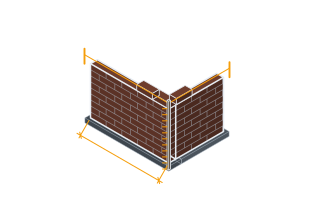
Manufactured stone veneer is set into a mortar scratch coat and setting bed whose average thickness varies with the profile depth of the stone units used.
Mortar volume needed
268.1 gal
They open the calculator with your figures already in it
Manufactured Stone Veneer Mortar Coverage Calculator: 268 gal — shown in imperial, US market. The link sets both, so the result they see is the one on your screen.
Show calculation logicHide calculation logic
How this was calculated
Formula source(s)
- Mortar volume = wall area × average setting-bed thickness, the standard method for a scratch coat and mortar bed applied beneath adhered manufactured stone veneer
Inputs used
- Wall Area
- 430 sq ft
- Average Mortar Bed Thickness
- 1 in
What this calculation does not cover
- This is the bed under the stone, and on an adhered veneer that is not all the mortar. Most manufacturers require every unit to be back-buttered — a full coat troweled onto the back of the stone before it is pressed home, so no void is left behind it — which is a second application over the same wall area. Buy to the setting-bed figure alone and the order can be short by a third or more.
- Liters of placed mortar is not bags of product. A pre-blended veneer mortar yields roughly 12 to 15 liters (3.2 to 4 gal) of mixed material per 25 kg (55 lb) bag once gauged with water, and a site mix has to be converted through its cement-to-sand ratio, so this volume still needs the yield printed on the bag before anyone can count pallets.
Estimated cost — your price
This site holds no price list for this material — local prices vary too much to publish honestly. Enter your supplier's price and the result is costed with it.
Computed in your browser — nothing you enter is uploaded. Presented in US customary units and US trade terminology. Where a formula follows a published standard, that standard and its edition are cited beside it on this page; where none governs, the page says so. Local amendments override model codes — verify against the code in force where you build.
Sources checked 2026-09-06 · in the site-wide review of 2026-09-06 · v1.0.1
Regulatory standards & verification citations1
- Mortar volume = wall area × average setting-bed thickness, the standard method for a scratch coat and mortar bed applied beneath adhered manufactured stone veneer
Cite this page
Your workspace
Most jobs need more than one number. Add the calculators you need next and they open right here, underneath this one — your figures stay on screen and nothing is lost to a page change.
Tools and safety for this job
To mix adhesive or mortar and mix mortar. Generic types, no brands, no prices.
Protection this work requires
- Cutting or grinding concrete, masonry, screed, tile or fibre-cement board releases respirable silica: cut wet or extract at the tool, and wear a P2/N95 respirator at minimum — a nuisance dust mask does not filter it.
- Wet cement and lime burn skin and eyes painlessly until the damage is done: waterproof gloves to EN 374, safety glasses whenever the mix can splash, and never kneel in wet mix in permeable trousers.
Show the 5 tools this job needsHide tools
Essential
Mixing bucket or tub
Paddle mixer
Shovel and spade
Wheelbarrow
Recommended
Cement mixer
what each tiling tool is for and what each masonry tool is for, and the spec that decides which to buy where one does.