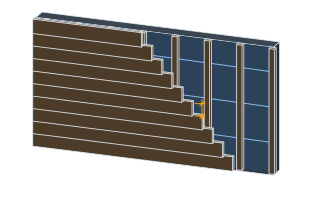
Materials & Quantities

Rain-Screen Cladding Panel Fastener Calculator

Calculate the total fasteners needed for a rain-screen cladding panel installation.

  • Answers as you type
  • Every formula cited
  • Calculated in your browser
SettingsSettings for this calculationUS
Market
Imperial · sales tax
The total number of rain-screen cladding panels in the installation.

Count every panel in the rain-screen cladding system that needs to be fastened to the furring or substructure.

The number of fasteners the panel manufacturer specifies per panel.

Check your cladding system's installation instructions for the specified fastener count and pattern per panel.

Total fasteners needed

320 fasteners

High confidence
Then change the inputs to see how far the answer moves.

Show calculation logic

How this was calculated

Formula source(s)

  • Total fasteners = panel count × fasteners per panel, the standard fastening-count method for rain-screen cladding panel systems

Inputs used

Number of Cladding Panels
80
Fasteners per Panel
4
Final result320 fasteners

What this calculation does not cover

  • Counts fasteners without saying what they must be made of. A rain screen is a wet, ventilated cavity and the fixing sits in it for the life of the building - carbon steel screws into aluminium panels or aluminium rails corrode galvanically and stain the face within a season, which is why cladding fixings are normally austenitic stainless, moving to the higher molybdenum grade within a few kilometres of the coast or in a pool or chemical atmosphere. The head finish matters as much: an exposed fixing is colour-matched to the panel and ordered against a RAL reference, with the lead time that implies.
  • Says nothing about what the fixing goes into. The specified count per panel came from a capacity per fixing in a particular backing, so the same four fasteners into 0.55 mm (0.02 in) light-gauge steel, into timber battens, or into masonry are three different fixings with three different embedments and three different pull-out values - and a screw a thread short of full engagement in thin-gauge steel holds a fraction of what was assumed for it. Where the substrate or the wind load differs from the tested arrangement, the number per panel changes before the total ever does.

Estimated cost — your price

This site holds no price list for this material — local prices vary too much to publish honestly. Enter your supplier's price and the result is costed with it.

Part of a bigger job

This trade is one line of a job takeoff. Run the whole job and every other trade comes back with it, off the same measurements.

Computed in your browser — nothing you enter is uploaded. Presented in US customary units and US trade terminology. Where a formula follows a published standard, that standard and its edition are cited beside it on this page; where none governs, the page says so. Local amendments override model codes — verify against the code in force where you build.

Sources checked 2026-09-06 · in the site-wide review of 2026-09-06 · v1.0.1

Regulatory standards & verification citations1
  1. Total fasteners = panel count × fasteners per panel, the standard fastening-count method for rain-screen cladding panel systems
Cite this page

Your workspace

Most jobs need more than one number. Add the calculators you need next and they open right here, underneath this one — your figures stay on screen and nothing is lost to a page change.

Tools and safety for this job

To hang siding or cladding. Generic types, no brands, no prices.

Protection this work requires

  • Hardwood dust is a recognised carcinogen: extract at the tool and wear a P2/N95 respirator when cutting or sanding indoors.
  • Saws, grinders and breakers run above 85 dB, where hearing damage accumulates and does not recover: defenders or plugs for every cut, not just the long ones.
  • Most fatal falls on small jobs are from under three metres: use a tower or a ladder tied at the top, and never work off the top two rungs.
Show the 7 tools this job needs

Essential

  • Chalk line

  • Circular saw

  • Cordless drill/driver

  • Spirit level

  • Tape measure

  • Tower scaffold or trestles

Recommended

  • Mitre saw

Also needed as materials: chalk refill, circular saw blades, drill and driver bits, mitre saw blades.

what each cladding tool is for, and the spec that decides which to buy where one does.

Now that you have the number

These guides cover the work this quantity is for — the first ones run this calculator inside the section that raises the question.

How to calculate rain-screen cladding panel fastener in 3 steps

  1. Number of Cladding PanelsThe total number of rain-screen cladding panels in the installation.
  2. Fasteners per PanelThe number of fasteners the panel manufacturer specifies per panel.
  3. Total fasteners neededThe tool computes the total fasteners needed from those figures and shows the formula, its sources, and a confidence rating alongside it.

Total fasteners needed by number of cladding panels

Page defaults, not your figures above.

Number of Cladding PanelsTotal fasteners needed (fasteners)
1040
2080
50200
100400
200800
5002,000

Frequently asked questions

Can I put the fasteners wherever the count works out?
No, and on a rain screen that constraint usually beats the count. A panel hung outboard of the wall is in full sun and full wind, and it grows and shrinks with the temperature — aluminium moves roughly twice as much as steel for the same swing, and a three-metre panel can move several millimetres over a summer day. So the fixing pattern is set first by two rules the arithmetic knows nothing about: a minimum edge distance, below which the fixing tears out of the panel edge rather than holding it, and one fixed point per panel with every other hole slotted or oversized so the panel can move around it. Fix a panel rigidly at both ends and it does not stay flat — it buckles between the fixings in summer and pulls at them in winter. Take the number here as the quantity to buy, then place it against the panel manufacturer's edge distance and fixed-point detail.
How many fasteners does a rain-screen panel need?
As many as the cladding system's installation instructions specify for that panel, a count and pattern that vary with panel size, material and wind-load rating. Check the manufacturer's instructions for your specific system.
Does this include extra fasteners for cut or edge panels?
No — this calculates the base fastener count using a uniform fasteners-per-panel figure across the total panel count entered. Edge and corner panels that require additional fastening should be accounted for separately.
Does this include fasteners for the furring or substructure itself?
No — this counts only the fasteners attaching the cladding panels to the substructure, not the fasteners used to install the furring strips themselves.
What if the panels are not all the same size?
Then one fasteners-per-panel figure does not fit them, and the total is only as good as that figure. On a rail-backed system the fixings in a panel are the rails it crosses times the fixings down each rail, the second set by the maker's maximum spacing along the rail and its minimum edge distance: a panel crossing three rails with three fixings down each takes nine, and a narrow infill beside a window crossing two rails at the same height takes six. Group the panels by size, run the page once per group and add the totals. The fixings-per-panel box stops at ten, so a group of larger panels that takes more than ten each is multiplied out by hand, panels times fixings, and added to the rest.
Rivets or screws: does the total split?
It usually does. The backing decides the fixing: blind rivets are the usual fixing into aluminium rails, screws into timber battens, and a fixing into light steel sections is a self-drilling screw matched to that gauge. Within a panel the sliding holes are oversized so the panel can move, while the fixed point is made either by a hole drilled to the fixing's own size or, on some riveted systems, by a sleeve or a different rivet, so the order is several lines by type, fixed or sliding, and head colour, though this page gives one total. UK practice calls the substructure rails on helping-hand brackets; North American practice calls it girts, hat channels or Z-girts.
What counts as a fastener on a concealed-fix or cassette system?
Not a face fixing, because none show. Cassette panels, folded metal or composite trays, hang on pins or hooks on the rails and take a few locking screws; back-fixed panels carry undercut anchors in their rear face with clips or hangers that sit on horizontal rails; bonded systems hold the panel with structural adhesive on a tape and have no face fixings at all unless a mechanical backup is specified. For those, enter the maker's count of anchors, pins or clips per panel and treat the hangers and rail fixings as their own lines: the multiplication is the same, but the parts are not screws.
Does the total include spares?
No, it is the exact number to be installed. A blind rivet that is drilled out is scrap, and fixings dropped from a scaffold or a cradle are not always recovered, so an allowance belongs on top of this figure. Where the heads are colour-matched to the panel, order the spares with the main batch, since a later painted batch can differ in shade on the face of the building.
Preliminary estimate, not certified engineering. This tool produces an indicative quantity calculation for planning purposes only — it is not a certified structural analysis, a guaranteed material takeoff, or a substitute for building department approval. Always verify measurements on-site and have a licensed contractor or structural engineer review any load-bearing, code-sensitive, or safety-critical work before purchasing materials or starting construction. Spotted an arithmetic or standards error? Report it to contact@craftquantities.com with your inputs — a confirmed fix gets a permanent check of its own, so the same mistake cannot come back.