
SettingsSettings for this calculationUS
The total area to receive the finish coat.
Use the same area as the brown coat beneath it — the finish coat is applied over the full browned-out surface.
The applied thickness of the finish coat.
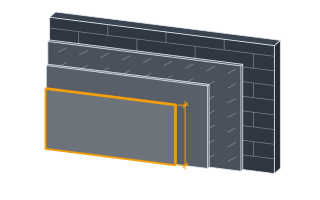
The finish coat is the thinnest, smoothest layer in a three-coat system, typically applied around 3 mm thick to produce the final surface texture.
Finish coat plaster volume
23.56 gal
The finish coat is thin, and its quantity is small relative to the coats beneath. What it is not is forgiving — it reveals whatever the brown coat left behind rather than correcting it.
- Equivalent volume
- 0.12 yd³
They open the calculator with your figures already in it
Gypsum Plaster Finish Coat Volume Calculator: 23.56 gal — shown in imperial, US market. The link sets both, so the result they see is the one on your screen.
Show calculation logicHide calculation logic
How this was calculated
Formula source(s)
- Three-coat plaster system volume per coat = wall area × coat thickness; the finish coat is the thinnest, smoothest layer (commonly ~3 mm)
Inputs used
- Wall/Ceiling Area
- 320 sq ft
- Finish Coat Thickness
- 0.12 in
Intermediate steps
- Equivalent volume
- 0.12 yd³
Confidence note: The finish coat is thin, and its quantity is small relative to the coats beneath. What it is not is forgiving — it reveals whatever the brown coat left behind rather than correcting it.
What this calculation does not cover
- A FINISH COAT IS A THICKNESS OF 2-3 MM AND A QUESTION OF FLATNESS, not a quantity to be stretched. Applying it thicker to bury a background that was never levelled is the commonest cause of a finish that crazes or delaminates, and no material figure prevents it.
- Set is time, not quantity. A bag mixed and not used inside its working time is waste regardless of the area it would have covered, so the order is governed by how much can be laid in one working period as much as by the wall.
- Says nothing about the background it is going on to. Finish plaster over new board, over a brown coat and over painted plaster are three different preparations with three different suction conditions.
- Excludes the scratch and brown coats, which together account for most of a rendered wall's material.
- Coverage varies markedly with the texture being achieved; a smooth trowelled finish and a heavy float finish consume different amounts of the same product.
- Does not include the first coat new plaster takes before it is decorated, a mist coat or a primer made for new plaster, nor the paint that goes over it.
Estimated cost — your price
This site holds no price list for this material — local prices vary too much to publish honestly. Enter your supplier's price and the result is costed with it.
Part of a bigger job
Or plan the space itself: measure it once, doors and windows included, and this figure comes back worked out on that space, with what goes with it.
Computed in your browser — nothing you enter is uploaded. Presented in US customary units and US trade terminology. Where a formula follows a published standard, that standard and its edition are cited beside it on this page; where none governs, the page says so. Local amendments override model codes — verify against the code in force where you build.
Sources checked 2026-08-26 · in the site-wide review of 2026-09-06 · v1.0.0
Regulatory standards & verification citations1
- Three-coat plaster system volume per coat = wall area × coat thickness; the finish coat is the thinnest, smoothest layer (commonly ~3 mm)
Cite this page
Your workspace
Most jobs need more than one number. Add the calculators you need next and they open right here, underneath this one — your figures stay on screen and nothing is lost to a page change.
Tools and safety for this job
To skim a plaster finish. Generic types, no brands, no prices.
Protection this work requires
- Wet cement and lime burn skin and eyes painlessly until the damage is done: waterproof gloves to EN 374, safety glasses whenever the mix can splash, and never kneel in wet mix in permeable trousers.
- Most fatal falls on small jobs are from under three metres: use a tower or a ladder tied at the top, and never work off the top two rungs.
Show the 4 tools this job needsHide tools
Essential
Mixing bucket or tub
Paddle mixer
Plastering trowel and hawk
Recommended
Step ladder
what each plastering tool is for, and the spec that decides which to buy where one does.