
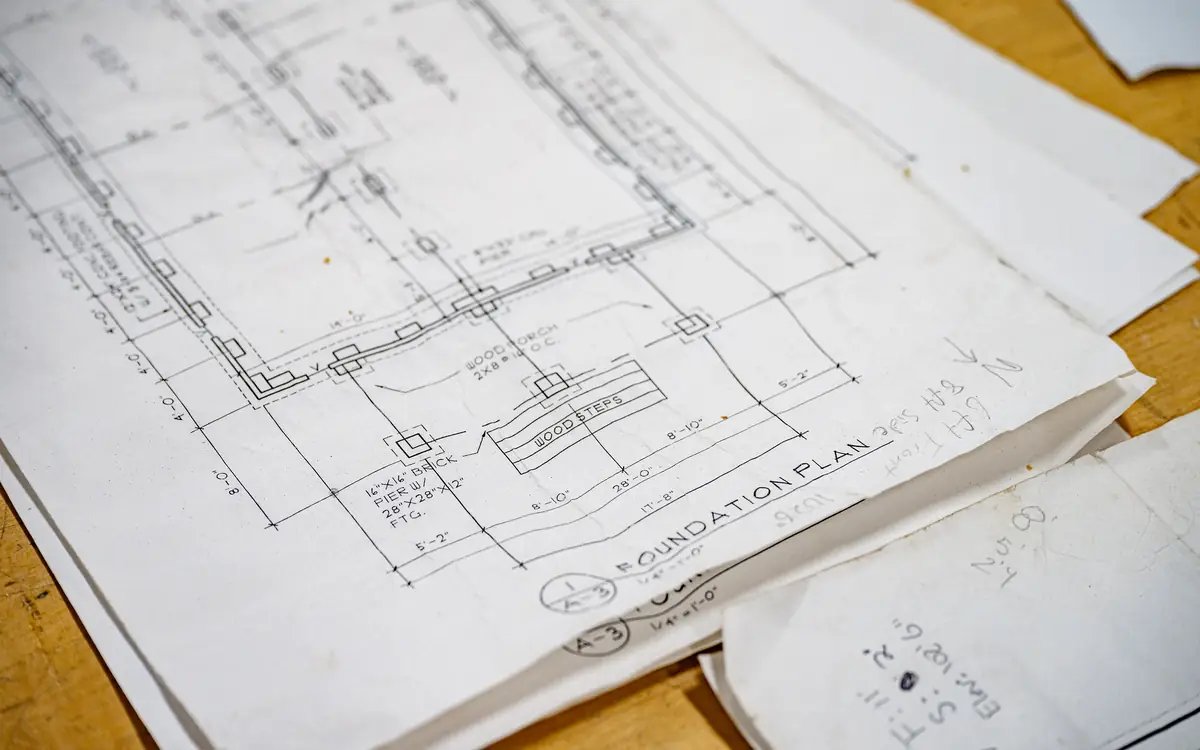
The date on the covering letter
Skirtings are off and stacked against the chimney breast. One wall is down to brick, the other three are not. The old boards are up, the joist ends over the party wall are visible and the ones running into the bay are not, and the room smells of a hundred years of dust. The architect has emailed a revised plan that moves the opening nine hundred millimetres and takes the radiator wall out altogether, and the client and the builder are standing on the joists with a phone between them, agreed in principle and stuck on the number.
The folder is open on the windowsill and everybody is looking at the wrong page of it. The total is not the useful number on the quotation; the date on the covering letter is. Every rate underneath that total was assembled from a merchant's price list, a plasterer's day rate and a hire tariff that were all current in one particular week, and that week is now some distance behind. What is being priced on the joists this morning is being priced against a different set. Nobody has said this out loud, and within ten minutes both of them will use the phrase the same rate meaning two entirely different things.
That collision — a contract sum frozen on a date, a market that was not — is the whole subject here. The paperwork around a change is another matter and is covered on its own terms by the guide to instructing a variation: whose authority an instruction has to carry, which of the standard valuation bases governs a given line, why deleting work refunds less than adding it costs, and how the completion date moves. The payment machinery underneath all of it belongs to the stage-payments guide. What this page is for is the twenty minutes on the windowsill: how to build a number that both parties can still defend in November, when the rates it was built from have moved again.
Base date, and the line nobody fills in on a domestic job
The trade already has a word for the date on the covering letter, and it is worth borrowing even on a job whose contract runs to two pages. It is the base date: the day whose prices the contract sum is taken to have been built on. JCT prints it in the Contract Particulars. FIDIC defines it in the general conditions as the date twenty-eight days before the latest date for submission of the tender, which is a deliberately unromantic way of saying the last moment the estimator could still see the market. NEC4 needs one for its inflation option. It exists for a single reason: without a stated day, there is no way to measure how far anything has moved, and every argument about movement becomes an argument about memory.
What each form then does with that date is the interesting part. JCT offers three fluctuations options and they are three different bargains. Option A is contribution, levy and tax fluctuations — a firm price in which the contractor carries market movement but not changes in statutory contributions and duties. Option B extends recovery to labour and materials cost as well as tax. Option C abandons line-by-line recovery and adjusts the price by formula, using the JCT Formula Rules and published index numbers. NEC4 does the same job through secondary Option X1, price adjustment for inflation, which computes an adjustment factor from indices named in the Contract Data against their values at the base date. FIDIC's Clause 13 carries a cost-adjustment mechanism operated through a table of adjustment data, in which a fixed coefficient represents the portion of the price that does not adjust at all and the remainder is weighted across named indices. AIA's A201 has no equivalent anywhere in it, which is precisely why the American answer arrives as a separate instrument — the ConsensusDocs 200.1 amendment for potentially time and price-impacted materials.
A domestic job has almost none of this. The JCT Building Contract for a Home Owner/Occupier and the two-page letter most extensions are actually built under are firm prices with no fluctuations provision at all and no stated base date. The Minor Works form is the near miss: it does print a Base Date in its Contract Particulars, and it does carry a fluctuations provision — but only the narrow one, the contribution, levy and tax clause that is Option A in the principal contracts, with no route to Option B or Option C and so no recovery of a movement in labour or material cost. For the argument on the joists that comes to the same place as having nothing. What that means is precise and worth stating plainly: the builder took the risk of the market moving on the work that was in the contract. It does not follow, and it is not usually written down, that he took the same risk on work that was not in the contract. That is the hinge the whole morning turns on. Varied work is valued when it is varied, and the only question that matters on the joists is which day's prices it is valued at.
So the cheap fix is at signing rather than here: one line naming the base date, and a second saying whether varied work is valued at base-date rates or at rates current when the variation is agreed. Either answer is defensible. What is not defensible is neither answer, which is the position almost every domestic job is in by the time somebody is standing on a joist with a phone. Where the line was never written, it has to be settled in the room before a figure is spoken, because once a figure has been spoken it stops being a question about method and becomes a question about whether somebody is trying it on.
| Arrangement | What the price is anchored to | Who carries a movement in cost |
|---|---|---|
| JCT Fluctuations Option A | The base date in the Contract Particulars, for statutory contributions, levies and duties only | The contractor carries market movement; the employer carries changes in tax and levy |
| JCT Fluctuations Option B | The base date, extended to labour and materials cost as well as tax | The employer, on evidence, line by line — recovery requires records nobody keeps by accident |
| JCT Fluctuations Option C | Published index numbers under the JCT Formula Rules, measured from the base date | Shared by formula, without anyone proving what a particular delivery actually cost |
| NEC4 secondary Option X1 | Indices named in the Contract Data, valued at the base date | Shared through a price adjustment factor, applied whether or not the contractor bought well |
| FIDIC Clause 13 cost adjustment | A table of adjustment data: a fixed non-adjusting coefficient plus index weightings | Split by the coefficients agreed at tender, which is a negotiation about proportions, not about receipts |
| A domestic firm price with no fluctuations provision | Nothing stated; in practice the week the quotation was assembled | The contractor, on the contract work. On varied work it is unsettled until somebody settles it |
What the material actually did, and where you can prove it
There are two standards of proof available for the sentence timber has gone up, and they are not close to each other. The strongest is the merchant's own history on your account: two invoices for the same product code, the same pack size and the same delivery address, one from around the quotation date and one from last month. Subtract, divide, and you have measured the exact thing being argued about rather than a proxy for it. Any builder with a trade account can produce that in a morning, and a client who has seen it stops asking whether the increase is real.
Second best is a published index for the material category. In the United Kingdom the Department for Business and Trade publishes Monthly Statistics of Building Materials and Components, which carries series for individual materials rather than for construction as a lump. In the United States the Bureau of Labor Statistics Producer Price Index programme does the same through its commodity indices for construction materials, with an inputs to construction industries series aggregating them. A handful of materials are rebased against something published daily and move visibly before any merchant's list catches up — a cable manufacturer's price against the London Metal Exchange copper settlement, a mill's against the CME Group lumber contract. What an index is not is a price. It is a ratio against a base period, computed over a basket that is not your order, in a market that is not your town.
One distinction inside that second tier ruins more of these conversations than any other, and it is easy to get right once it has been pointed out. There are indices of what inputs cost and indices of what contractors charge, and they are not interchangeable. RICS Building Cost Information Service publishes both — a general building cost index tracking the contractor's own input costs, and a tender price index tracking what work is actually being won at, which contains market appetite and margin as well as cost. The ONS construction output price indices are output prices in the same sense. Escalate a material line with a tender price index and you have imported somebody else's margin into a figure that your own markup is then going to be applied to on top. Material lines take an input cost index. Nothing else.
Then there is the shape of the movement, which no index reproduces. Indices drift; real prices step. A duty lands on an imported profile on a stated date. A haulage surcharge appears in a month when fuel moved. A supplier reissues its list annually on a fixed day and nothing happens in between. A tax rate changes, and on domestic work the boundaries are drawn round what the work is rather than round who is paying for it — HMRC's VAT Notice 708 sets out where construction to a dwelling is standard rated, reduced rated or zero rated, and a variation that changes the nature of the work can carry a line across one of those boundaries without anybody intending it to. Steps like these belong on the sheet as their own adjustments, applied after the drift, not smoothed into it.
Two pieces of arithmetic before any of it goes into a box. If the movement you measured spans more than a year, convert it to an annual equivalent first: divide the new price by the old, raise the result to the power of one over the number of years, and subtract one. Simply dividing the total by the number of years is close enough at ordinary rates and drifts further out the larger the move was. And know what the tool does with the figure you type: it divides your annual rate by twelve and compounds it monthly, so a full year comes out slightly above what you entered. At a few per cent that is invisible. At thirty it is several per cent of real money, and it is worth entering a rate that is already the answer you want rather than one you expect to be handed back unchanged.
Escalate one material line, never the quotation total — the timber subtotal, the cable, the units, whatever you can hold an invoice against. Months since the price you are actually holding was quoted, not months since the contract was signed. Then treat the answer as a forecast of what a re-quote will say rather than as the price itself: on anything with a lead time the arithmetic is only there to tell you how urgent the phone call is.
The price from an old quote or estimate.
How many months have passed since the quote was given.
Your assumed yearly rate of change for this material category.
Estimated current price
$10,512
This assumes a steady compounding rate, but real material prices (especially lumber, steel, and copper) often move in sharp, unpredictable swings rather than smoothly — get a fresh quote for anything time-sensitive.
- Total change
- $511.62
They open the calculator with your figures already in it
Material Price Escalation Calculator: 10,512 $ (estimated current price) — shown in imperial, US market. The link sets both, so the result they see is the one on your screen.
What this calculation does not cover
- Months Since Quote is held between 1 and 120 and an out-of-range entry is clamped to the nearer end when you leave the box, so a quote three weeks old has to be pushed up to a full month and one eleven years old is escalated as though only ten years had passed.
- The rate field accepts nothing below -20% or above 50% a year and the original price stops at $1,000,000, so a timber line that doubled since it was priced, or a seven-figure supply package, has to be broken into stages or separate runs before the figures will go in.
- Two numbers come back and no more, the escalated price and the dollar difference from the original, with no month-by-month schedule underneath, so there is nothing showing how much of the rise accumulated in the first year against the last.
- The old price is simply multiplied out, with no currency term anywhere in the arithmetic, so a quote issued in another currency carries whatever the exchange rate has done since it was written entirely outside this answer.
- Nothing separates months already gone from months still ahead of you, because the figure you type is used only as an exponent, so escalating to a delivery date some way off means adding that lead time into the months yourself.
A contract rate is not wrong for being old
Back on the joists, the argument arrives in a predictable shape. The contract has a rate for the work being added, the client points at it, and the builder says he cannot buy at it any more. Both statements are true at the same time, and neither person is being difficult. Which rate applies to which kind of varied work is a question the standard forms answer through a valuation hierarchy, and that hierarchy is set out properly on the instructing guide rather than repeated here. The step after it is the one nobody writes down: what to do when the rule points at a rate the market has moved out from under.
The answer is to take the rate apart instead of arguing about it whole. A composite rate for an extra square metre of board and skim is labour, plus material, plus waste, plus margin, welded into one figure by an estimator months ago. Those four have not aged at the same speed. The labour half is usually still sound, because a subcontract rate agreed for a job is normally fixed for that job, and the plasterer is not renegotiating in the middle of it. The material half may not be. Value the labour at the contract rate, value the material at a dated quotation or a dated invoice, and the disagreement collapses from a whole rate down to one line with a document sitting behind it.
The test for whether a rate has genuinely gone stale is commercial rather than statistical. A rate is not stale because an index moved; it is stale because a supplier will no longer sell at it. The evidence for that is a written quotation for the same specification, today, with a supplier's name and a date on the face of it — not a chart. Where nothing can be quoted yet, because the material has not been specified or the extent is unknown, an index is what you have, and the figure it produces should be labelled a forecast on the sheet so that nobody reads it back in six weeks as though it had been a price.
One more thing to fix while both parties are still in a good mood, because it costs nothing now and is impossible later. Whatever rule is agreed — base-date rates, or rates current at the variation — apply it to every variation on the job, in both directions. Prices fall as well as rise, and a client who insisted on current rates while the market was climbing has to accept them when the market gives some back. A rule that only ever gets invoked by one party is not a rule, and by the fourth variation everyone can see it.
- Get the build-up behind the contract rate, not the single figure on the face of the quotation — labour, material, waste and margin as separate numbers.
- Date the material component: the day the price behind it was quoted, which is rarely the week the contract was signed.
- Ask the supplier for a written quotation for the same specification today, and use that figure wherever one exists.
- Use an index only where nothing can yet be quoted, take it from an input cost series rather than a tender price series, and write the word forecast beside the result.
- Leave the labour component at the contract rate unless the subcontract rate itself has actually been renegotiated — in which case produce that document too.
- Add margin once, at the end, to the rebuilt rate — not once to the escalated material and then again to the line total, which is how a change quietly earns twice.
Pricing an extent nobody can see yet
The harder problem in a room with the floor up is not the rate. It is the quantity. One wall is open and three are not; the joist ends you can see are sound and the ones disappearing into the bay are a rumour. A lump sum for work whose extent is still behind plaster is a guess wearing the clothes of an agreement, and when the guess turns out low it is the client who gets told, in week nine, that it was always only an estimate.
So price the rate and cap the quantity rather than pricing the total. Six things have to be agreed for that to hold, and they take four minutes standing up: the unit, the rate per unit, the method of measurement, who does the measuring, when and in whose presence they do it, and a ceiling quantity at which work stops and the price is re-agreed rather than the ceiling being quietly passed. RICS New Rules of Measurement 2 will supply a measurement method with an authority behind it if one is wanted; on a house the important thing is not which method but that one is named, written down, and capable of being applied by both parties to the same wall without producing two answers.
There is a cost to the conversation itself, and it is the one nobody prices. While the rate is being settled the room is not being worked in. Either the gang stands, or it goes to another job and comes back when there is a gap, and both of those cost somebody money. Say out loud how long the pricing is going to take, what the crew does in the meantime, and whether any of that lands on the client. It is a small number and an easy conversation on the morning it happens, and it is neither of those things when it appears at the bottom of an invoice. The wider programme consequence of the change — the revised completion date, the scaffold and welfare that run whether or not anybody is working — is the instructing guide's ground and not repeated here.
What gets handed over at the end of the morning is a ceiling, not a price, and it should be described that way in the sentence that hands it over. A ceiling that is not reached is a good outcome for both sides and generates no argument at all. A lump sum that turns out to have been low generates nothing but argument, and it does so at the point in the job when the client has the least leverage and the builder has the most sunk cost. The same arithmetic gets run twice: once now against the capped quantity, to produce the ceiling, and once when the floor is fully up and the real quantity has been measured.
Price the ceiling rather than the expectation. Put the rate multiplied by the capped quantity into the work figure, take the markup percentage from whatever the contract settled on for changed work rather than from a number chosen this morning, and add the flat administration charge only if the contract carries one. What comes out is the most that can be asked for under this sheet — say so when you hand it across, then run it again on the measured quantity once the floor is up.
Your direct material + labor cost for the added scope.
Markup applied to the additional work, same as your normal project markup.
A flat fee covering paperwork, re-scheduling, and coordination overhead.
Total change order cost
$2,400
- Markup amount
- $300
They open the calculator with your figures already in it
Change Order Cost Calculator: 2,400 $ (total change order cost) — shown in imperial, US market. The link sets both, so the result they see is the one on your screen.
What this calculation does not cover
- Markup lands on the added work cost alone — the administrative fee is added after it and is never marked up, so a contract that allows markup on the processing charge will settle slightly above this figure.
- One percentage covers the whole variation, with no split between overhead and profit and no separate rate for subcontracted work; where a sub's price already carries its own uplift, no second tier is stacked on top of it here.
- Time is absent from the arithmetic. Nothing is priced for extra days on site, extended preliminaries, or the disruption to work already sequenced around the original scope, which on a mid-project change is often the larger number.
- The flat fee is counted once per run. Several small variations that each trigger their own charge, or one order bundling unrelated items, have to be worked through individually rather than as a single lump.
- Deductive changes have no route in: the added work cost cannot be taken below zero, so a credit for scope removed has to be handled as its own line away from this page.
- The added work cost is entered as one figure, so nothing distinguishes short-notice material pricing, restocking on cancelled orders, or remedial work to undo what was already built — those belong inside the number you type, or they are missing from the total.
How long the price stays buyable
A variation price is an offer, and it is resting on other offers underneath it. The merchant's quotation behind the material line has a validity period stated in its terms, and a great many trade terms of sale reserve the right to invoice at the price ruling on the date of despatch rather than the date of order. Put those two facts together with a lead time and the trap is obvious as soon as it is written down: a price agreed on a Tuesday, against a quotation that lapses on Friday, for an item that will not ship for nine weeks, is a price nobody can actually buy at unless the order goes in inside the window. The expiry date belongs on the variation sheet, immediately next to the figure, in the same size of writing.
A re-quote also changes things that have nothing to do with inflation and never appear in escalation arithmetic. A line is discontinued and the substitute has a different thickness or coverage, which moves the quantity as well as the price. A pack or pallet quantity changes and the waste allowance moves with it. A delivery zone is redrawn and a job that was inside it is now outside. A minimum order value that the main contract cleared easily cannot be reached by one small variation on its own, so the extra either waits for another delivery or carries a carriage charge nobody budgeted. Ask about all four when the price is asked for; each of them is a single question on a call that is happening anyway.
One point of consumer law, in a clause, because the frame around it belongs to the stage-payments guide. Schedule 2 of the Consumer Rights Act 2015 lists among the terms that may be regarded as unfair one permitting the trader to raise the price after the contract is made without giving the consumer a corresponding way out. That is a reason to attach a dated supplier quotation and an expiry to a specific variation rather than to write a general escalation clause into a domestic contract and expect to lean on it. Between two businesses the position is entirely different, which is exactly why the builder's own supplier can hold a price-on-despatch term over him while he cannot pass the same term down to the household he is working for.
| What moves | Why escalation arithmetic cannot see it | What to ask on the call |
|---|---|---|
| The quotation's validity period | The maths has no concept of an offer lapsing — it will happily escalate a price that expired last week | How long is this held for, and does placing the order or paying the deposit hold it? |
| Price ruling at the date of despatch | It models a single price, not a term allowing that price to be reset before delivery | Is this fixed to delivery, or is it the price on the day you ship? |
| Pack, pallet or coil quantity | It escalates a rate and knows nothing about how the material is sold | What is the pack quantity now, and has it changed since this code was last quoted? |
| A discontinued line and its substitute | The substitute has a different specification, so the old price is not being escalated at all | Is this exact code still current, and if not, what is the replacement and how does it differ? |
| Delivery zone and minimum order value | Carriage is not in the material rate and does not move with the material index | Does this address still fall in the free delivery zone, and what is the minimum order? |
| A tax or duty change | Steps on a date; an index averages it across a quarter and buries it | Is the rate on this line the same as when the job was quoted? |
Two dates on one sheet
The finished thing carries two dates that ordinary variation sheets do not: the day the rates behind the price were current, and the day after which the price is no longer available. Everything else on that sheet — who instructed it, what basis each line was valued on, what it does to the completion date, the two signatures at the foot — is described on the instructing guide and does not need building twice. These two are the ones that go missing, and they are the two that decide whether the figure is still meaningful when somebody reads it back.
The argument for doing all of this before the instruction rather than after it is not really about paperwork. It is that the price of a change is not a fixed quantity sitting there waiting to be discovered. It is a range, and the range is at its narrowest on the morning the floor comes up: nothing has been ordered, nothing has been cut, both parties can see the same joists, and either of them can still walk away from the whole idea. Every commitment made after that collapses the range onto whatever has actually been spent, and once it has collapsed the only question anybody can still argue about is who pays for it. Twenty minutes on a windowsill with a folder, two dated quotations and a capped quantity is what buys the difference.
While the floor is still up and nothing has been ordered
This morning the information is at its widest and the price is at its narrowest, and both of those move the wrong way from here. Six things to get onto the sheet before either does.
- The day the contract's rates were built on — JCT prints it in the Contract Particulars, FIDIC fixes it twenty-eight days before tender, NEC4 needs one for Option X1, and even a Minor Works form has the line — but the letter contract most extensions are built under names no day at all, which is why the week on the covering letter has to serve as one.
- Whether varied work goes at those rates or at today's — A firm price means the builder carried market movement on the work in the contract. It does not automatically mean he carried it on work that was never in the contract, and unsettled is the worst of the three possible answers.
- The material half of the rate, split out and dated — Labour, material, waste and margin have not aged at the same speed. A subcontract rate fixed for the job is usually still sound; the merchant's price behind it may not be, and only one of the four needs re-evidencing.
- An input cost index, and only where nothing can be quoted — A dated supplier quotation beats every index. Where there is nothing to quote yet, take the figure from a materials cost series rather than a tender price series, or you import somebody else's margin into a number your own markup then multiplies.
- A rate, a measurement method and a capped quantity — Three walls are still closed. Agree the unit, the rate, who measures and when, and the ceiling at which work stops and the price is re-agreed — then hand over a ceiling and describe it as one.
- The expiry date, written next to the price — The merchant's quotation lapses, many terms of sale invoice at the price on the day of despatch, and a lead time can outrun both. Ask about pack quantity, substitutions, delivery zone and minimum order on the same call.
Opens the calculators above on one screen with the dimensions from this article already filled in. Quantities only — this site publishes no price list, because local prices vary too much to publish honestly.