
SettingsSettings for this calculationUS
The standard allowance most suppliers and estimating guides assume for ordinary work.
The floor being sanded, length × width, less anything fixed that stays down.
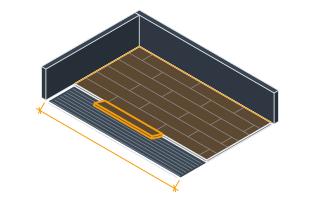
Measure wall to wall and take off kitchen units, a hearth or a built-in cupboard the machine will not reach. Add a bay, an alcove or a landing as its own rectangle. One area serves the sanding and the finish, because every coat goes over every square of floor the drum touched.
Tools needed: Tape measure or laser measure
The length of wall, hearth and fixed edge round the floor, which the edger does.
Walk the floor's boundary: every wall, both sides of a doorway threshold, round a hearth, and along the kick of any fitted unit. A 5 × 4 m room is 18 m of edge (16 × 13 ft is 58 ft). The edger works a band next to each of them at every grit the drum uses, so this length decides its discs.
Which kind of finish goes on; each brings the coats and spread rates its makers publish.
Each choice carries figures from named data sheets, listed under Sources: Junckers and Bona for water-based lacquer, DuraSeal and Minwax for oil-modified polyurethane, Osmo and Fiddes for hardwax oil, Rubio Monocoat for a one-coat oil. Where two sheets disagree, or one gives a range, the page takes the thicker spread, so it never has you spreading a product thinner than its maker allows and leaves room for a crew working at the heavy end. Choose the last option and type your own product's figures if its tin says something else.
Coats beyond the system's usual count, such as a third lacquer coat in a busy hallway.
Bona recommends a third coat of Traffic HD in heavy traffic, and a hall, a kitchen or a shop floor is where it goes. Each extra coat is another full coat of the finish at the same spread rate. On a polyurethane or a hardwax oil it adds a round of abrading as well; the lacquer keeps its one round after the primer, and a one-coat oil has none. Not every product takes one: Rubio makes Oil Plus 2C to protect in a single layer and Fiddes recommends two coats of its hardwax oil at most, so read your product's sheet before adding a coat. A stain or colour coat is not one of these: it is a separate product with its own rate.
The size of can or bottle the sealer and finish come in.
Floor finishes are sold in 1, 2.5 and 5 litre cans (0.26, 0.66 and 1.32 US gallons) in the UK and Europe, where Junckers' 4.95 L (1.31 gallon) pack includes its hardener, and in quarts (0.95 L) and 1 US gallon (3.79 L) bottles in North America, with 5 gallon (18.9 L) pails for large jobs. For a quart, enter a quarter of a gallon. The page counts sealer and finish separately in this one size, so where the two come in different sizes, run it once for each.
Sealer and finish that never reaches the floor: soaked into the applicator, left in the tray and the can.
No data sheet publishes this, so it is your figure; the page opens at 10%. A T-bar or roller holds a surprising amount of a thick lacquer, a two-pack product mixed in excess cannot be kept once its pot life runs out, and the last of every can clings to its sides. Set it lower for a thin oil spread with a pad, higher for a small room where the tools hold a bigger share.
The grits the drum and the edger work through, coarsest first.
Each sequence skips at most one grit between cuts, the NWFA rule, so every grit can take out the scratch the one before it left. Start coarse where the floor needs it: old paint, wax or polish, a thick old film and deep cupping all do, and Junckers has a waxed or polished floor stripped at 24–36 grit before it works up. The shortest sequence is for boards with no finish left on them. Stop where the finish's own sheet asks: Osmo and Fiddes want 120–150 grit for their oils, and Bona has an unstained lacquered floor cut to 80–120.
How much floor one sheet or belt of the coarsest grit sands before it stops cutting — your figure, not a published one.
The first grit meets the old finish, and the finish is what clogs abrasive. No maker publishes a life for it, so the page opens at 10 m² (about 110 sq ft) a sheet, its own figure. A thick polyurethane, paint, bitumen or years of wax polish can finish a sheet in 2 or 3 m² (20 to 30 sq ft), since wax loads the abrasive as readily as any film. Set it after the first few sheets of the job, or from the hire shop's experience of your machine.
How much floor one sheet or belt of each finer grit covers, once the old finish is gone.
The later cuts meet clean timber, so a sheet goes much further. The page opens at about 250 sq ft (23 m²), the low end of the 250–300 sq ft (23–28 m²) a belt that one US floor contractor states, a single firm's figure rather than a maker's rate. Hard species, resinous pine and a heavy hand all shorten it.
How far along the edge one disc of the coarsest grit lasts — your figure, not a published one.
An edger disc is small and spins fast, so on an old finish it loads quickly. The page opens at 3 m (10 ft) a disc, its own figure, which is half what it allows the later grits. Paint and gloss finishes along a skirting, where decades of brush drips sit thickest, shorten it again.
How far along the edge one disc of each finer grit lasts.
The page opens at 20 ft (6.1 m), the point at which one US floor contractor changes an edger disc; like the drum figure it is one firm's stated figure, not a maker's rate. Keep the edger at the same grit as the drum before either moves on, which is why every grit in the sequence is counted for both machines.
How much floor one screen, abrasive disc or maroon pad on a buffer abrades before it is spent — your figure.
Between coats the finish is only dulled and de-nibbed, so one pad goes a long way; the page opens at 50 m² (about 540 sq ft) a pad for each round, its own figure, as no maker publishes one. DuraSeal names a maroon pad or a 120 screen, Junckers 150–180 grit paper after its primer, Bona 180–240 grit discs when it asks for abrading at all.
Sealer and finish to buy
2.125 gal
Water-based lacquer is counted as one sealer or primer coat at 8 m² per litre (326 sq ft per US gallon) and two finish coats at 350 sq ft per US gallon (8.6 m² per litre), the thick end of each maker's figures, with one round of abrading after the sealer. The product's data sheet governs every figure, and its recoat, ventilation and cure times are the maker's.
- Floor area, one coat
- 220 ft²
- Edge for the edger
- 59 ft
- Sealer or primer coats
- 1 coat
- Sealer or primer to buy
- 0.74 gal
- Sealer or primer containers
- 1 container
- Finish coats
- 2 coats
- Finish to buy
- 1.38 gal
- Finish containers
- 2 containers
- Grits in the sanding sequence
- 4 grits
- Drum or belt sheets, first grit
- 2 sheets
- Drum or belt sheets, each later grit
- 1 sheet
- Drum or belt sheets, all grits
- 5 sheets
- Edger discs, first grit
- 6 discs
- Edger discs, each later grit
- 3 discs
- Edger discs, all grits
- 15 discs
- Rounds of abrading between coats
- 1 round
- Screening pads between coats
- 1 pad
They open the calculator with your figures already in it
Floor Sanding and Finish Calculator: 2.13 gal — shown in imperial, US market. The link sets both, so the result they see is the one on your screen.
Show calculation logicHide calculation logic
How this was calculated
Formula source(s)
- NWFA Sand and Finish Guidelines (updated June 2016): use the last sequenced grit, not skipping more than one grit between sanding cuts, and on parquet not skipping any — every grit sequence offered here keeps to the first rule
- Bona Traffic HD technical data sheet (Bona US, 05/27/2026): 350–400 sq ft per gallon (8.6–9.8 m² per litre), not to be spread thinner; a Bona sealer and two coats, a third in heavy traffic; abrading between coats only needed after 48 hours
- Junckers product information F 8.5, HP Commercial (UK, 2015-03-05): one coat of PreLak at 8 m² per litre (326 sq ft per US gallon) or ProSeal at 10 m² per litre (407 sq ft per US gallon), then two coats at 10–12 m² per litre (407–489 sq ft per US gallon), sanded with 150–180 grit after the primer; packs of 4.95 L (1.31 US gallons)
- DuraSeal 550 VOC Polyurethane product page (oil-based): approximately 500 sq ft per gallon (12.3 m² per litre), at least two coats, abraded between each with a maroon pad or a 120 grit screen; quart, gallon and 5 gallon containers
- Minwax Super Fast-Drying Polyurethane for Floors product page: 600–700 sq ft per gallon (14.7–17.2 m² per litre), three coats over bare wood; 1 gallon (3.79 L) and 2.5 gallon (9.46 L) cans
- Osmo Polyx-Oil Original product information (version 12/20): 24 m² per litre (978 sq ft per US gallon) for one coat, a second coat applied thinly, no primer and no sanding between coats, floors sanded finally to P120–150; cans from 0.375 to 25 L (0.1 to 6.6 US gallons)
- Fiddes Australia, Hard Wax Oil application instructions (version 11-22): no sealer, at most two coats at 20–24 m² per litre (815–978 sq ft per US gallon) depending on how dense the timber is, lightly abraded with a maroon pad before the second; sanded to 120–150
- Rubio Monocoat Oil Plus 2C technical data sheet (05/02/2025): colours and protects in one layer at 30–50 m² per litre (1,222–2,037 sq ft per US gallon), depending on wood type and sanding; floors finished with a 100 screen first
- Pete's Hardwood Floors, sanding FAQ: a drum sander belt should last 250–300 sq ft (23–28 m²) and an edger disc be changed every 20 linear ft (6.1 m), one US floor contractor's stated figures rather than a maker's rate; the later-grit defaults here, and to be checked against your own machine
- Unsourced: no maker or trade body publishes how long a first-grit sheet or disc lasts on an old finish, or how much floor one screening pad buffs; the page opens on its own figures for these and they are the reader's fields, set from the sander and the floor
- EPA Renovation, Repair and Painting Rule, 40 CFR Part 745, §745.85(a)(3): in pre-1978 US housing, paid work may not machine-sand paint unless the machine has a shroud or containment and a HEPA vacuum attachment
- HSE, Construction hazardous substances: Lead — lead pigments were widely used in house paint until the 1960s and not removed from all common paint until the early 1980s; on-tool extraction (H or M class) and RPE of protection factor 20
Inputs used
- Floor area to sand and finish
- 220 sq ft
- Edge the drum cannot reach
- 59 ft
- Finish system
- Water-based lacquer: a sealer or primer, then finish coats
- Extra finish coats
- 0
- Container size
- 1 gal
- Finish lost to tools and containers (%)
- 10
- Sanding grit sequence
- 40 – 60 – 80 – 100: a sound floor under a worn film finish
- Floor one drum sheet sands at the first grit
- 110 sq ft
- Floor one drum sheet sands at each later grit
- 250 sq ft
- Edge one edger disc sands at the first grit
- 10 ft
- Edge one edger disc sands at each later grit
- 20 ft
- Floor one screening pad buffs between coats
- 540 sq ft
- Sealer or primer coats (your product)
- 1
- Sealer or primer spread rate (your product)
- 400 ft²/gal
- Finish coats (your product)
- 2
- Finish spread rate (your product)
- 400 ft²/gal
- Abrading between coats (your product)
- Between every two coats
Intermediate steps
- Floor area, one coat
- 220 ft²
- Edge for the edger
- 59 ft
- Sealer or primer coats
- 1 coat
- Sealer or primer to buy
- 0.74 gal
- Sealer or primer containers
- 1 container
- Finish coats
- 2 coats
- Finish to buy
- 1.38 gal
- Finish containers
- 2 containers
- Grits in the sanding sequence
- 4 grits
- Drum or belt sheets, first grit
- 2 sheets
- Drum or belt sheets, each later grit
- 1 sheet
- Drum or belt sheets, all grits
- 5 sheets
- Edger discs, first grit
- 6 discs
- Edger discs, each later grit
- 3 discs
- Edger discs, all grits
- 15 discs
- Rounds of abrading between coats
- 1 round
- Screening pads between coats
- 1 pad
Confidence note: Water-based lacquer is counted as one sealer or primer coat at 8 m² per litre (326 sq ft per US gallon) and two finish coats at 350 sq ft per US gallon (8.6 m² per litre), the thick end of each maker's figures, with one round of abrading after the sealer. The product's data sheet governs every figure, and its recoat, ventilation and cure times are the maker's.
What this calculation does not cover
- Whether the floor can take a sanding at all is outside this count. Solid boards give up only the timber above their nails or tongues, and an engineered board only its wear layer, which on a thin product will not survive one machine sanding; gaps, cupping, loose or split boards and the subfloor beneath are never assessed here. How much can come off, and whether it should, is for the person who inspects the floor.
- Old paint on floorboards is often lead paint. In US housing built before 1978, paid work falls under the EPA's RRP rule (40 CFR Part 745), which bars machine-sanding paint without a shroud and a HEPA vacuum attachment; in Great Britain HSE notes that lead stayed in some common paint until the early 1980s, and for stripping it asks for H or M class on-tool extraction and a mask of protection factor 20, such as an FFP3. Testing, containment, extraction and the cleaning after are not in any row here.
- Each finish system carries one spread rate and one coat count, taken from the sheets named under Sources and set to the thicker spread where two disagree or a sheet gives a range. The product in your hand governs: its coverage, its recoat window, its ventilation and its cure time before furniture and rugs go back belong to its maker, and none of them is set by this page.
- A stain or colour coat is not counted. It goes onto bare timber before the sealer, it is a separate product with its own rate, and a lacquer system over a stained floor may drop or change its sealer (Bona's sheet says no sealer is needed over its stain); count the colour coat on its own and change the system's coats to match.
- The abrasive rows are only as good as the four life figures behind them. The first-grit figures are this page's own, the later-grit ones a single contractor's stated figures, and paint, bitumen, old wax, a thick polyurethane or a floor of resinous pine can use several times the sheets shown. A parquet floor, where NWFA asks for no grit to be skipped, needs every intermediate grit, which the offered sequences leave out.
- Several consumables of the job are outside the rows: the multi-disc or buffer screen some systems ask for after the final cut and before the first coat, hand paper and a scraper for corners and under radiators, the beige and white pads a one-coat oil is worked in and wiped off with, and filler, tack cloths and vacuum bags.
- Sealer and finish are both counted in the one container size entered and rounded up to whole containers separately, so where the base coat comes in quart (0.95 L) bottles and the finish in 5 litre (1.32 US gallon) cans the container rows need running once for each size; the litre rows hold either way.
Estimated cost — your price
This site holds no price list for this material — local prices vary too much to publish honestly. Enter your supplier's price and the result is costed with it.
Part of a bigger job
This trade is one line of a job takeoff. Run the whole job and every other trade comes back with it, off the same measurements.
Computed in your browser — nothing you enter is uploaded. Presented in US customary units and US trade terminology. Where a formula follows a published standard, that standard and its edition are cited beside it on this page; where none governs, the page says so. Local amendments override model codes — verify against the code in force where you build.
Sources checked 2026-09-28 · v1.0.0
Regulatory standards & verification citations12
- NWFA Sand and Finish Guidelines (updated June 2016): use the last sequenced grit, not skipping more than one grit between sanding cuts, and on parquet not skipping any — every grit sequence offered here keeps to the first rule
- Bona Traffic HD technical data sheet (Bona US, 05/27/2026): 350–400 sq ft per gallon (8.6–9.8 m² per litre), not to be spread thinner; a Bona sealer and two coats, a third in heavy traffic; abrading between coats only needed after 48 hours
- Junckers product information F 8.5, HP Commercial (UK, 2015-03-05): one coat of PreLak at 8 m² per litre (326 sq ft per US gallon) or ProSeal at 10 m² per litre (407 sq ft per US gallon), then two coats at 10–12 m² per litre (407–489 sq ft per US gallon), sanded with 150–180 grit after the primer; packs of 4.95 L (1.31 US gallons)
- DuraSeal 550 VOC Polyurethane product page (oil-based): approximately 500 sq ft per gallon (12.3 m² per litre), at least two coats, abraded between each with a maroon pad or a 120 grit screen; quart, gallon and 5 gallon containers
- Minwax Super Fast-Drying Polyurethane for Floors product page: 600–700 sq ft per gallon (14.7–17.2 m² per litre), three coats over bare wood; 1 gallon (3.79 L) and 2.5 gallon (9.46 L) cans
- Osmo Polyx-Oil Original product information (version 12/20): 24 m² per litre (978 sq ft per US gallon) for one coat, a second coat applied thinly, no primer and no sanding between coats, floors sanded finally to P120–150; cans from 0.375 to 25 L (0.1 to 6.6 US gallons)
- Fiddes Australia, Hard Wax Oil application instructions (version 11-22): no sealer, at most two coats at 20–24 m² per litre (815–978 sq ft per US gallon) depending on how dense the timber is, lightly abraded with a maroon pad before the second; sanded to 120–150
- Rubio Monocoat Oil Plus 2C technical data sheet (05/02/2025): colours and protects in one layer at 30–50 m² per litre (1,222–2,037 sq ft per US gallon), depending on wood type and sanding; floors finished with a 100 screen first
- Pete's Hardwood Floors, sanding FAQ: a drum sander belt should last 250–300 sq ft (23–28 m²) and an edger disc be changed every 20 linear ft (6.1 m), one US floor contractor's stated figures rather than a maker's rate; the later-grit defaults here, and to be checked against your own machine
- Unsourced: no maker or trade body publishes how long a first-grit sheet or disc lasts on an old finish, or how much floor one screening pad buffs; the page opens on its own figures for these and they are the reader's fields, set from the sander and the floor
- EPA Renovation, Repair and Painting Rule, 40 CFR Part 745, §745.85(a)(3): in pre-1978 US housing, paid work may not machine-sand paint unless the machine has a shroud or containment and a HEPA vacuum attachment
- HSE, Construction hazardous substances: Lead — lead pigments were widely used in house paint until the 1960s and not removed from all common paint until the early 1980s; on-tool extraction (H or M class) and RPE of protection factor 20
Cite this page
Your workspace
Most jobs need more than one number. Add the calculators you need next and they open right here, underneath this one — your figures stay on screen and nothing is lost to a page change.
Protection this work requires
- Stop and check first. Textured ceiling coatings, board behind panels, floor tiles and bitumen adhesive in older buildings — built before asbestos was banned or phased out where you are — can contain asbestos, and drilling or sanding them releases fibres. Do not disturb it — have it sampled first. This is not a job for better PPE.
- Stop and check first. Paint under later coats in older housing can be lead-based, and sanding or heat-stripping it produces lead dust that is especially harmful to children and to anyone pregnant. Test before you disturb it — this is a job for a tested, controlled method, not a better mask.
Tools and safety for this job
To sand the wood floor and apply the floor finish. Generic types, no brands, no prices.
- Hardwood dust is a recognised carcinogen: extract at the tool and wear a P2/N95 respirator when cutting or sanding indoors.
- A dust mask does nothing about solvent vapour: ventilate through, and use an organic-vapour (A1) cartridge respirator in an enclosed room.
- Saws, grinders and breakers run above 85 dB, where hearing damage accumulates and does not recover: defenders or plugs for every cut, not just the long ones.
- Breakers and grinders cause permanent nerve damage: limit continuous trigger time, keep hands warm, and stop if fingers tingle or blanch.
- Boards, blocks and bagged material cause most lasting back injuries on small sites: two people or a lifter for full sheets, and never a bag on one shoulder up a ladder.
- Loose sheeting, trailing leads and offcuts turn every trip across a room into a fall: tape protection down at every edge, run leads along the walls, and keep the way in clear of waste.
- Rags, applicator pads and the dust bag of a sander used over an oiled floor, once wet with an oil finish or an oil-based stain, can heat up by themselves as the oil cures and catch fire hours later with no spark near them: spread them flat outdoors to dry or seal them in a metal container filled with water, and never leave them screwed up in a heap, a bin bag or the sander's bag.
Show the 7 tools this job needsHide tools
Essential
Brushes
Dust extractor or vacuum with a fine filter
Floor edging sander
Floor sander (drum or belt)
Roller frame, sleeves and tray
Recommended
Rotary floor buffer
Scraper
Also needed as materials: buffing pads, edger discs, by grit, roller sleeves, sanding sheets or belts, by grit, screening pads.
what each flooring tool is for, and the spec that decides which to buy where one does.