
SettingsSettings for this calculationUS
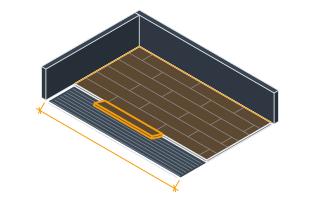
The width of the room across the direction the sheet roll will be rolled out.
Measure the room's shortest dimension if you plan to run the sheet across it, since fewer/no seams are needed when the roll width covers that dimension in one piece.
The width of the vinyl sheet flooring roll as supplied.
Vinyl sheet flooring is commonly supplied in 6 ft (1.83m) or 12 ft (3.66m) roll widths — check your specific product.
Seams needed
1 seam
They open the calculator with your figures already in it
Vinyl Sheet Flooring Roll Seam Calculator: 1 seam — shown in imperial, US market. The link sets both, so the result they see is the one on your screen.
Show calculation logicHide calculation logic
How this was calculated
Formula source(s)
- Seams needed = ceil(room width ÷ roll width) − 1, since the first roll width strip needs no seam and each additional strip requires one
Inputs used
- Room Width
- 16.5 ft
- Sheet roll width
- 12 ft
What this calculation does not cover
- A roll only covers a room narrower than the roll is. Sheet vinyl is cut oversize and scribed to the walls, so each edge needs extra beyond the finished dimension for trimming — which means a room measured at exactly the roll width returns zero seams here and needs one on site. Enter the room's widest measurement plus the trimming allowance, not the nominal size off the plan.
- Only the across-the-roll direction is counted. Roll length is never asked for, so a room longer than the piece you can actually get produces cross-seams that this number does not include — and a cross-seam runs at right angles to the traffic, which is the worst orientation for one to sit in.
- This gives how many seams, not where to put them. A seam through a doorway, under an appliance that gets dragged in and out, or along the front of a sink or bath is the one that lifts first, so a layout is often right to accept an extra seam in order to move the others into dry, low-traffic ground. The arithmetically minimal count is not automatically the best cut.
Computed in your browser — nothing you enter is uploaded. Presented in US customary units and US trade terminology. Where a formula follows a published standard, that standard and its edition are cited beside it on this page; where none governs, the page says so. Local amendments override model codes — verify against the code in force where you build.
Sources checked 2026-09-06 · in the site-wide review of 2026-09-06 · v1.0.1
Regulatory standards & verification citations1
- Seams needed = ceil(room width ÷ roll width) − 1, since the first roll width strip needs no seam and each additional strip requires one
Cite this page
Your workspace
Most jobs need more than one number. Add the calculators you need next and they open right here, underneath this one — your figures stay on screen and nothing is lost to a page change.